Supersymmetry Explained: Key to Unlocking Cosmic Mysteries
Beyond the Standard Model of Particle Physics
The Standard Model of particle physics is one of science’s crowning intellectual achievements, accurately categorizing elementary particles and describing three fundamental forces: electromagnetism, the weak nuclear force, and the strong nuclear force. Yet it remains incomplete. It fails to account for gravity, offers no candidate for dark matter, and leaves the delicate mass of the Higgs boson unexplained. Theoretical physicists proposed supersymmetry (SUSY) as an elegant theoretical extension to solve these mysteries.
Superpartners and the Fermion-Boson Duality
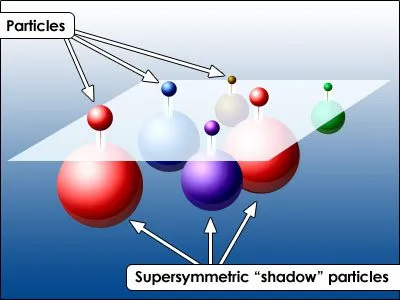
In standard particle physics, matter particles (fermions: electrons, quarks, neutrinos) have half-integer quantum spins, while force-carrying particles (bosons: photons, gluons, W/Z bosons, Higgs) have integer spins. Supersymmetry hypothesizes a profound symmetry linking both domains: for every known fermion, there exists a heavier bosonic superpartner, and for every boson, a fermionic superpartner.
- The electron’s superpartner is the selectron.
- The quarks’ superpartners are squarks.
- The photon’s superpartner is the photino.
- The gluon’s superpartner is the gluino.
Resolving the Dark Matter Mystery
Dark matter constitutes approximately 85 percent of all matter in the universe, providing the gravitational scaffolding that holds galaxies together, yet its composition remains unknown. In supersymmetric models with R-parity conservation, the lightest supersymmetric particle—often the neutralino—is electrically neutral, weakly interacting, and exceptionally stable. The neutralino serves as a leading candidate for Weakly Interacting Massive Particles (WIMPs) comprising dark matter.
Stabilizing the Higgs Boson and Unifying Forces
In the Standard Model, quantum radiative corrections should mathematically drive the Higgs boson mass toward the astronomical Planck scale. Supersymmetric partner loops cancel these divergent corrections, naturally stabilizing the observed 125 GeV Higgs mass. Furthermore, when extrapolated to high energies, the coupling constants of the strong, weak, and electromagnetic forces converge into a single unified Grand Unified Theory (GUT) under supersymmetry.
The Search at the Large Hadron Collider
Despite its mathematical beauty, experimental verification has proved elusive. Decades of ultra-high-energy proton collisions at CERN’s Large Hadron Collider (LHC) have yet to uncover direct evidence of superpartners. While this excludes the simplest minimal supersymmetric models at low mass thresholds, physicists continue testing higher energy domains. Whether superpartners appear in future colliders or require new theoretical concepts, the quest to decode nature’s underlying symmetries continues unabated.