A Human Crater on the Moon: Rocket Collision

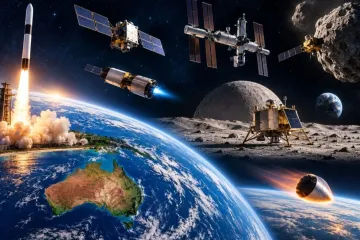
An exceptional celestial impact occurred upon the Moon: not the crash of an asteroid or comet, but the violent collision of human space hardware.
What Happened?
Following the launch of a lunar lander mission on 15 January 2025, the upper stage of a SpaceX Falcon 9 rocket remained stranded in high orbit. After deploying its payload, the rocket stage lacked sufficient propellant to de-orbit back into Earth’s atmosphere. Subjected to the gravitational tug-of-war between Earth, the Sun, and the Moon, the tumbling booster wandered in an chaotic orbit for months until orbital calculations predicted its collision with the lunar surface.
The Energy of the Collision
Weighing approximately 3.9 tonnes, the spent booster struck the Moon at a velocity of roughly 8,700 kilometres per hour. The violent kinetic impact carved a fresh crater estimated at 20 to 30 metres in diameter, ejecting a substantial plume of lunar dust and regolith fragments.
What Was Visible from Earth?
While dramatized in headlines, the event posed zero threat to Earth. The brief flash of impact was invisible to the naked eye. However, astronomical observatories worldwide and lunar orbiters targeted the impact site to capture scientific observations.
By analyzing the resulting ejecta plume, subsurface dust composition, and seismic tremors, planetary scientists gained valuable insights into the density and structure of lunar regolith. What began as space debris became a controlled impact experiment.
A Historic Precedent
The Moon is constantly bombarded by meteoroids and micro-meteorites. Telescopes on Earth routinely record brief impact flashes on the lunar nightside; in 2013, a substantial meteoroid explosion was bright enough to be seen with the naked eye.
Yet this event was distinct: it involved an artificial booster whose trajectory, mass, and velocity were precisely known beforehand, allowing observatories to pre-point instruments at the coordinates. Such advance notice for lunar impacts is exceptionally rare.
Human Artifacts on Lunar Soil
For billions of years, cosmic impacts sculpted the Moon’s cratered face. Now, artificial hardware joins that long geologic ledger.
Human marks on the Moon began with Apollo boots; today, they include craters blasted by spent orbital boosters. For planetary scientists, it remains a rare and valuable opportunity to study impact mechanics on another world.