Prime Editing: A Precision Leap in Genome Technology
The Dawn of Prime Editing
On October 21, 2019, a landmark study published in the journal Nature by researchers at Harvard University and the Broad Institute introduced a transformative genome editing technology: prime editing. Developed by Dr. David Liu and his team, this novel platform offers unprecedented accuracy and flexibility, surpassing conventional CRISPR-Cas9 systems.
Genetic Disorders and Limitations of Traditional CRISPR
Many devastating hereditary diseases stem from pinpoint mutations in specific genes. For decades, geneticists have sought tools to correct these aberrant sequences back to their healthy states. While CRISPR-Cas9 revolutionized molecular biology, it relies on cutting both strands of the DNA double helix. Double-strand breaks can introduce unpredictable insertions, deletions (indels), and dangerous off-target cuts, limiting CRISPR’s clinical utility for human gene therapies.
Unmatched Precision of Prime Editing
Prime editing operates with remarkable surgical precision, radically reducing unwanted insertions, deletions, and off-target mutations. In laboratory demonstrations using human and mouse cells, scientists successfully corrected the primary mutations causing severe genetic illnesses such as sickle cell disease and Tay-Sachs disease without introducing double-strand breaks.
How the Search-and-Replace Mechanism Works
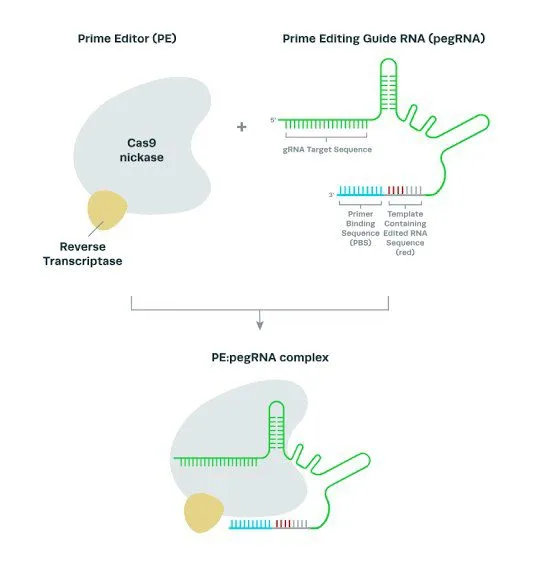
Where standard CRISPR-Cas9 shears both DNA strands, prime editing employs an engineered Cas9 nickase that cuts only a single target strand. The system pairs this Cas9 nickase with an engineered reverse transcriptase enzyme and a custom prime editing guide RNA (pegRNA). The pegRNA serves a dual function: it directs the complex to the precise genomic site and encodes the desired edit directly within its RNA sequence.
Direct Writing of Genetic Information
Once the Cas9 nickase creates a single-strand nick, the reverse transcriptase copies the edit directly from the pegRNA into the host DNA strand. The edited flap replaces the original genomic sequence through natural cellular repair pathways. In their pioneering demonstrations, Liu’s team performed over 175 precise edits—including transitions, transversions, insertions, and deletions—estimating that prime editing could potentially correct up to 89 percent of known disease-associated human genetic variants.
Evolution of the Platform and PEmax Enhancements
Since 2019, molecular biologists have rapidly advanced the platform. In 2022, researchers at the Broad Institute unveiled engineered prime editor architectures, including PEmax, which drastically boosted editing efficiencies and reduced bystander modifications. Ongoing developments have brought prime editing into living animal models, marking a major leap forward for in vivo gene therapy.
Current Clinical Horizons and Experimental Therapeutics
By 2024, biotech enterprises commenced pre-clinical trials and early-phase clinical evaluations exploring prime editing for monogenic disorders, including sickle cell anemia, metabolic liver diseases, and inherited retinal dystrophies. While widespread human therapeutic use requires further optimization in delivery vehicles, initial laboratory and pre-clinical results are profoundly encouraging.
The Future of Curative Genetic Medicine
Prime editing remains a burgeoning technology demanding rigorous clinical evaluation. Yet scientists remain optimistic that molecular search-and-replace tools will pave the path toward eradicating severe hereditary diseases at their genetic roots, transforming the future of modern medicine.