Search for Extraterrestrial Civilizations: Are We Alone?
Ancient Curiosities About Life in the Cosmos
Since the dawn of human consciousness, people have looked up at the star-studded night sky and wondered whether we are truly alone. Early humans gazed at the multitude of twinkling stars in awe, tracing animal figures into constellations that formed the zodiac. In the fifth century BCE, Greek philosopher Democritus proposed that countless worlds exist throughout infinite space, some of which might teem with life. Four centuries later, Roman philosopher Lucretius wrote of other worlds harboring diverse creatures and civilizations.
The Birth of Science Fiction
The intuition that advanced civilizations might inhabit other worlds provided fertile ground for scientific speculation, eventually giving birth to modern science fiction. In the seventeenth century, German astronomer Johannes Kepler wrote Somnium, an imaginative tale about a voyage to the Moon and encounters with extraterrestrial reptilian life—often regarded by historians as one of the earliest works of science fiction.
Scientific Foundations of Cosmic Speculation
Later that century, Dutch mathematician and physicist Christiaan Huygens published Cosmotheoros, arguing that life is likely to exist on other planets orbiting distant stars. He speculated on their planetary environments, cultures, and anatomy. These pioneering works laid the groundwork for combining empirical astronomy with speculative imagination, expanding humanity’s cosmic worldview.
The History of Searching for Life on Mars
In 1894, American astronomer Percival Lowell pointed his telescope toward Mars and observed linear crisscrossing markings across its arid surface. Convinced these were artificial canals built by an intelligent Martian civilization to channel water from polar ice caps to parched cities, his claims sparked worldwide sensation. Subsequent observations with larger optical telescopes and spacecraft flybys proved Lowell’s canals to be optical illusions, yet the dream of discovering Martian life persisted.
Modern Space Exploration and Extraterrestrial Prospects
During the twentieth century, astrobiology evolved into a rigorous scientific discipline. Humanity launched robotic spacecraft across the solar system, retrieved lunar rocks, and landed rovers on Mars. We detected sub-surface water ice on the Moon and Mars, discovered a subsurface liquid ocean on Jupiter’s moon Europa, and identified amino acids within carbonaceous meteorites. Using state-of-the-art optical and radio telescopes, astronomers have discovered thousands of exoplanets beyond our solar system. Yet despite these profound leaps, definitive evidence of extraterrestrial life remains elusive.
Scientific Goals in Searching for Alien Civilizations
Modern astrobiologists pursue two major avenues: first, searching within our solar system for microbial biosignatures, and second, searching beyond our solar system for technosignatures produced by intelligent civilizations. Given the unfathomable vastness of the universe, scientists argue that the biological and evolutionary processes that birthed intelligent life on Earth could readily occur on suitable exoplanets elsewhere.
The Kardashev Scale of Civilizations
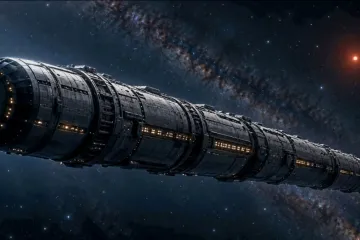
In 1964, Soviet astrophysicist Nikolai Kardashev proposed a classification scale for technological civilizations based on their energy consumption capabilities: Type I harnesses the full energy budget of its home planet; Type II captures the entire energy output of its host star (via concepts like Dyson spheres); and Type III commands the energy of its entire host galaxy. Human civilization currently ranks around Type 0.73. Modern theoretical extensions have posited higher types capable of manipulating spacetime, though these remain fascinating hypotheses.
The Drake Equation: Quantifying Intelligent Civilizations
In 1961, astronomer Frank Drake formulated a famous probabilistic equation to estimate the number of active, communicative technological civilizations in the Milky Way galaxy. The Drake Equation multiplies factors such as star formation rates, fraction of stars with planetary systems, and probabilities of life developing intelligence. Depending on the values assigned to these parameters, the estimated number of civilizations ranges from a solitary one (just ourselves) to hundreds of thousands.
Project SETI and the Radio Sky
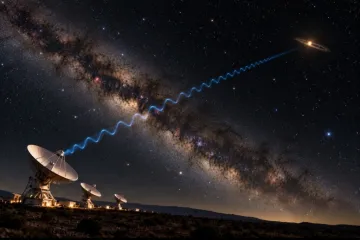
Frank Drake also initiated observational searches by aiming radio dishes at nearby Sun-like stars. He focused on the 1420 MHz hydrogen line—the frequency emitted by neutral hydrogen, the most abundant element in the universe. Reasoning that any technological civilization would recognize this universal “water hole” as a logical interstellar beacon, Drake launched Project Ozma. While that initial attempt detected no alien beacons, it sparked the foundation of SETI—the Search for Extraterrestrial Intelligence—utilizing massive radio observatories worldwide.
The Enigmatic Wow! Signal and Optical SETI
In August 1977, Ohio State University’s “Big Ear” radio telescope detected a powerful, narrowband 72-second signal from the direction of Sagittarius. Astronomer Jerry Ehman was so astonished that he circled the signal on the computer printout and scribbled “Wow!” in red ink. The Wow! Signal has never repeated despite decades of continuous monitoring. Alongside radio searches, contemporary astronomers now conduct Optical SETI, searching for pulsed laser emissions that advanced civilizations might use for high-bandwidth interstellar communications.
Breakthrough Listen: A Major New Epoch
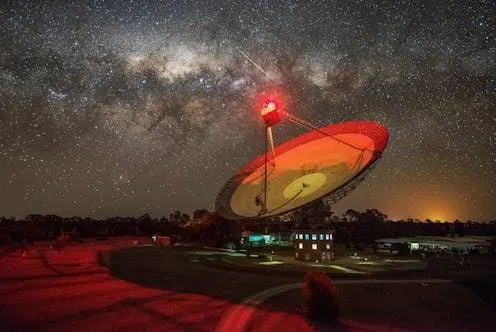
In 2016, entrepreneur Yuri Milner and renowned astrophysicists launched Breakthrough Listen, backed by a $100 million commitment. Utilizing premier facilities like the Green Bank Telescope and the Parkes Observatory, the project conducts unprecedented systematic surveys scanning millions of stars across wide radio and optical bandwidths.
The Mystery of the Proxima b Signal
In December 2020, Breakthrough Listen researchers detected a curious 982 MHz radio candidate originating from Proxima Centauri, home to the exoplanet Proxima b, located 4.2 light-years away. Termed BLC1, the narrowband signal stirred global interest. Subsequent exhaustive forensic analyses in 2021 revealed that BLC1 was an unusually complex form of terrestrial radio frequency interference, not an alien transmission.
Machine Learning and Advanced Signal Detection
Astrobiologists now leverage sophisticated machine learning and deep neural networks to filter noise and flag promising anomalous candidate signals within petabytes of observational data, exponentially boosting detection sensitivities.
The Roswell Incident and Modern UFO Lore
In July 1947, near Roswell, New Mexico, a rancher discovered strange metallic debris. The local army air field briefly issued a press release stating that a “flying disc” had been recovered, igniting sensational headlines before military officials corrected the statement, identifying the debris as a weather balloon. Decades later, the Air Force clarified that the wreckage belonged to Project Mogul, a classified nuclear test monitoring program. Nonetheless, Roswell became a cornerstone of UFO mythology and conspiracy theories alleging government cover-ups of extraterrestrial craft.
The Controversial Peruvian Mummies in Mexico
In September 2023, the topic took another controversial turn when journalist Jaime Maussan presented two small mummified specimens before the Mexican Congress, claiming they were non-human biological remains from Peru. Mainstream anthropologists and scientific bodies strongly disputed the claims, demonstrating that the specimens were composite fabrications assembled from ancient human and animal bones.
Humanity’s Enduring Curiosity and Future Horizons
Are we truly alone, or does someone across the cosmos await our signals? While science has yet to find definitive answers, the search itself reflects humanity’s deepest yearning to understand our place in the universe. If first contact ever occurs, it will mark the most profound turning point in human history, forever expanding the horizons of our consciousness.