Genome Editing: CRISPR-Cas9 Advances and Limits
The Rise and Promise of Genome Editing
Genome editing has become one of the most prominent topics in contemporary science and medicine. Researchers increasingly forecast that editing genomic code will permanently resolve debilitating genetic disorders, extend healthy human lifespan, and ignite a second Green Revolution in agriculture. We stand on the precipice of what many describe as a biological renaissance, driven by revolutionary genome editing platforms.
The Architecture of the DNA Double Helix
To grasp how genome editing works, one must first understand deoxyribonucleic acid, or DNA—the fundamental blueprint of terrestrial life residing inside the chromosomes of biological cell nuclei. DNA forms a double helix composed of deoxyribose sugar, phosphate groups, and four nitrogenous bases: adenine (A), thymine (T), guanine (G), and cytosine (C). Under strict base-pairing rules, adenine pairs exclusively with thymine, and guanine pairs with cytosine. The precise sequence of these billions of base pairs dictates every physiological characteristic of a living organism.
The Genome and the Non-Coding DNA Enigma
An organism’s complete set of genetic instructions is termed its genome. The human genome contains over three billion base pairs, encoding an estimated 20,000 to 25,000 protein-coding genes. These genes provide instructions for synthesizing the proteins that regulate bodily functions. Yet protein-coding sequences constitute only a tiny fraction of the total genome; the vast remainder consists of non-coding DNA, whose complex regulatory functions continue to be actively decoded by geneticists.
The Concept of Genome Editing
Modifying specific sequences within an organism’s genome can alter its physical traits, much like editing text in a word processor where letters or words are rewritten to change the narrative. Modern biotechnology allows scientists to locate, excise, replace, or deactivate specific segments of DNA with unprecedented precision—a process known as genome editing.
The CRISPR-Cas9 Revolution
The most transformative and widely adopted genome editing tool today is CRISPR-Cas9. For its development, biochemists Emmanuelle Charpentier and Jennifer Doudna were awarded the 2020 Nobel Prize in Chemistry. CRISPR technology was adapted directly from an ancient adaptive immune mechanism evolved by bacteria to defend against viral bacteriophages.
Repurposing Bacterial Defenses into Molecular Scissors
Bacteria store fragments of viral genetic code within specialized repetitive sequences known as CRISPR (Clustered Regularly Interspaced Short Palindromic Repeats). When a previously encountered virus invades, the bacterium transcribes these sequences into guide RNA molecules that direct the Cas9 endonuclease enzyme to chop up and destroy the viral genome. Scientists harnessed this natural bacterial defense system to target and edit genomic DNA in any living organism.
Guide RNA and Cas9 Mechanism
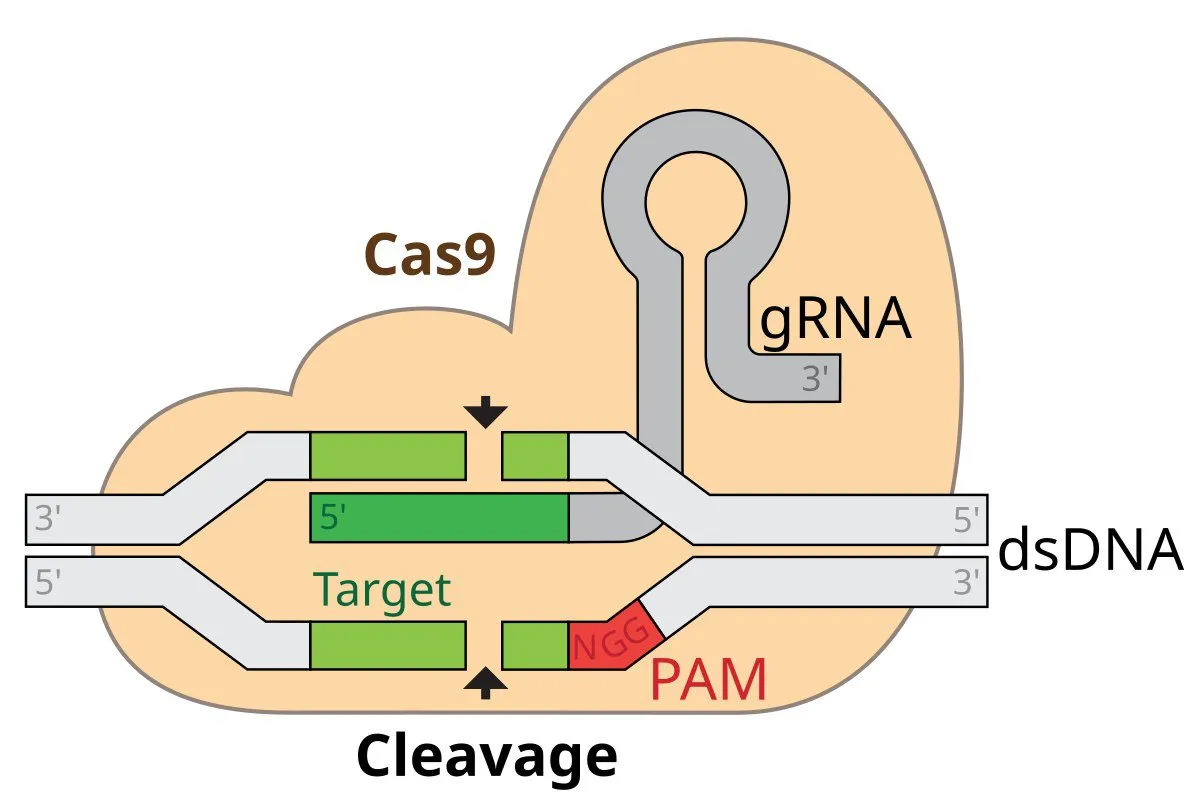
In laboratory applications, researchers design a synthetic guide RNA (gRNA) matching a specific genomic target sequence of roughly twenty bases. The gRNA leads Cas9 directly to the target location, where the enzyme cleaves both strands of the DNA double helix. When the cell mobilizes its natural repair machinery to stitch the break back together, researchers can introduce a desired replacement sequence or disrupt an aberrant, disease-causing gene.
Agricultural Breakthroughs and Crop Resilience
Due to its modularity, efficiency, and accessibility, CRISPR has been embraced globally. Agronomists deploy CRISPR to engineer staple crops—including rice, wheat, corn, and soybeans—with enhanced yields, resistance to blight, and resilience against drought and climate volatility. In Bangladesh, researchers have applied CRISPR tools to cultivate wheat varieties resistant to devastating wheat blast disease, as well as low-glycemic rice strains suitable for diabetic diets.
Therapeutic Frontiers and Gene Therapy
In clinical medicine, CRISPR gene therapies are delivering curative outcomes. Clinical trials targeting sickle cell anemia, beta-thalassemia, genetic blindness, and certain oncology indications have achieved historic successes. In 2023, regulatory agencies including the US FDA approved Casgevy (exa-cel)—the world’s first CRISPR-based therapeutic—to treat patients with severe sickle cell disease and transfusion-dependent beta-thalassemia.
Limitations and Mutation Risks
Despite its remarkable utility, traditional CRISPR-Cas9 possesses notable limitations. Cutting both strands of DNA can trigger unpredictable chromosomal rearrangements, large deletions, or off-target mutations at unintended genomic sites. To overcome these hazards, geneticists developed higher-precision editing platforms: base editing and prime editing.
Base Editing: Precise Single-Letter Changes
Base editing enables the direct, single-step chemical conversion of one target base into another (such as C-to-T or A-to-G) without creating double-strand DNA breaks. By circumventing double-strand cleavages, base editing minimizes unwanted insertions and deletions, making it exceptionally safe for treating point mutations.
Prime Editing: Search-and-Replace Writing
Prime editing represents an even more versatile advance. By fusing an engineered Cas9 nickase to a reverse transcriptase enzyme and guiding it with prime editing guide RNA (pegRNA), prime editors directly write new genetic sequences into the targeted genomic locus. Prime editing can execute transitions, transversions, precise insertions, and deletions with minimal off-target risks.
Heritable Editing and Ethical Controversies
These powerful capabilities also raise serious ethical dilemmas, particularly regarding germline gene editing. In 2018, Chinese researcher He Jiankui announced the birth of twin girls whose embryonic genomes had been edited using CRISPR to disable the CCR5 gene. The global scientific community condemned the experiment for violating ethical boundaries and exposing human infants to unknown long-term risks. He Jiankui was subsequently prosecuted and imprisoned, and international consensus now strictly prohibits clinical reproductive germline modification in humans.
The Path Toward Responsible Innovation
Genome editing has transitioned from science fiction into everyday biomedical reality. Tools like CRISPR-Cas9, base editing, and prime editing provide humanity with unprecedented power over the code of life. Exercising this power requires scientific vigilance, robust ethical frameworks, and a collective commitment to ensuring that genetic technologies serve the welfare of all humanity.