The Quantum Mechanics Riddle: Reality, Waves, and Paradoxes

The Impact of Quantum Mechanics on Modern Technology
The subatomic universe operates under the counterintuitive laws of quantum mechanics. The motion, interactions, and energy exchanges of electrons, photons, and other fundamental particles are described with breathtaking accuracy by quantum mathematical formalisms. Modern technological civilization rests squarely on these equations: silicon microchips, solar panels, fiber-optic communications, and hospital MRI scanners would all cease to function without the principles of quantum physics.
International Recognition of Quantum Science
To celebrate a century of revolutionary quantum discoveries, UNESCO officially proclaimed 2025 as the International Year of Quantum Science and Technology. Yet behind this triumphant engineering success lies a startling open paradox: even after a century of rigorous validation, physicists still do not agree on what quantum mechanics actually means about physical reality.
Is the Quantum Wave Function Real?
In an extensive survey published by Nature, over a thousand physicists were asked whether the quantum wave function represents an objective physical entity. Approximately 47 percent responded that it is merely an epistemic mathematical tool representing human knowledge rather than physical reality. Another 36 percent argued that the wave function is physically real, while others described it as an intertwined combination of subjective probability and underlying ontological structure.
The Copenhagen Interpretation and Superposition
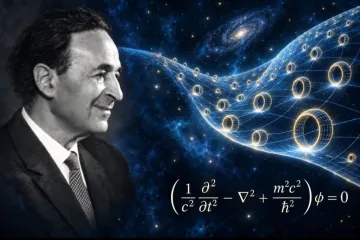
The standard textbook framework remains the Copenhagen Interpretation, developed in the 1920s by Niels Bohr and Werner Heisenberg. According to this view, a quantum particle does not possess definite physical properties prior to observation; instead, it exists as a cloud of probabilities in a state of superposition. The mathematical equation describing this probability distribution is the wave function ($psi$). The moment a measurement occurs, the wave function instantly collapses, resolving the cloud of possibilities into a single definite measurement.
Quantum Entanglement and Spooky Action
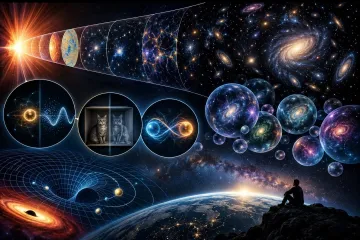
An even more baffling phenomenon is quantum entanglement. When two particles become entangled, their quantum states are fundamentally linked regardless of the spatial distance separating them. Measuring the state of one instantaneously determines the state of the other, even across light-years. Albert Einstein famously dismissed this as “spooky action at a distance,” yet decades of Bell-test experiments have confirmed entanglement as an incontrovertible feature of nature.
Parallel Universes and the Many-Worlds Interpretation
Because the Copenhagen collapse seems arbitrary and subjective, alternative interpretations have emerged. In 1957, Hugh Everett III proposed the Many-Worlds Interpretation, which argues that wave functions never collapse. Instead, every quantum measurement causes the universe to decohere and branch into multiple parallel realities, where every possible outcome physically occurs.
Debates Across the History of Science
Such intellectual divergence is not new in science. During Isaac Newton’s era, debate raged for two centuries over whether light consisted of corpuscular particles or continuous waves. In modern quantum mechanics, the debate over ontology continues to stimulate cutting-edge research.
The Future of Quantum Reality
Debate keeps scientific inquiry vibrant. Conceptual disagreements inspire novel experiments in quantum foundations, quantum computing, and quantum information theory. As Nobel laureate Richard Feynman wryly observed: “If you think you understand quantum mechanics, you don’t understand quantum mechanics.” The mystery remains one of humanity’s greatest intellectual frontiers.