Nuclear Fusion and ITER: Unleashing the Power of the Sun on Earth

Replicating the Engine of the Stars
Deep within the incandescent core of the Sun, gravitational pressures and temperatures exceeding 15 million degrees Celsius fuse hydrogen nuclei into helium. This stellar reaction—known as nuclear fusion—releases colossal amounts of energy, generating the light and heat that sustains all terrestrial life.
For decades, physicists have sought to replicate this stellar process on Earth. Successfully harnessing controlled fusion would grant humanity an virtually inexhaustible, carbon-free energy source. The preeminent global scientific effort leading this quest is the International Thermonuclear Experimental Reactor (ITER), currently under construction in Saint-Paul-lès-Durance, southern France.
The Tokamak: Confining a Burning Star
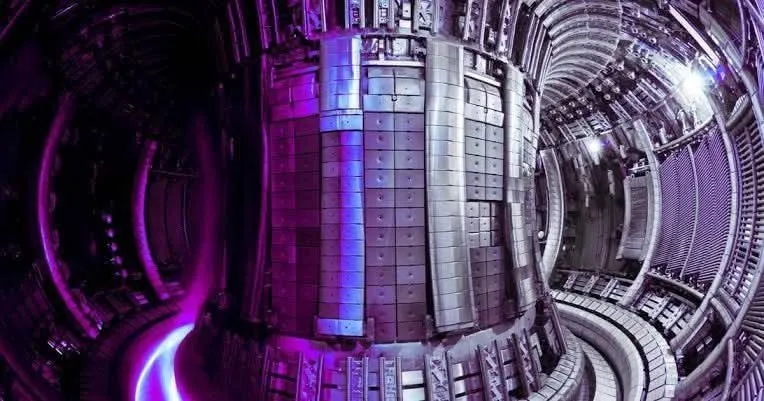
ITER is an experimental research reactor designed to demonstrate the scientific and technical feasibility of large-scale magnetic confinement fusion. At its core is a “tokamak”—a doughnut-shaped vacuum chamber designed to trap superheated plasma.
Inside the tokamak, gaseous isotopes of hydrogen—deuterium and tritium—are injected and heated via radiofrequency waves and neutral beam injectors to temperatures exceeding 150 million degrees Celsius, ten times hotter than the center of the Sun. At these extreme temperatures, electrons decouple from atomic nuclei, creating an energetic plasma that overcomes mutual electrostatic repulsion (the Coulomb barrier) to fuse.
Superconducting Magnets and Engineering Extremes
Because no physical container can withstand direct contact with a 150-million-degree plasma, ITER employs a complex cage of giant superconducting electromagnets to suspend the plasma in a vacuum away from vessel walls.
These niobium-tin and niobium-titanium magnets generate magnetic fields 280,000 times stronger than Earth’s magnetic field. To maintain superconductivity, the coils are chilled with liquid helium to minus 269 degrees Celsius. Managing this astonishing thermal gradient—millions of degrees in the plasma core mere meters from near-absolute zero magnets—represents one of the greatest engineering feats in human history.
A Historic Global Collaboration
ITER represents the largest collaborative scientific mega-project on Earth, uniting seven member entities representing over half the world’s population: the European Union, the United States, Japan, China, Russia, South Korea, and India.
Sub-components manufactured across disparate continents—massive toroidal field coils from Japan and Europe, central solenoids from the US, vacuum vessel sectors from Korea—are transported to Cadarache and assembled with sub-millimeter precision.
The Path Toward Commercial Fusion Energy
ITER aims to achieve a “net energy gain” factor ($Q ge 10$), generating 500 megawatts of fusion power from an input of 50 megawatts for sustained pulses. If successful, ITER will pave the way for prototype demonstration power plants (DEMO), transitioning fusion from laboratory physics to grid-scale electricity.
Fueled by deuterium extracted from seawater and tritium bred within lithium blankets, nuclear fusion produces no greenhouse gas emissions and leaves no long-lived transuranic nuclear waste. Achieving controlled fusion will mark a historic turning point in human civilization, providing sustainable baseload energy for millennia to come.