Weighing the Earth: Henry Cavendish's Historic Torsion Balance Experiment
A Monumental Feat in an 18th-Century Laboratory
The year 1798 remains a celebrated milestone in experimental physics. Working in a secluded outbuilding on his estate in Clapham, south of London, British natural philosopher Henry Cavendish conducted an extraordinarily sensitive experiment that allowed humanity, for the first time, to achieve weighing the Earth.
Cavendish did not place our planet onto a scale; rather, he measured the minuscule gravitational attraction between known masses in his laboratory to deduce the mean density of Earth. Calculating Earth’s density at approximately 5.48 times that of liquid water, he derived a total planetary mass of roughly $5.7 \times 10^{24}$ kilograms—astonishingly close to the modern value of $5.97 \times 10^{24}$ kilograms.
Newton’s Law of Universal Gravitation and the Elusive Constant
Over a century earlier, Sir Isaac Newton had formulated his law of universal gravitation, stating that every particle attracts every other particle with a force proportional to the product of their masses and inversely proportional to the square of the distance between them:
$$F = G \frac{m_1 m_2}{r^2}$$
While Newton could calculate the relative masses of the planets compared to the Sun, Earth’s actual physical mass could not be determined without knowing the numerical value of $G$, the universal gravitational constant. Because gravity is by far the weakest of the fundamental forces, the gravitational pull between laboratory-sized masses was considered too infinitesimal to detect.
The Torsion Balance and Lead Spheres
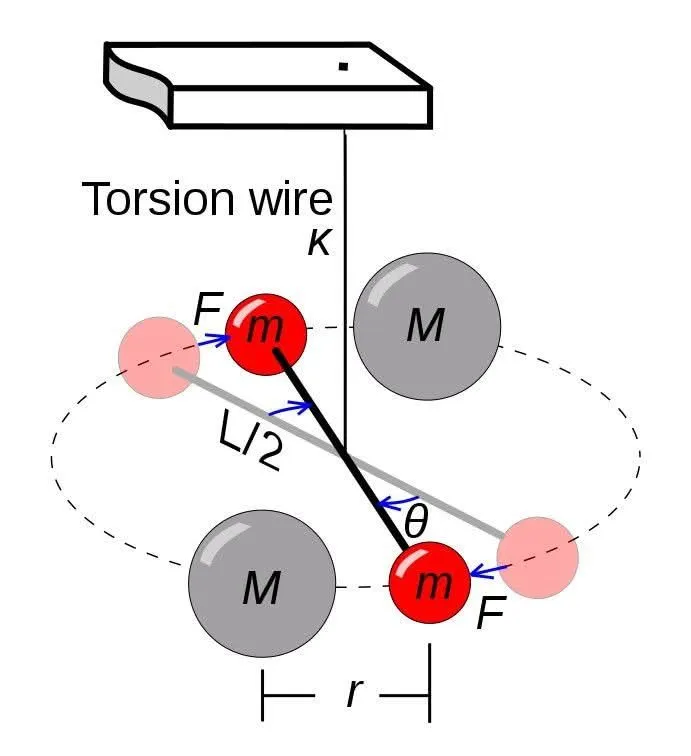
To overcome this challenge, Cavendish refined a delicate apparatus originally designed by geologist John Michell: the torsion balance. The instrument consisted of a light wooden arm suspended horizontally by a fine, resilient torsion wire. Attached to either end of the arm were two small lead balls (roughly 5 centimeters in diameter and 0.73 kg each).
Outside the wooden housing, Cavendish placed two massive spherical lead weights, each weighing 158 kilograms. When moved into position near the suspended balls, their mutual gravitational pull exerted a faint torque, twisting the suspension wire through a minute angle until the wire’s elastic restoring torque balanced the gravitational force. By measuring this tiny deflection angle and the natural oscillation period of the balance, Cavendish quantified the force of gravity, enabling the calculation of $G$ and Earth’s mass.
Meticulous Precision and Infinite Patience
The gravitational force Cavendish measured was less than the weight of a grain of dust. Convection air currents, minor drafts from human breathing, or subtle temperature differentials could completely invalidate the measurement.
To isolate the apparatus, Cavendish enclosed it in a draft-proof room two feet thick. He remained outside the chamber, manipulating the external weights with pulleys and observing the tiny deflections through glass windows using telescopes illuminated by lanterns. His painstaking attention to experimental control set new benchmarks for precision physics.
Conclusion
Henry Cavendish’s achievement went far beyond measuring lead spheres. By measuring the faintest whisper of gravity, he provided the key that unlocked the masses of Earth, the Moon, the Sun, and the planets. His triumph remains one of the most elegant examples of how human intellect and experimental rigor can weigh an entire world from within a laboratory room.