The Einstein-Bohr Debates: Quantum Mechanics and the Nature of Reality
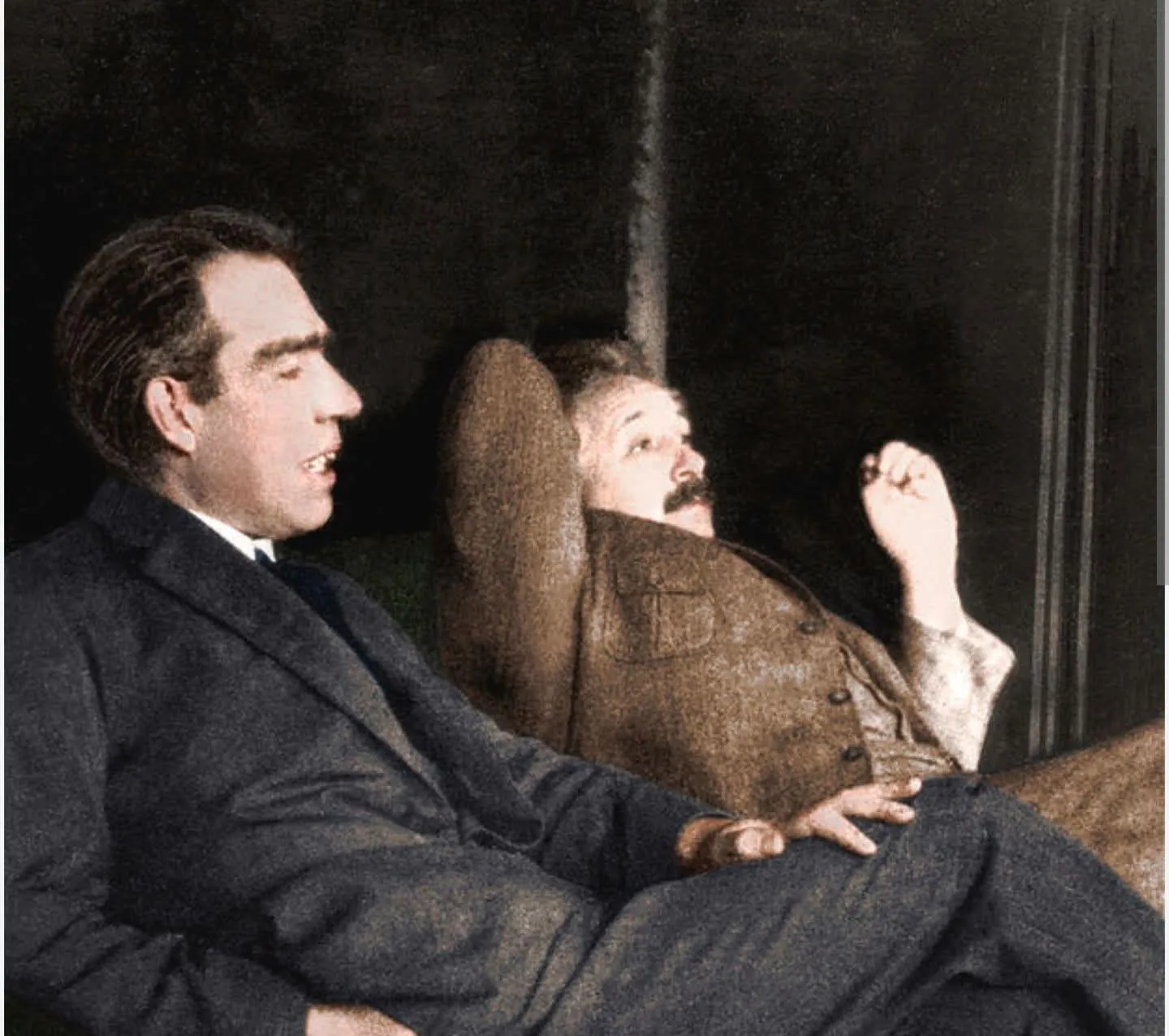
The Great Schism of Modern Physics
During the early twentieth century, physics split into two irreconcilable worldviews. On one side stood the deterministic framework of classical Newtonian physics, where the universe operated like precision clockwork governed by knowable laws. On the other side emerged the nascent quantum world, where subatomic particles inhabit superpositions of states, physical outcomes are governed by probabilities, and the act of measurement actively constructs reality.
The clash between these two foundational philosophies ignited the most celebrated intellectual contest in modern science: the Einstein-Bohr debates.
Certainty vs. Probability: Does God Play Dice?
Albert Einstein fundamentally rejected the notion that physical reality is inherently indeterministic. While acknowledging the mathematical prowess of quantum mechanics, he maintained that the theory was incomplete, famously declaring, “God does not play dice with the universe.” In Einstein’s view, physical systems possess objective, predetermined properties independent of human observation.
Danish physicist Niels Bohr, the father of the Copenhagen interpretation, countered that physicists must describe nature as experiment reveals it, not according to philosophical prejudices. Bohr argued that uncertainty is an irreducible feature of physical reality, and that particles simply do not have definite classical properties prior to measurement.
The 1927 Solvay Conference: The Clash of Minds
The intellectual duel reached its zenith at the fifth Solvay International Conference in Brussels in 1927. Gathered around dining tables and conference halls were the titans of modern physics: Einstein, Bohr, Heisenberg, Schrödinger, Dirac, and Planck.
Each morning, Einstein would arrive with an ingenious thought experiment designed to expose contradictions in Heisenberg’s uncertainty principle. Each evening, Bohr would pace tirelessly, dissecting Einstein’s premise, only to return the next morning with a watertight rebuttal—often using Einstein’s own general relativity equations to prove the consistency of the uncertainty principle.
The EPR Paradox and “Spooky Action at a Distance”
In 1935, Einstein, along with Boris Podolsky and Nathan Rosen, published the famous EPR paper. They demonstrated that if quantum mechanics was correct, measuring one entangled particle would instantaneously determine the state of its paired partner, regardless of how many light-years separated them.
Einstein dismissed this non-local correlation as “spooky action at a distance,” arguing that particles must carry predetermined “local hidden variables.” Bohr retorted that an entangled quantum pair forms an inseparable, unified system that cannot be analyzed as isolated parts.
Bell’s Theorem and the Triumph of Entanglement
Neither thinker lived to see the debate resolved experimentally. In 1964, Northern Irish theorist John Stewart Bell published “Bell’s Theorem,” formulating a mathematical inequality that distinguishing between local hidden variables and quantum non-locality.
In subsequent decades, pioneering experiments by John Clauser, Alain Aspect, and Anton Zeilinger demonstrated conclusive violations of Bell’s inequalities, proving that nature is fundamentally non-local and vindicating quantum entanglement—a discovery that earned the trio the 2022 Nobel Prize in Physics.
Conclusion
The Einstein-Bohr debates were not merely about winners and losers. Without Einstein’s rigorous critiques, quantum mechanics might never have developed its deep conceptual clarity. Without Bohr’s steadfast defense, the revolutionary nature of the quantum realm might have remained obscure. Today, their intellectual clash underpins quantum computing, quantum cryptography, and the ongoing quest to understand the fabric of reality.