New Horizons and Proxima Centauri: An Endless Voyage of Space Science
The Historic Encounter with Pluto
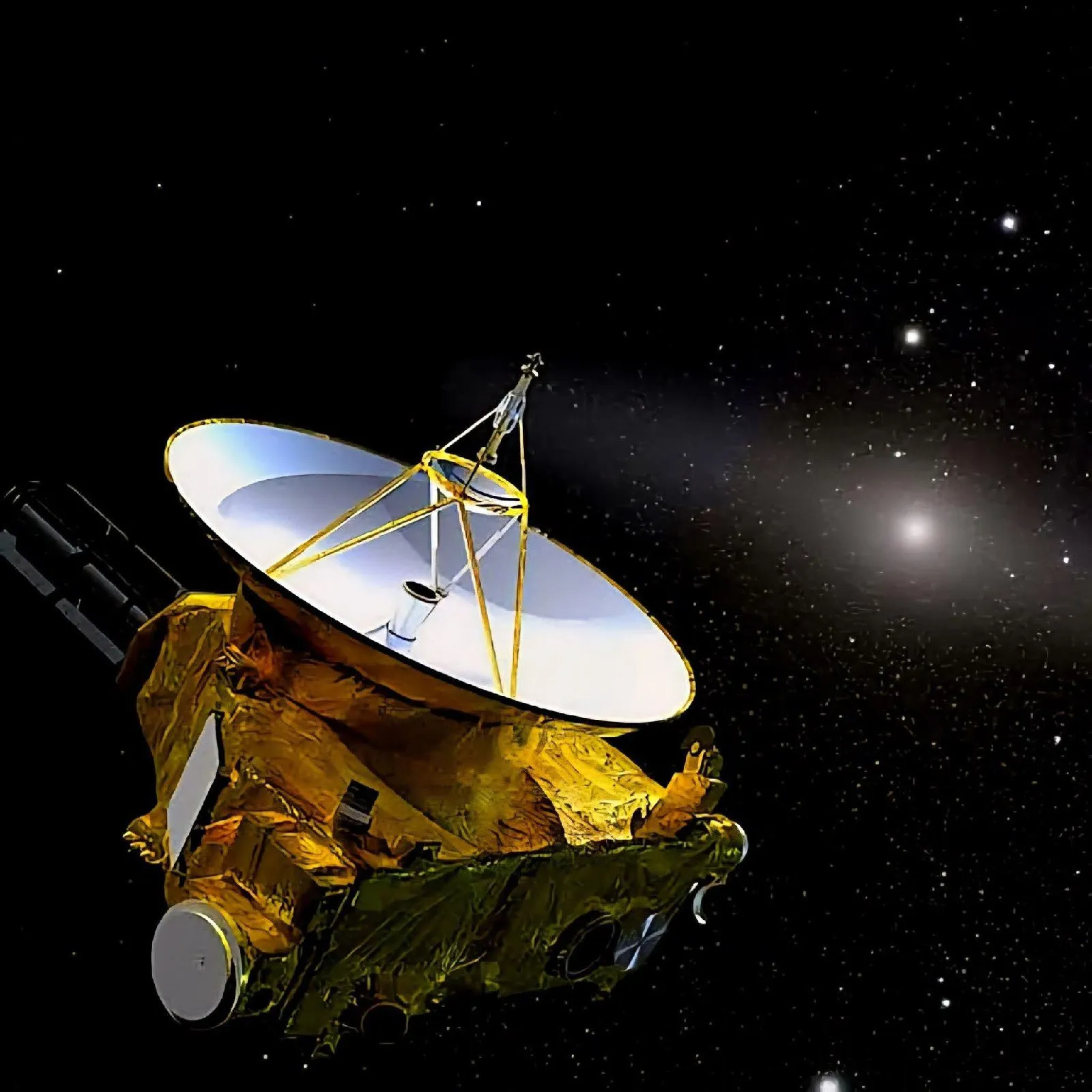
On July 14, 2015, NASA’s New Horizons spacecraft etched its name into exploration history. Racing past Pluto, it captured the first high-resolution portraits of the dwarf planet’s nitrogen ice glaciers, towering water-ice mountains, and hazy hydrocarbon atmosphere. Prior to New Horizons, Pluto was little more than a blurry pixel in the most powerful telescopes.
Pushing Beyond the Frontiers of the Solar System
Following its historic flyby and a subsequent rendezvous with the Kuiper Belt object Arrokoth, many assumed the mission was drawing to a close. In reality, New Horizons continues to serve as an indispensable scientific vanguard, charting the uncharted outermost frontier of our solar system.
Stellar Parallax and 3D Galactic Mapping
Currently traversing the outer Kuiper Belt toward the boundary of the heliosphere, New Horizons cruises at a distance exceeding 65 Astronomical Units (AU)—nearly 10 billion kilometers from Earth. From this unique vantage point, the spacecraft views nearby stars from an angle significantly displaced from Earth. This displacement creates measurable stellar parallax, allowing astronomers to construct unprecedented 3D navigational maps of nearby star fields—vital knowledge for future interstellar travel.
Proxima Centauri and Potentially Habitable Proxima b
Could New Horizons ever reach Proxima Centauri? Located 4.24 light-years away, Proxima Centauri is the closest star to our solar system. Orbiting within its habitable zone lies Proxima b, an Earth-sized exoplanet tidally locked to its host red dwarf star. If liquid water and life exist on Proxima b, they likely cling to the twilight terminator zone between scorching day and frozen night.
The Staggering Reality of Interstellar Distances
Yet reaching our stellar neighbor is an immense challenge. New Horizons hurtles outward at approximately 14 kilometers per second. While blistering by terrestrial standards, at this velocity it would take roughly 73,000 years to reach Proxima Centauri. Furthermore, the probe is not heading in that star’s direction. Reaching interstellar targets requires propulsion far beyond conventional chemical or nuclear-thermal rocketry.
Next-Generation Interstellar Propulsion Technologies
To cross interstellar chasms within a human lifetime, scientists are exploring radical propulsion concepts: laser-driven light sails, nuclear fusion engines, and antimatter drives. The visionary Breakthrough Starshot initiative proposes utilizing ground-based laser arrays to propel gram-scale microprobes to 20 percent the speed of light. At that speed, probes could reach Proxima Centauri in just over twenty years. While engineering hurdles such as deep-space communications and dust shielding remain formidable, the physics is sound.
Probing the Solar Wind and Outer Heliosphere
Meanwhile, New Horizons continues to yield groundbreaking discoveries with its onboard suite of particle detectors, plasma spectrometers, and cosmic dust counters. It measures how the solar wind interacts with the interstellar medium at the outer boundary of the heliosphere. Every gigabyte of telemetry transmitted across billions of miles provides essential data for designing future interstellar craft.
The Enduring Vision of Human Exploration
New Horizons is more than a robotic spacecraft; it is a trailblazer for humanity’s future among the stars. Even as its power source gradually wanes over the coming decade, it will cruise endlessly into the galactic silence—a proud monument to human curiosity and our boundless ambition to explore the unknown.