The Green Sahara: Is the World's Greatest Desert Transforming?
Unexpected Deluges and Sudden Foliage in the Sahara
Is the vast Sahara Desert turning green? In September 2024, meteorologists and travelers witnessed an extraordinary anomaly across North Africa. Torrential atmospheric downpours lashed arid regions across Morocco, Algeria, Libya, and Tunisia. In localities that had not seen substantial precipitation in decades, floodwaters transformed arid sand dunes into temporary lakes. Within days, hardy grasses, desert shrubs, and blooming flora sprouted across the barren sands, painting emerald swaths across the golden dunes.
Satellite Views of a Changing Landscape
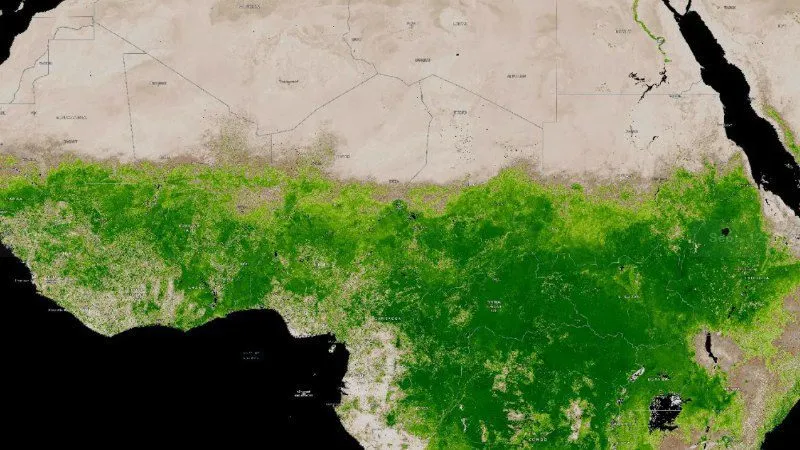
Earth-observation satellites captured vivid before-and-after imagery showing emerald patches flourishing where only parched earth once stood. These striking pictures reignited a fascinating scientific question: Is the Sahara beginning to green once more?
Ephemeral Blooms vs. Long-Term Realities
Climatologists advise caution before drawing hasty conclusions. This sudden greening is an ephemeral pulse. As desert heat and desiccating winds return, ephemeral lakes evaporate and desert flora withers within weeks. The hyper-arid Sahara readily accommodates fleeting storms, but permanently transforming into a lush ecosystem requires systemic climatic shifts.
Echoes of the Ancient African Humid Period
Yet this transient burst provides an enchanting glimpse into Earth’s prehistoric past. Roughly 11,000 to 5,000 years ago, the Sahara was a vibrant, lush savanna known to paleoclimatologists as the African Humid Period. During this “Green Sahara” epoch, cyclical wobbles in Earth’s orbital precession enhanced the West African monsoon. Rivers surged, vast inland lakes teemed with fish and hippos, and savanna grasses supported diverse human cultures and wildlife. As orbital configurations shifted roughly 5,000 years ago, monsoon rains retreated, rapidly desertifying the landscape. Orbital Milankovitch cycles suggest that the Sahara naturally oscillates between arid and humid states every 21,000 years, pointing toward a naturally green Sahara millennia in our distant future.
The Sahel Transition and Climate Dynamics
In recent decades, the transitional borderland south of the desert—the Sahel region—has experienced subtle vegetation increases. Scientists attribute this modest greening to shifting precipitation patterns influenced by global climate change, improved agricultural stewardship, and large-scale afforestation initiatives like the Great Green Wall. However, localized greening in the Sahel does not signal a continental transformation of the Sahara proper.
The Sheer Scale of the Continental Giant
The Sahara spans roughly 9.2 million square kilometers (3.5 million square miles)—an area roughly comparable in size to China or the United States. Maintaining vegetation across this immense expanse requires sustained, continental-scale monsoon patterns and deep soil development, which the current global climate system does not support.
Future Outlook Under Global Climate Change
Climatologists continue to monitor whether global warming will alter tropical rain belts and intensify Saharan weather anomalies. Some predictive models suggest extreme storms may strike the northern desert margins more frequently, supporting pockets of perennial shrubs, while others warn of intensifying heat waves and desertification.
A Living Reminder of Planetary Cycles
The ephemeral greening of the Sahara serves as a poignant reminder that Earth’s climate is inherently dynamic. Even the harshest arid landscapes on our planet preserve the geological memory of flowing waters and ancient savannas, patiently awaiting the rhythmic turn of cosmic and planetary cycles.