Einstein's Greatest Blunder? The Cosmological Constant and Dark Energy
Albert Einstein and the Architecture of General Relativity
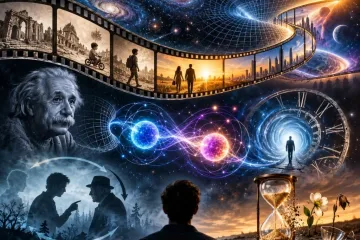
Albert Einstein remains one of the greatest scientific minds in human history. In 1915, his General Theory of Relativity revolutionized our understanding of nature. Rather than treating space and time as rigid, separate backdrops, Einstein unified them into a malleable four-dimensional fabric known as spacetime.
Spacetime Curvature and Gravitational Waves
Mass and energy warp the fabric of spacetime, and objects moving through this curved geometry experience the phenomenon we call gravity. Furthermore, Einstein predicted that violent cosmic collisions—such as merging black holes—would send ripples propagating through spacetime at the speed of light. These ripples are known as gravitational waves.
The Century-Long Quest to Detect Gravitational Waves
Gravitational waves were extraordinarily difficult to verify empirically because their distortions at Earth are subatomic in scale. Exactly one century after Einstein’s prediction, in September 2015, the Laser Interferometer Gravitational-Wave Observatory (LIGO) made history by detecting gravitational waves from two colliding black holes. This epochal discovery provided triumphant confirmation of General Relativity and opened an entirely new window onto the cosmos.
The Cosmological Constant and the Static Universe
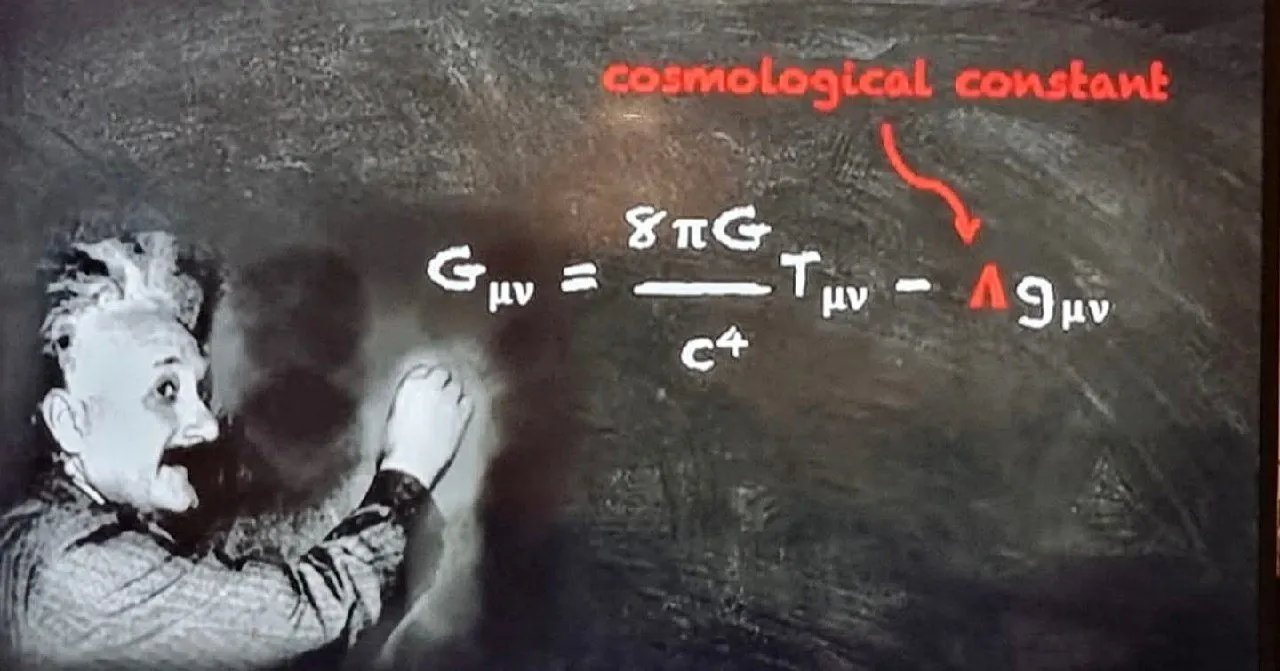
Where, then, did Einstein’s supposed “blunder” occur? When Einstein applied his field equations to the cosmos as a whole in 1917, astronomers universally assumed that the universe was eternal, static, and unchanging. Because gravity is universally attractive, an unconstrained static universe would inevitably collapse in on itself under its own mass. To counterbalance gravitational attraction and force his equations to yield a static universe, Einstein introduced a mathematical fudge factor: the Cosmological Constant, represented by the Greek letter Lambda (λ).
Edwin Hubble and the “Biggest Blunder”
In 1929, astronomer Edwin Hubble analyzed distant galaxies and discovered that they are racing away from us in all directions: the universe is actively expanding! Confronted with empirical proof that the universe was never static, Einstein abandoned the cosmological constant with profound regret, reportedly telling physicist George Gamow that introducing Lambda was the “biggest blunder” of his career.
Accelerating Cosmic Expansion: A Supernova Surprise
For decades, cosmologists assumed the cosmological constant was permanently dead. They believed cosmic expansion would gradually decelerate over time due to gravitational attraction. However, in 1998, two competing teams of astronomers observing distant Type Ia supernovae made an astonishing discovery: cosmic expansion is not slowing down—it is accelerating! For this discovery, Saul Perlmutter, Brian Schmidt, and Adam Riess were awarded the 2011 Nobel Prize in Physics.
Dark Energy: The Resurrected Constant
What mysterious repulsive force is pushing the universe apart at an accelerating rate? Physicists named this pervasive force dark energy. Comprising roughly 68 to 70 percent of all mass-energy in the cosmos, dark energy acts as an intrinsic energy density of empty space itself. And how do cosmologists mathematically model dark energy in General Relativity today? Precisely by reinstating Einstein’s cosmological constant!
Einstein’s Unintentional Triumph
Today, the cosmological constant Lambda forms the cornerstone of the standard cosmological model (Lambda-CDM). What Einstein discarded as his greatest mistake turned out to be an uncanny prophetic insight into the fundamental physics of the cosmos. Even when he believed he was wrong, Einstein’s genius pointed the way forward for generations of scientists.