A Letter from the Primordial Universe: Ancient Starlight from Galaxy AMORE6
The Cosmic Dawn and the Big Bang
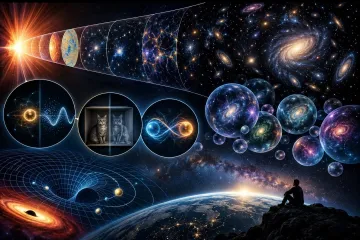
The epic chronicle of our cosmos began roughly 13.8 billion years ago with the Big Bang. In that transcendent moment, space, time, energy, and primordial matter were born. Every particle that makes up our stars, galaxies, and our own bodies traces its lineage back to that cosmic dawn. Yet astronomers have long wondered: Can we peer back through billions of years of cosmic expansion to observe the universe’s very first stars and galaxies as they ignited?
The Discovery of Ancient Galaxy AMORE6
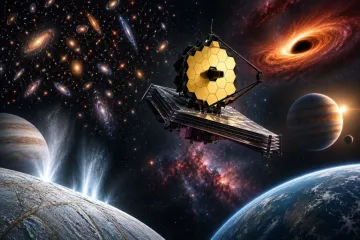
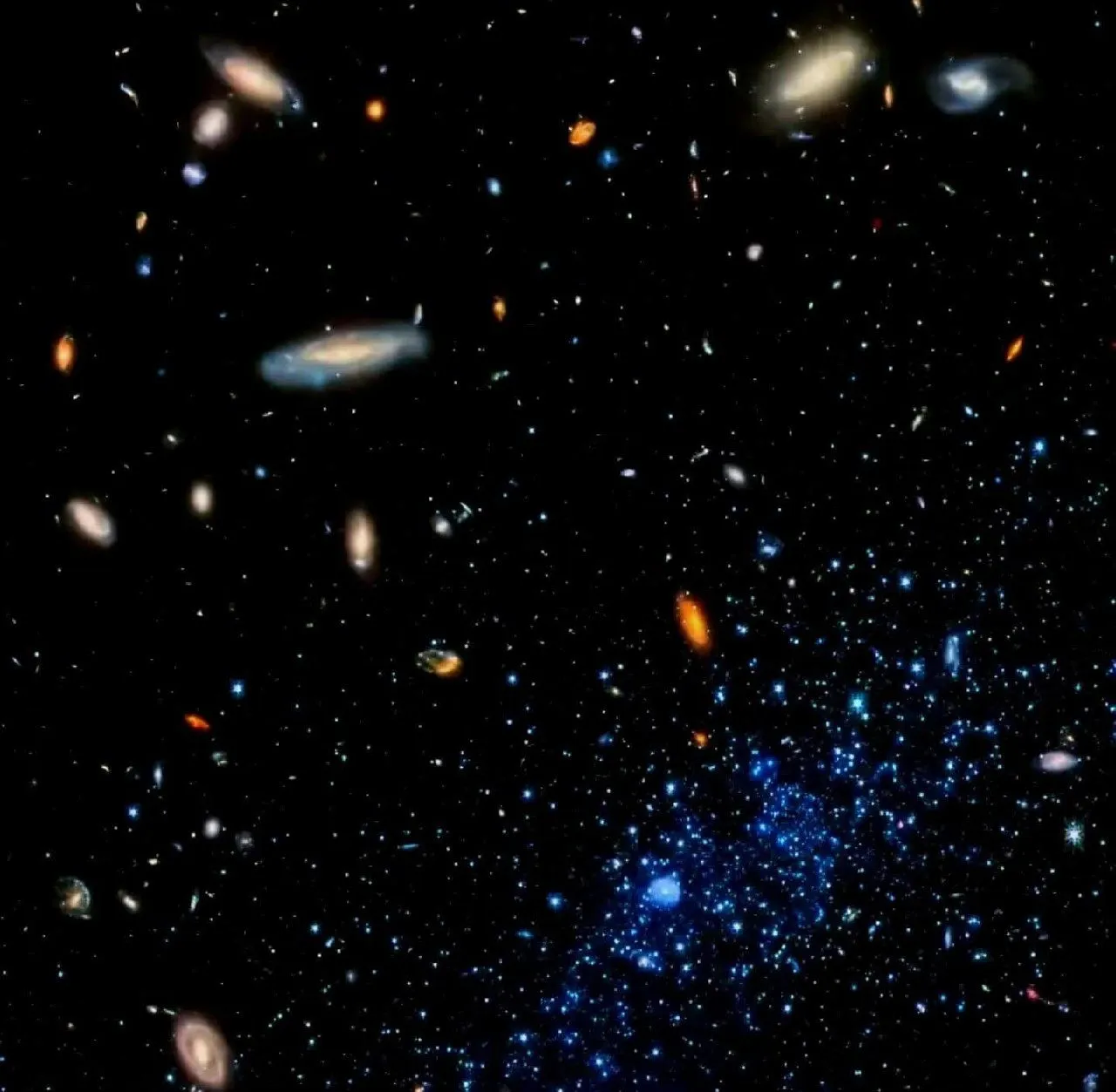
Thanks to the James Webb Space Telescope (JWST), that dream has become reality. Deep in the cosmic horizon, astronomers detected a faint, compact galaxy designated AMORE6. The starlight from this distant world traveled across space for more than 13 billion years to reach our mirrors. We behold AMORE6 as it existed when the universe was a mere infant, around 800 million years old. Neither our Sun nor Earth existed when this ancient light began its voyage across the void.
A Pristine Galaxy Free of Heavy Elements
What makes AMORE6 truly astonishing is its chemical composition. In standard galaxies, spectroscopic analysis reveals signatures of heavy elements: carbon, oxygen, nitrogen, and iron. In AMORE6, these heavy elements are virtually nonexistent. The galaxy consists almost exclusively of primordial hydrogen, helium, and trace amounts of lithium. It represents one of the most chemically pristine early galaxies ever identified.
Gravitational Lensing: Nature’s Natural Telescope
AMORE6 is so small and distant that even JWST could not have resolved it without cosmic assistance. Fortunately, a massive foreground galaxy cluster sat directly along our line of sight, acting as a gravitational lens. The immense gravity of the cluster bent and magnified the faint starlight behind it, rendering this primordial fossil visible to modern astronomy.
The Long-Sought Domain of Population III Stars
Astrophysicists believe AMORE6 may host Population III stars—the first generation of stars born after the Big Bang. For decades, these legendary stars existed only in theoretical models. Formed from pure primordial gas without metal cooling, Population III stars were hundreds of times more massive than our Sun, burning with searing brilliance before detonating as violent supernovae. AMORE6 brings us closer than ever to witnessing their stellar nurseries.
The Cosmic Microwave Background: The Universe’s First Light
AMORE6 is not the only relic connecting us to cosmic beginnings. Even older is the Cosmic Microwave Background (CMB) radiation—the afterglow of the Big Bang released roughly 380,000 years after creation, when the cooling universe first became transparent to light.
Confirming the Big Bang Timeline
Discovered in 1965 by Arno Penzias and Robert Wilson, the CMB provided empirical proof for the Big Bang. While the CMB shows us the universe’s primordial glow, AMORE6 shows us the universe taking its first tentative steps toward complex cosmic architecture. Together, they demonstrate that Big Bang cosmology is not mere speculation, but an observable physical history.
Stellar Nucleosynthesis and the Forging of Matter
The pristine simplicity of AMORE6 confirms what stellar physics has long argued: in the beginning, only hydrogen and helium existed. The heavy elements of the periodic table—the carbon in our DNA, the iron in our blood, the calcium in our bones—were forged inside the thermonuclear furnaces of first-generation stars and scattered across space in their dying supernova explosions. In AMORE6, we are gazing upon the universe before those furnaces began forging complex matter. It is a cosmic postcard sent across time, revealing the pristine dawn from which all modern wonders arose.