The Great Attractor: The Universe's Invisible Gravitational Center
An Invisible Cosmic Current
The universe appears to follow an orderly, serene cosmic choreography. Planets, stars, nebulae, and entire galaxies glide through space in well-defined celestial orbits. Yet beneath this tranquil cosmic facade lies an astonishing gravitational phenomenon pulling entire galactic neighborhoods across deep space.
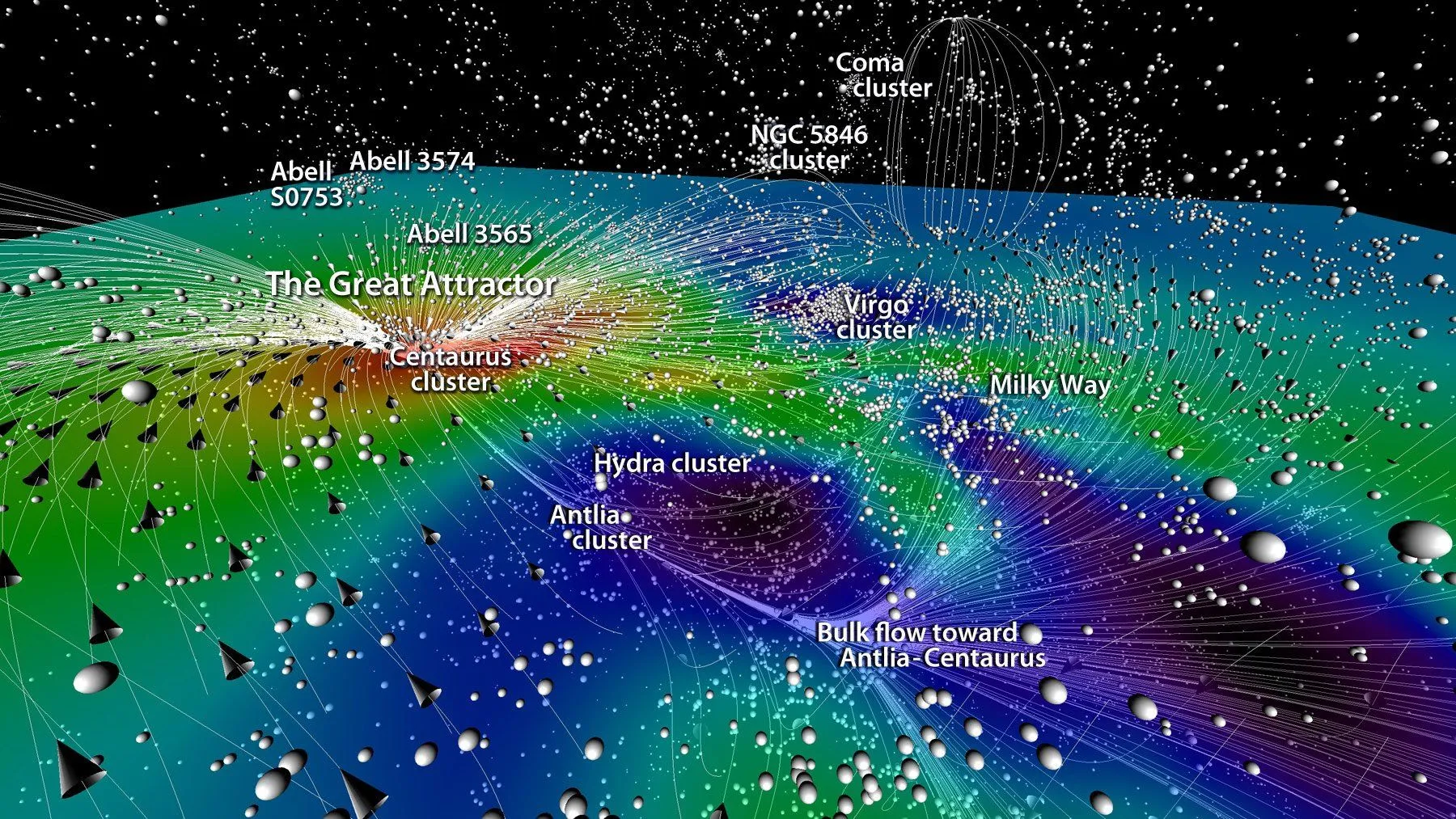
Galaxies are not merely orbiting; they are hurtling at staggering velocities toward an unseen gravitational concentration. Some colossal, hidden mass is exerting an overwhelming gravitational pull across hundreds of millions of light-years. That mysterious destination is known as the Great Attractor.
Peculiar Motion and the Galactic Race
Our Milky Way galaxy is far from stationary. Cosmologists have calculated that our galaxy is racing through the cosmos at over two million kilometers per hour toward a specific region in the sky. Remarkably, we are not alone on this journey.
Neighboring galaxies—including the Andromeda Galaxy, the Virgo Cluster, and hundreds of surrounding star systems—are all streaming in the exact same direction. Astronomers refer to this collective deviation from uniform cosmic expansion as “peculiar motion.” At the focal point of this immense gravitational river lies the Great Attractor.
The Zone of Avoidance: Shrouded from Sight
Despite exerting such colossal mass, the attractor cannot be observed directly with optical telescopes. It lies directly behind the thick plane of our own Milky Way galaxy, an area dense with interstellar gas, obscuring cosmic dust, and billions of crowded stars.
This blinded swath of the sky is termed the Zone of Avoidance. For decades, this astronomical barrier prevented optical astronomers from seeing what lay behind the galactic veil, hiding one of the universe’s most massive structures behind an opaque wall of cosmic dust.
The Laniakea Supercluster: Our Cosmic Address
Determined to pierce this veil, astrophysicists turned to radio astronomy, infrared detectors, and X-ray observatories. By analyzing galaxy velocities, gravitational redshifts, and X-ray emissions from hidden galaxy clusters, scientists revealed a titanic cosmic empire hidden within the dark zone.
In 2014, researchers mapped this gigantic structure and named it the Laniakea Supercluster, derived from the Hawaiian term for “immense heaven.” Spanning over 520 million light-years and containing roughly 100,000 galaxies, Laniakea defines our broader cosmic home. Cosmologists identified the Great Attractor as the central gravitational basin of this immense supercluster, drawing galaxies along cosmic filaments like water draining into a vast basin.
The Shapley Supercluster and Beyond
Further investigations revealed that the story does not end at Laniakea. Beyond the Great Attractor lies an even more gargantuan cosmic giant: the Shapley Supercluster.
This suggests that our galactic voyage is part of a multi-tiered gravitational hierarchy. The Great Attractor is a regional gravitational nexus along the pathway, while the deeper pull originates from the enormous concentration of matter residing within the Shapley Supercluster.
Conclusion
The irresistible pull of the Great Attractor underscores how much of the cosmos remains beyond direct optical sight. Through radio, infrared, and gravitational wave astronomy, humanity continues to piece together the grand architecture of the universe, deciphering the unseen cosmic forces that steer our galactic destiny.