The Golden Ratio: Fibonacci Sequence and Nature's Mathematical Mystery
Leonardo of Pisa and the Fibonacci Sequence
In the early thirteenth century, Italian mathematician Leonardo of Pisa, popularly known as Fibonacci, introduced a simple mathematical sequence in his classic work Liber Abaci. Today, that simple sequence is known globally as the Fibonacci sequence.
Starting with $0$ and $1$, each subsequent integer is the sum of the preceding two terms: $0, 1, 1, 2, 3, 5, 8, 13, 21, 34, 55, 89, 144, \dots$ and continues infinitely. What initially appears to be an elementary numerical progression conceals a profound mathematical signature underpinning the natural world.
The Golden Ratio: The Divine Proportion
Dividing any Fibonacci number by its immediate predecessor yields an intriguing sequence of approximations:
- $5 \div 3 = 1.666\dots$
- $8 \div 5 = 1.6$
- $13 \div 8 = 1.625$
- $55 \div 34 \approx 1.6176$
- $144 \div 89 \approx 1.6179$
As the sequence progresses toward infinity, this ratio converges precisely toward an irrational constant: approximately $1.6180339887\dots$ Known as the golden ratio, it is conventionally denoted by the Greek letter Phi ($\phi$).
Botanical Architecture and Natural Optimization
Nature repeatedly expresses this mathematical relationship across biological structures:
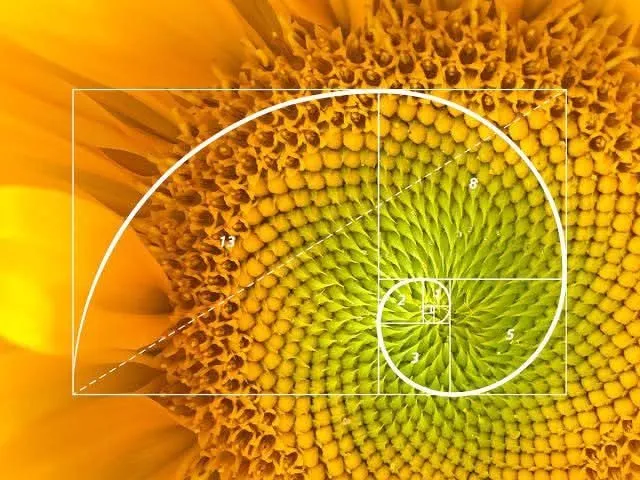
- Sunflower Seed Capitula: Sunflower seed spirals intersect in counter-rotating spirals featuring consecutive Fibonacci numbers (such as 34 and 55, or 55 and 89). This arrangement maximizes packaging efficiency, ensuring that every seed receives optimal space and sunlight.
- Pinecones and Pineapples: The hexagonal scales of pinecones and the rhomboid eyes of pineapples display intersecting spiral patterns governed by Fibonacci counts.
- Phyllotaxis: The arrangement of leaves along a plant stem often diverges by the “golden angle” (approximately $137.5^\circ$), preventing upper foliage from shading lower leaves and ensuring efficient photosynthesis.
Human Anatomy, Aesthetics, and Art
For centuries, classical artists, sculptors, and architects regarded the golden ratio as the golden standard of structural harmony and aesthetic perfection. Polykleitos in ancient Greece, Vitruvius in Rome, and Leonardo da Vinci during the Renaissance incorporated proportional geometry into their works. Da Vinci’s celebrated Vitruvian Man illustrates proportions echoing golden geometry.
While modern anatomical studies show wide variation among human facial proportions, aesthetic medicine and classical design continue to reference golden harmonies as an archetype of visual balance.
The Blueprint of Life: DNA Helices
Remarkably, the golden ratio appears within the fundamental blueprint of molecular biology: the DNA double helix. Each complete helical turn of the B-DNA molecule measures approximately $34$ angstroms in length, while the diameter of the helix measures approximately $21$ angstroms.
Both $21$ and $34$ are consecutive numbers in the Fibonacci sequence. Their ratio ($34 / 21 \approx 1.619$) approximates the golden ratio ($1.618$), demonstrating that nature organizes genetic architecture with mathematical elegance.
Galactic Spirals and the Golden Spiral
On cosmic scales, logarithmic spirals resembling the golden spiral emerge within rotating astrophysical systems. The geometric arms of spiral galaxies, including the Whirlpool Galaxy (M51) and our own Milky Way, exhibit logarithmic expansion angles closely approximating golden geometry.
From the molecular coils of DNA to blooming flora and sprawling spiral galaxies, the golden ratio demonstrates that the physical universe speaks a profound, unified mathematical language.