Raychaudhuri Equation: Amal Kumar Raychaudhuri and Cosmic Singularities

A Solitary Pioneer of Theoretical Physics
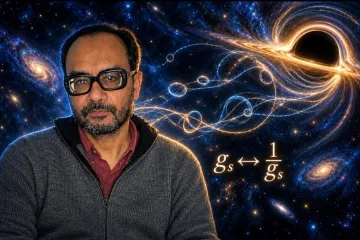
Indian theoretical physicist Amal Kumar Raychaudhuri was born on September 14, 1923, in Barisal in undivided Bengal. Raised by his father, a dedicated mathematics teacher, he cultivated a passion for rigorous mathematical reasoning from early youth.
After graduating with honors in physics from Presidency College and earning his master’s degree from the University of Calcutta, he joined Sir Asutosh College in Kolkata as a lecturer. Working largely in isolation without institutional research grants, he embarked on deep investigations into Einstein’s general theory of relativity.
The Discovery of the Raychaudhuri Equation
During his tenure at Asutosh College, Raychaudhuri investigated the geometric dynamics of gravitational attraction, leading to the formulation of his landmark equation in 1953. Published in 1955 in the prestigious journal Physical Review, the Raychaudhuri equation provided the first rigorous, model-independent mathematical explanation of why gravity is universally attractive.
The equation quickly gained international recognition, establishing Raychaudhuri as one of the most brilliant relativistic cosmologists of the twentieth century.
Understanding the Raychaudhuri Equation
While the full mathematical derivation demands advanced differential geometry and tensor calculus, its core physical insight is conceptually intuitive:
In general relativity, freely falling test particles traverse curves called geodesics through four-dimensional spacetime. If multiple nearby particles travel along parallel geodesics, their trajectories form a bundle or “congruence.”
The Raychaudhuri equation tracks how the volume of this geodesic congruence evolves over time under the influence of spacetime curvature, kinematics, and energy density. It proves that whenever matter satisfies standard energy conditions, the cross-sectional area of a bundle of geodesics inevitably converges. In other words, spacetime curvature forces paths together, mathematically demonstrating the attractive nature of gravitation.
Cosmic Singularities and the Big Bang
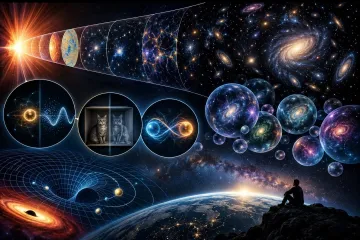
The convergence of geodesics carries profound cosmological implications. Tracing cosmic expansion backward in time, the Raychaudhuri equation reveals that geodesics must inevitably intersect at a point of infinite density and curvature—a gravitational singularity.
Before Raychaudhuri’s work, many physicists hypothesized that the Big Bang singularity was merely an artifact of idealized mathematical assumptions, such as perfect spatial isotropy and homogeneity. The Raychaudhuri equation conclusively demonstrated that gravitational collapse to a singularity is an inescapable consequence of general relativity.
Hawking, Penrose, and Global Acclaim
In the late 1960s and 1970s, Sir Roger Penrose and Stephen Hawking utilized the Raychaudhuri equation as the mathematical cornerstone for their celebrated Penrose-Hawking Singularity Theorems. Their theorems proved that singularities are inevitable both at the inception of the universe (the Big Bang) and in the final state of gravitational collapse (black holes).
Professor Raychaudhuri returned to Presidency College as a professor, mentoring generations of world-class Indian physicists. In 1979, Oxford University Press published his influential textbook, Theoretical Cosmology. Until his death in 2005 at the age of eighty-one, he remained a humble scholar whose mathematical breakthrough illuminated the origins of our universe.