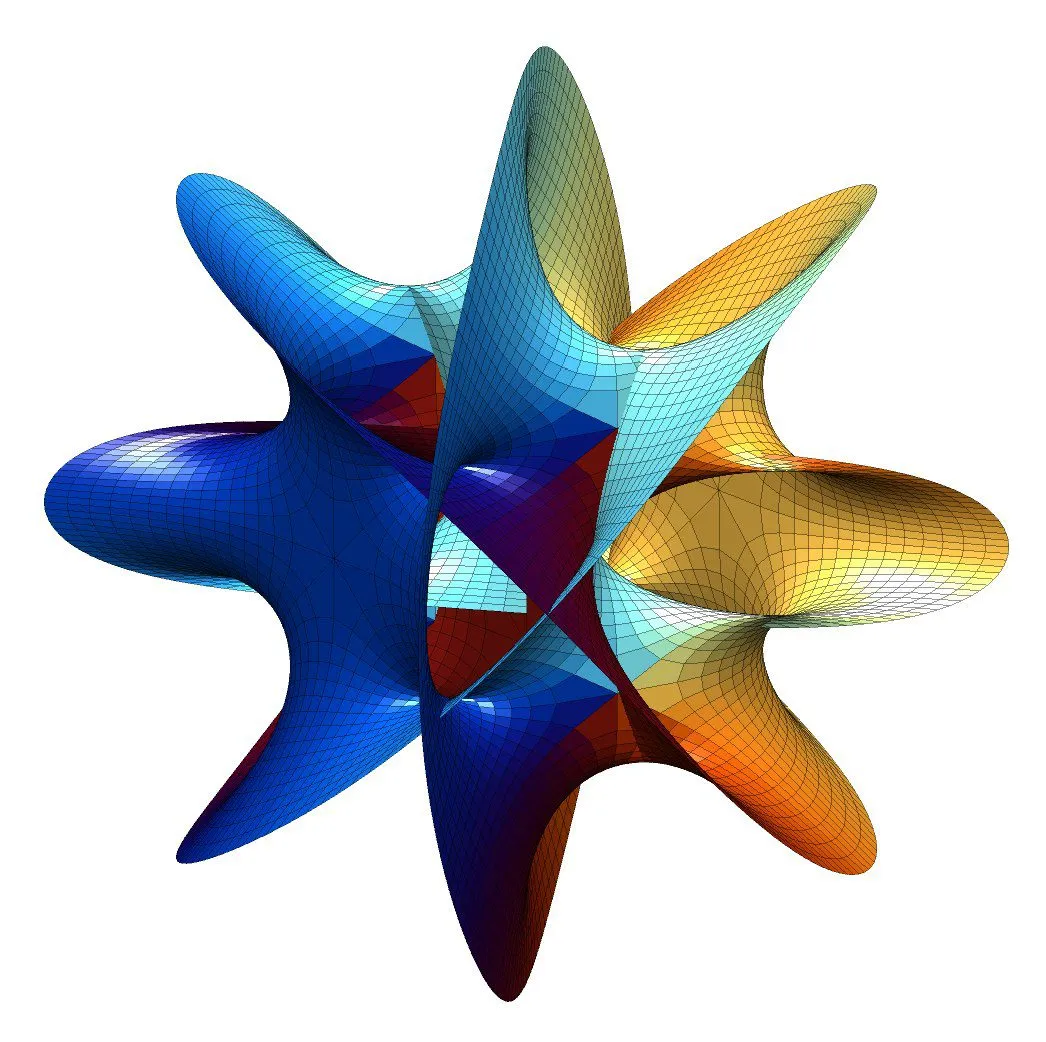
Bernhard Riemann: Mathematical Architect of Einstein's Relativity

The Unsung Architect of Spacetime
In 1915, Albert Einstein unveiled his general theory of relativity, transforming humanity’s comprehension of the cosmos. Einstein showed that gravity is not a Newtonian mechanical force, but the manifestation of four-dimensional spacetime curvature induced by mass and energy. Yet the sophisticated mathematical architecture that made general relativity possible had been formulated six decades earlier by a quiet German mathematical genius: Georg Friedrich Bernhard Riemann (1826–1866).
A Shy Genius Guided by Giants
From early childhood, Riemann demonstrated extraordinary mathematical talent. Despite his innate brilliance, he was painfully shy, reclusive, and plagued by severe social anxiety. Intensely modest, he found refuge in abstract mathematical contemplation.
Riemann studied under legendary figures at the University of Göttingen and the University of Berlin, mentored by Carl Friedrich Gauss—the “Prince of Mathematicians”—and physicist Wilhelm Weber. Under their guidance, Riemann developed the foundational concepts that would reshape modern geometry and mathematical analysis.
Riemannian Geometry: Expanding Spatial Dimensions
In his historic 1854 habilitation lecture, Riemann shattered two millennia of Euclidean dominance by introducing non-Euclidean differential geometry, known today as Riemannian geometry. He demonstrated that geometry need not be confined to flat planes or three dimensions, generalizing it to curved spaces of arbitrary dimensions ($n$-dimensional manifolds).
Key mathematical tools emerged from his groundbreaking framework:
- The Riemannian Metric: A tensor that defines distance, angle, and curvature at every point on an arbitrary smooth manifold.
- The Riemann Curvature Tensor: A rigorous mathematical object that encapsulates intrinsic gravitational curvature without referencing an external embedding space.
When Einstein struggled to formulate the field equations of general relativity sixty years later, Riemannian geometry provided the exact mathematical framework he required.
Contributions Across Mathematical Disciplines
Riemann’s contributions extended across mathematical analysis and complex function theory:
- The Riemann Integral: The first rigorous, precise definition of definite integrals in calculus.
- Real Analysis: Groundbreaking papers on Fourier series that established the foundations of modern harmonic analysis.
- Complex Analysis and Riemann Surfaces: Multi-sheeted geometric representations of complex multi-valued functions, transforming topology and geometric function theory.
The Riemann Hypothesis: Mathematics’ Greatest Unsolved Riddle
In an 1859 paper examining prime number distribution, Riemann introduced the Riemann hypothesis regarding the non-trivial zeros of the Riemann zeta function. He conjectured that all non-trivial zeros lie on the critical line with real part equal to $1/2$.
Now recognized as one of the Millennium Prize Problems, the hypothesis remains unsolved. A definitive proof would unlock profound insights into number theory, prime distribution, cryptography, and quantum chaos.
Practical Applications: Geodesics and Aviation
Beyond abstract cosmology, Riemann’s geometry underpins everyday modern navigation. Because Earth is an oblate spheroid, the shortest distance between two distant global airports is not a straight line on a flat mercator map, but a geodesic—the shortest curve along the curved surface of a sphere. Modern aviation flight routes directly reflect Riemannian principles.
The Enduring Legacy of Bernhard Riemann
Although Riemann died of tuberculosis at the young age of thirty-nine, his profound insights laid the bedrock for general relativity, string theory, topological physics, and modern digital cryptography. Bernhard Riemann demonstrated that pure mathematics holds the foundational key to decoding the physical universe.