Earth’s Geographic and Magnetic Poles Explained

As Earth travels along its orbit around the Sun, it rotates continually on its axis from west to east once every 23 hours, 56 minutes, and 4 seconds. This diurnal rotation produces the cycle of sunrise and sunset that governs day and night.
The rotational axis intersects Earth’s surface at two permanent geometric coordinates: the Geographic North Pole and the Geographic South Pole. Together with geomagnetism, Earth features distinct geographic and magnetic poles.
Geographic North and South Poles
The geographic poles represent the northernmost and southernmost mathematical points on the planet:
- Geographic North Pole (90° North): Situated in the Arctic Ocean north of Greenland, where ocean depths exceed 4,000 meters beneath drifting sea ice. Establishing permanent stations here is difficult; summer temperatures average 0°C, while winter drops to -40°C. Standing at this point, every direction is south.
- Geographic South Pole (90° South): Situated on the continental ice sheet of Antarctica at an elevation of 2,835 meters. Since 1956, the Amundsen-Scott South Pole Station has housed scientists conducting year-round astronomical and climate research. Summer averages -28°C, while winter plunges to -60°C. Standing here, every direction is north.
The South Pole is much colder and elevated than the North Pole. Due to Earth’s 23.5-degree axial tilt, both polar regions experience six months of continuous summer daylight alternating with six months of polar winter night. The great-circle distance between the geographic poles is 20,004 kilometers.
Earth’s Magnetic Poles and the Geodynamo
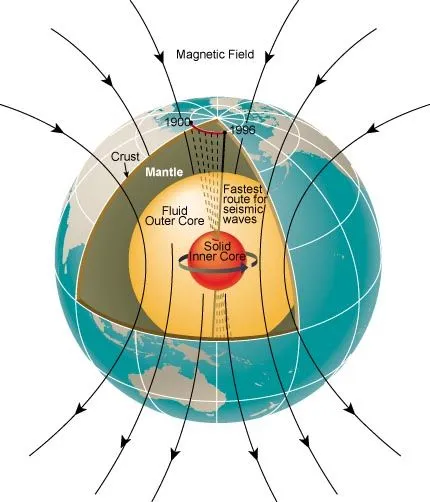
In addition to geographic poles, Earth possesses magnetic poles generated by convective electrical currents in the molten iron outer core (the geodynamo). This creates a planetary magnetic field that directs compass needles.
Because opposite magnetic poles attract, a magnetic compass’s north-seeking pole points toward Earth’s Magnetic North Pole (which is technically a magnetic south polarity in physical terms).
Drifting Magnetic Poles and Polarity Reversals
The magnetic poles do not coincide with the geographic poles, and unlike fixed geographic axes, magnetic poles continuously wander. Currently, the Magnetic North Pole is situated roughly 400 kilometers south of the Geographic North Pole, drifting rapidly toward Siberia.
Paleomagnetic records preserved in oceanic crust reveal that Earth’s geomagnetic poles periodically invert. The last complete magnetic reversal (the Brunhes-Matuyama reversal) occurred approximately 780,000 years ago.
The Magnetospheric Shield
Earth’s magnetic field extends tens of thousands of kilometers into deep space, forming the magnetosphere. This invisible shield deflects ionizing solar winds and cosmic radiation, protecting our atmosphere from being stripped away and safeguarding terrestrial life.