Lengthening Days: Why the Moon Is Slowing Earth's Rotation
The Primordial Speed of Planet Earth
Our ancient home, planet Earth, is roughly 4.5 billion years old—a chronology established through radiometric dating of ancient meteorites and zircon crystals. Yet in its infancy, Earth rotated far faster than it does today. Geological and paleontological evidence reveals that roughly 1.4 billion years ago, a full day on Earth lasted merely 18 hours. Over geological epochs, Earth has steadily shed rotational momentum, giving us our familiar 24-hour day.
The Decelerating Pull of the Moon
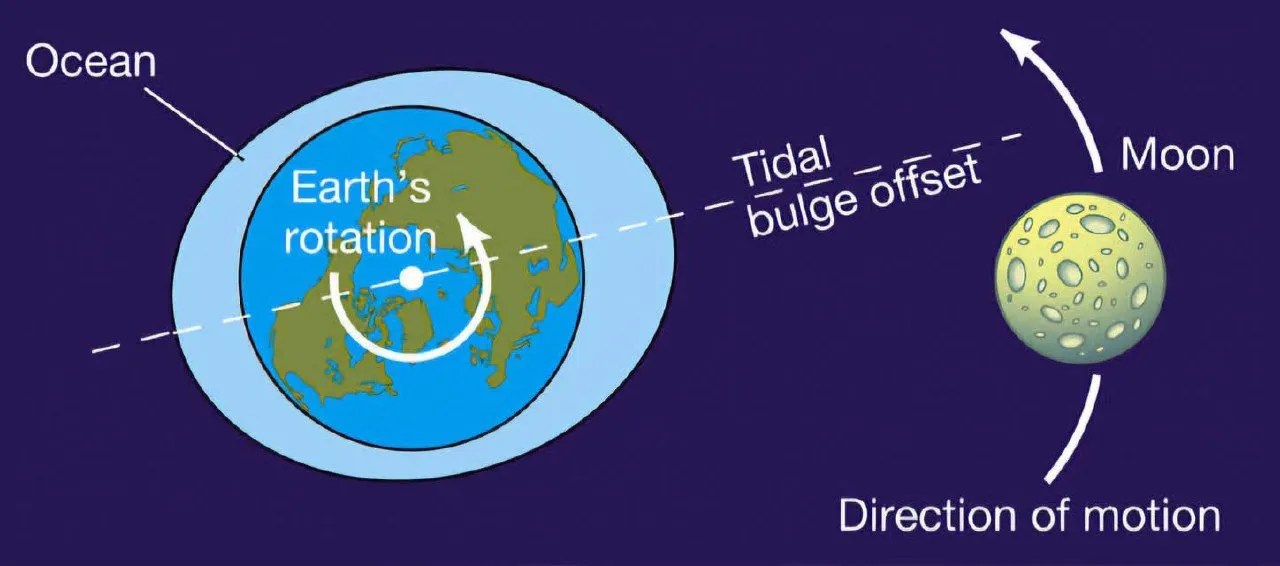
The primary driver behind this planetary slowdown is our celestial companion, the Moon. The Moon’s gravitational force exerts a relentless tug on Earth’s oceans, raising tidal bulges on both sides of the planet. Because Earth spins on its axis faster than the Moon orbits, planetary rotation carries these oceanic bulges slightly ahead of the Earth-Moon axis. As the Moon exerts gravitational pull back on these forward bulges, it acts as a planetary brake through tidal friction. By conservation of angular momentum, this braking energy pushes the Moon roughly 3.8 centimeters further away from Earth each year, while gradually lengthening our days.
Longer Days and the Oxygenation of Earth
Remarkably, geobiologists believe this gradual rotational braking was vital for the evolution of complex life. Roughly 2.4 billion years ago, photosynthetic cyanobacteria emerged in Earth’s oceans, producing oxygen via photosynthesis. When primitive days were short, alternating darkness interrupted bacterial photosynthesis before oxygen could accumulate in excess. As tidal braking lengthened daylight intervals, cyanobacteria enjoyed uninterrupted periods of sunlight, allowing surplus oxygen to saturate the seas and vent into the atmosphere. This catalytic surge, celebrated as the Great Oxidation Event, laid the indispensable foundation for aerobic life.
The Future of Earth’s Planetary Clock
Even today, Earth’s rotation continues to decelerate. Modern atomic clocks confirm that the length of a terrestrial day increases by roughly 1.8 milliseconds per century. While imperceptible over a human lifetime, across tens of millions of years this relentless braking will continue to reshape planetary climates, biological circadian rhythms, and orbital mechanics.
An Elegant Cosmic Partnership
The celestial dance between Earth and Moon demonstrates how planetary mechanics and biological evolution are deeply intertwined. A subtle gravitational friction created the longer days that breathed life into our atmosphere, proving that our existence is guided by the grand and delicate harmonies of the cosmos.