Geodesics & Riemannian Geometry: Curved Flight Paths
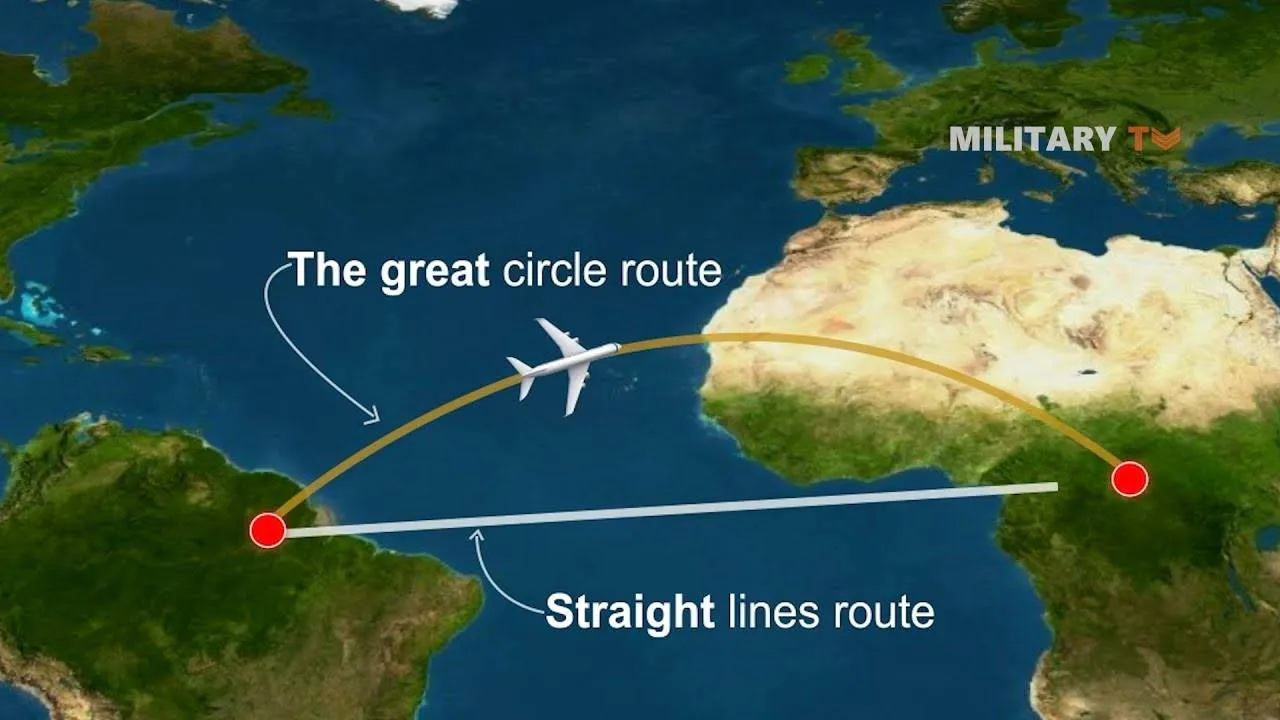
Straight Lines versus Curved Realities
Elementary geometry teaches that the shortest distance between two points is always a straight line. While that rule holds true on a flat sheet of paper, it breaks down on the curved spherical surface of planet Earth.
Consider commercial aviation: long-haul flights from New York to London, Los Angeles to Tokyo, or Dubai to Toronto never follow straight lines on a flat Mercator map. Instead, flight routes appear as broad curves arching toward the Arctic. In reality, that curve is the shortest distance over a globe.
Great Circle Routes
In aerial navigation, this shortest trajectory is known as a Great Circle route. A great circle is the largest circle that can be drawn around a sphere, sharing its center with the center of the Earth. Pilots follow these arcs because flying along great circles minimizes flight time and conserves thousands of gallons of jet fuel.
Geodesics: Straight Lines on Curved Surfaces
In differential geometry, the path representing the shortest distance between two points on any curved surface is called a geodesic:
- On a flat Euclidean plane, a geodesic is a standard straight line.
- On a sphere, a geodesic is a segment of a great circle.
To mathematically calculate geodesics across multi-dimensional curved spaces, mathematicians use Riemannian geometry, developed in the nineteenth century by German mathematician Bernhard Riemann.
Central to this mathematics is the metric tensor, which defines distances, curvature, and angles across non-Euclidean manifolds. When the metric tensor changes, the geometry of space changes with it.
Einstein’s Geometric Theory of Gravity
Riemann’s mathematical breakthrough provided the foundation for Albert Einstein’s General Theory of Relativity. Einstein demonstrated that gravity is not an attractive Newtonian force acting across empty space; rather, mass and energy physically warp four-dimensional spacetime.
Planets, stars, and rays of light simply follow natural geodesics through warped spacetime governed by Riemannian geometry. The orbit of Earth around the Sun is simply a geodesic through curved spacetime.
Spherical Triangles: Summing to 270 Degrees
Curved geometry yields startling properties. In Euclidean geometry, the interior angles of a triangle always sum to 180 degrees. But on Earth’s spherical surface, imagine a triangle formed by:
- The Equator from 0° longitude to 90° East longitude.
- The 0° prime meridian running from the Equator to the North Pole.
- The 90° East meridian running from the North Pole back to the Equator.
Each corner of this triangle meets at a right angle (90 degrees). The sum of its interior angles is 270 degrees! On positively curved surfaces, triangles always exceed 180 degrees.
Conclusion
From intercontinental flight paths to the gravitational curvature of the cosmos, Riemannian geometry and geodesics prove that the truest path through our universe is beautifully curved.