The Fermi Paradox: Where Is Everybody in the Cosmos?
Fermi’s Famous Question
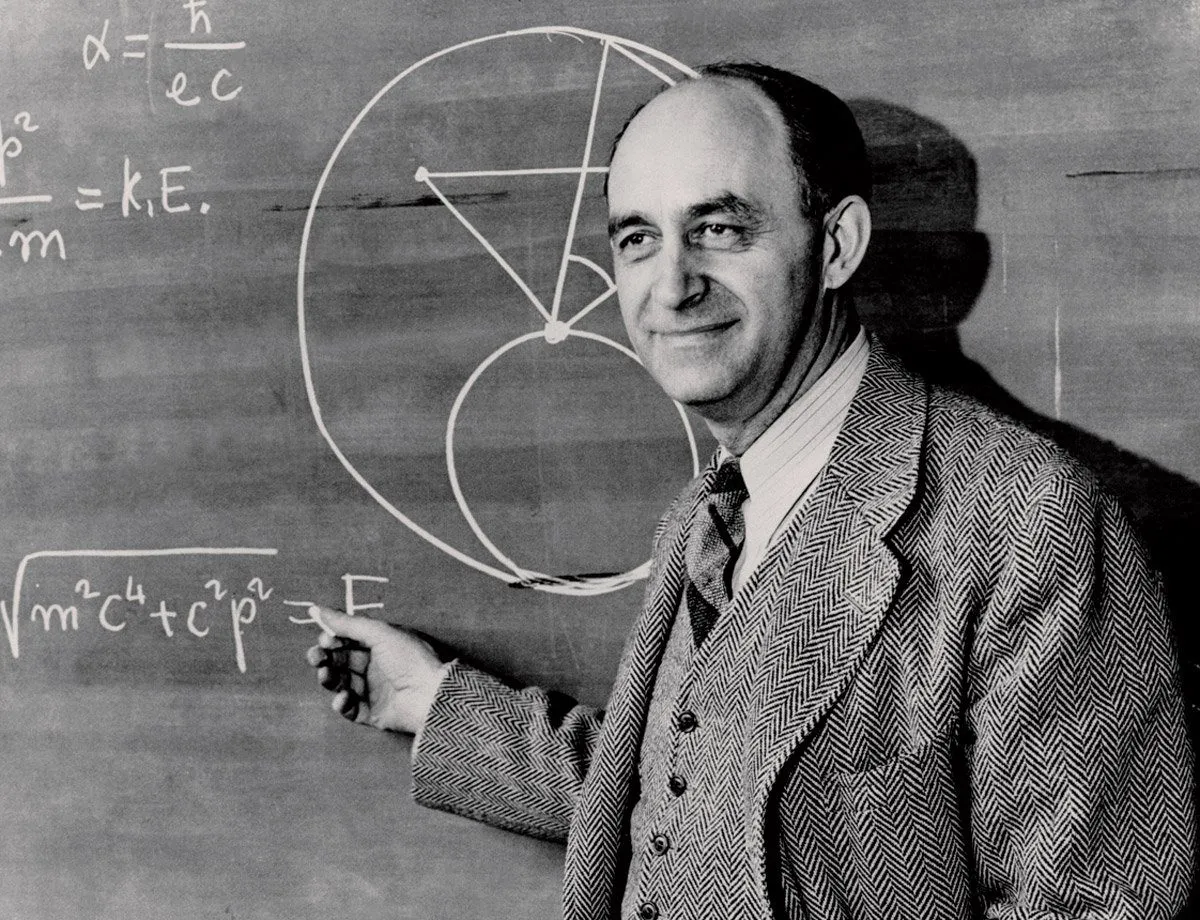
In 1950, during a casual lunchtime conversation with colleagues at Los Alamos, Nobel Prize-winning physicist Enrico Fermi blurted out a deceptively simple question: “Where is everybody?”
Fermi was one of the premier minds of twentieth-century physics, having led the construction of the world’s first nuclear reactor and made seminal contributions to quantum mechanics. His spontaneous question reflected a profound contradiction in our understanding of the universe—a riddle known today as the Fermi Paradox.
The Cosmic Silence and the Paradox
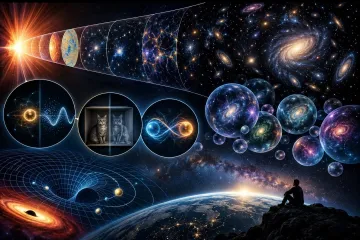
Given the billions of years the universe has existed, statistical probability suggests that intelligent life should have evolved multiple times across the stars. An advanced civilization possessing even modest interstellar propulsion could theoretically colonize an entire galaxy within a few million years.
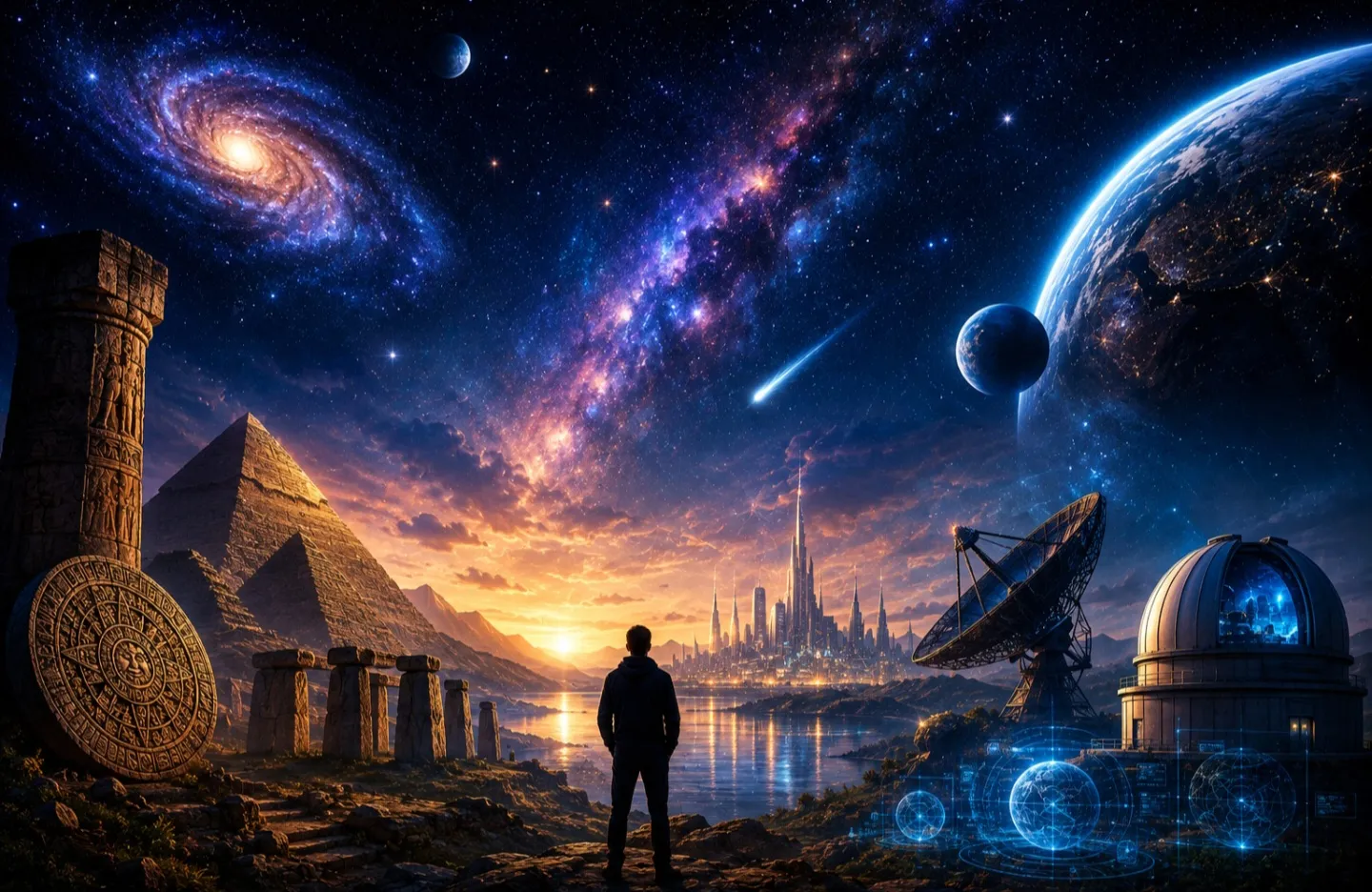
Yet despite decades of systematic listening, our radio telescopes have detected no transmissions, and our deep space surveys have encountered no alien artifacts. This glaring mismatch between the high probability of extraterrestrial civilizations and our total absence of contact constitutes the core paradox.
Statistical Odds and the Drake Equation
Our Milky Way galaxy contains between 100 and 400 billion stars. Across the observable universe, astronomers estimate there are up to two trillion galaxies, yielding an estimated 1022 to 1024 stars. Exoplanet discoveries confirm that Earth-sized worlds within habitable zones are common throughout the galaxy.
In 1961, astronomer Frank Drake formulated the Drake Equation to estimate the number of active, communicative extraterrestrial civilizations in the Milky Way. Depending on the values assigned to its variables, the expected number ranges from several dozen to many millions. If ancient civilizations arose millions of years before us, why have we found no trace of their presence?
Hypotheses Explaining the Silence
Scientists and cosmologists have proposed numerous solutions to the paradox:
- Interstellar Distances: Crossing light-years requires immense energy and time, making physical interstellar travel practically insurmountable.
- The Zoo Hypothesis: Advanced intelligences exist but deliberately isolate Earth as a wildlife sanctuary or cultural preserve to allow natural development.
- Technological Incompatibility: Extraterrestrials might communicate using exotic technologies—such as quantum entanglement or gravitational waves—that our crude detectors cannot perceive.
- Societal Collapse: Civilizations may routinely destroy themselves through nuclear conflict, environmental ruin, or uncontrolled technologies before achieving interstellar travel.
Berezin’s Disturbing Hypothesis: “First In, Last Out”
Physicist Alexander Berezin proposed a chilling alternative: the cosmic silence is not deliberate evasion, but the inevitable consequence of rapid cosmic expansion. The first civilization to achieve interstellar expansion might accidentally eradicate all others.
Just as human construction crews bulldoze anthills while building highways without malice, an expanding interstellar civilization strip-mining planetary systems would extinguish nascent ecosystems as a mere byproduct of growth. Under this perspective, humanity survives only because no technological titan has yet crossed our corner of the galaxy.
The Great Filter: Behind Us or Ahead?
Economist Robin Hanson introduced the concept of the Great Filter—an evolutionary barrier so difficult to cross that it eliminates almost all species before they achieve interstellar colonization:
- If the filter is behind us (e.g., the origin of life or multicellular complexity is extraordinarily rare), humanity may be among the few fortunate survivors.
- If the filter lies ahead (e.g., civilizations inevitably trigger their own extinction via advanced weapons or runaway AI), our species faces an existential test.
Conclusion
The Fermi Paradox is far more than an intellectual puzzle about alien life; it is a mirror held up to human destiny. As we stand on the threshold of becoming a multi-planetary species, the eerie silence of the cosmos urges us to navigate our technological power with care and wisdom.