Einstein Ring: The James Webb Telescope’s Cosmic Wonder
An Ancient Cosmic Mirror
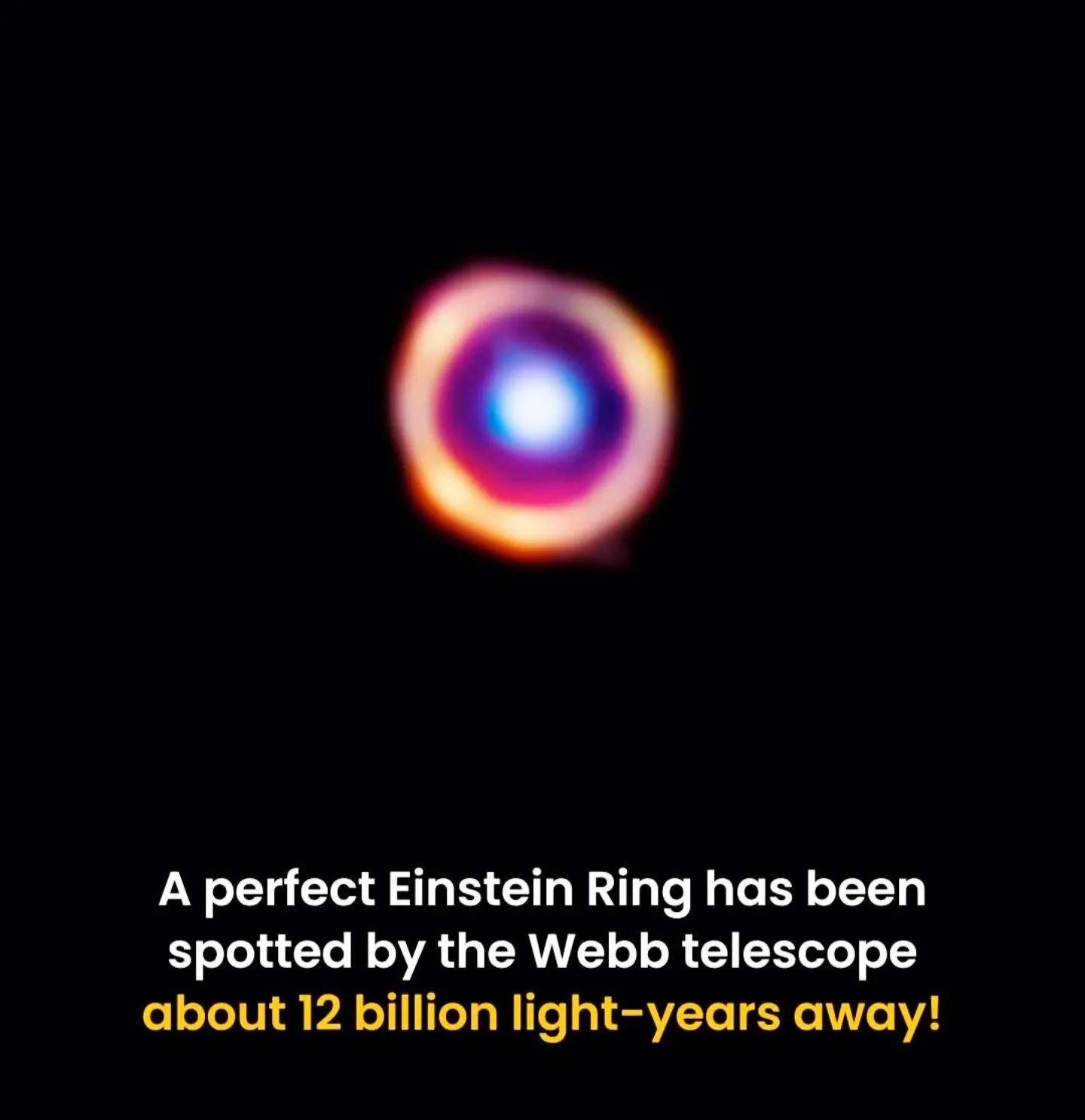
Standing at the dawn of deep time, a breathtaking astronomical phenomenon was captured by the James Webb Space Telescope (JWST): an almost geometrically perfect Einstein Ring.
At the center of this observation is an extremely remote galaxy designated SPT0418-47, situated approximately 12 billion light-years from Earth. We observe this galaxy as it existed when the universe was only 1.8 billion years old—barely past its cosmic infancy.
Curved Light and Gravitational Lensing
The photons reaching our sensors did not travel in a straight line. Directly between SPT0418-47 and Earth lies a massive foreground galaxy whose immense gravitational field warps the surrounding fabric of spacetime. As light from the background galaxy passes through this warped region, it is bent and magnified into a luminous circular halo: an Einstein Ring.
When source, lens, and observer align in near-perfect symmetry, the warped light merges into a complete ring. Such flawless geometry is exceptionally rare across the cosmos.
Nature’s Cosmic Magnifying Glass
Gravitational lensing serves as an extraordinary natural telescope. By bending and focusing light, immense galaxies amplify faint background objects that would otherwise remain far too dim for even our most powerful instruments to detect.
Through gravitational lensing, astronomers not only map distant infant galaxies, but also measure the distribution of invisible dark matter that comprises the gravitational lens itself.
Einstein’s General Relativity in Action
The theoretical framework behind this discovery was formulated in 1915 by Albert Einstein in his General Theory of Relativity. Einstein demonstrated that gravity is not merely a conventional force, but the physical curvature of spacetime caused by mass and energy. When light traverses curved spacetime, its trajectory bends—a prediction brilliantly vindicated every time an Einstein Ring is imaged.
New Revelations from the James Webb Telescope
JWST’s high-resolution near-infrared instruments revealed startling details inside SPT0418-47. Spectroscopic analysis detected molecular fingerprints of carbon monoxide and complex organic dust molecules.
This reveals that even in the early universe, galaxies matured far more rapidly than previous theoretical models anticipated, forging heavy elements and birthing stars at breakneck speeds.