Lunar Phases and Eclipses: The Science of the Moon
The Science Behind the Moon’s Changing Face
Why does the Moon appear as a full glowing orb one week, shrink into a slender crescent the next, and vanish entirely on other nights? For millennia, the changing face of our celestial neighbor has inspired folklore and curiosity. In reality, these transformations are governed by the elegant three-dimensional geometry connecting the Sun, Earth, and Moon.
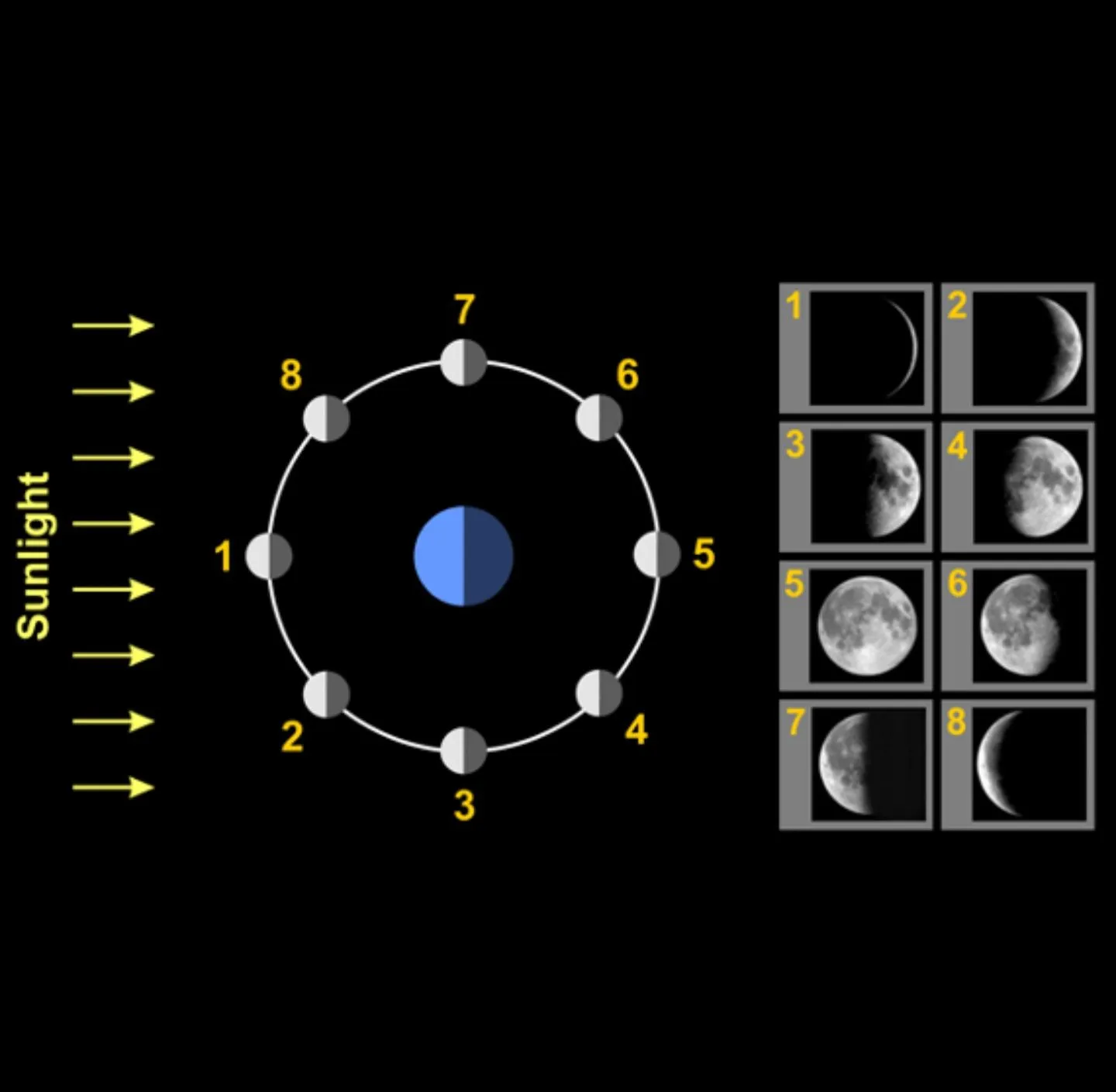
As Earth orbits the Sun, the Moon orbits Earth as our sole natural satellite. Because the Moon produces no light of its own, it shines purely by reflecting sunlight. At any given moment, exactly half of the lunar sphere is illuminated by the Sun, while the opposite hemisphere lies in shadow.
A common misconception holds that the changing shapes of the Moon are caused by Earth’s shadow. In truth, Earth’s shadow only falls on the Moon during a lunar eclipse. The regular cycle of lunar phases is caused entirely by the changing angle from which we view the Moon’s sunlit hemisphere as it orbits our planet.
The Geometric Dance of Full Moon and New Moon
Over its approximately 29.5-day synodic month, the relative angles between Sun, Earth, and Moon shift continuously:
- Full Moon: Occurs when Earth lies roughly between the Sun and the Moon. From our vantage point, the entire sunlit hemisphere of the Moon faces Earth.
- New Moon: Occurs when the Moon passes between Earth and the Sun. The illuminated side faces away from Earth, while the dark side faces us, rendering the Moon invisible against the daytime glare.
Waxing and Waning Cycles
Following a New Moon, the visible illuminated fraction steadily expands during the waxing phase. Night after night, the crescent widens through the first quarter and gibbous phases until reaching full illumination.
After the Full Moon, the cycle reverses into the waning phase. The sunlit area gradually diminishes through the third quarter until it disappears into the next New Moon. This rhythmic cycle has served as the astronomical foundation for calendars since antiquity.
Why Do Lunar Eclipses Happen?
On select Full Moon nights, the Sun, Earth, and Moon align in a straight line. When this happens, Earth passes directly between the Sun and the Moon, casting its shadow across the lunar surface and producing a lunar eclipse.
Lunar eclipses do not occur during every Full Moon because the Moon’s orbit is tilted by approximately 5 degrees relative to Earth’s orbital plane (the ecliptic). A lunar eclipse can only occur when a Full Moon happens near one of the two orbital nodes where the orbital planes intersect.
Upcoming Lunar Eclipses
Typically, two to three lunar eclipses occur globally each year. During a total lunar eclipse, sunlight filtering through Earth’s atmosphere bends toward the Moon, scattering blue light and bathing the lunar surface in a deep, coppery red—a phenomenon known as a “Blood Moon.”
The regular cycles of lunar phases and eclipses remind us of the clockwork precision of orbital mechanics, inviting observers everywhere to pause and look up at the wonders of our night sky.