Family Tree Mathematics: The Hidden Geometry of Kinship
When you hear the word family, what faces come to mind? Most likely your parents, siblings, grandparents, and a circle of aunts, uncles, and first cousins. If you are genealogically inclined, you might know the names of your great-grandparents. Beyond that threshold, personal knowledge evaporates into mist. For most of us, family is a modest circle of living relatives and recent ancestors.
Yet if you step outside this narrow circle and view your ancestry through the dual lenses of mathematics and human history, an astonishing realization emerges. Popularized by essayist Tim Urban of Wait But Why, the mathematics of our ancestral family tree reveals that our personal lineage is interwoven with the entirety of the human species in profound and unexpected ways.
Part 1: The Exponential Past
Imagine your ancestry as an inverted pyramid extending upward into deep time. You sit at the base. At the generation immediately above you are two biological parents. Without them, you would not exist.
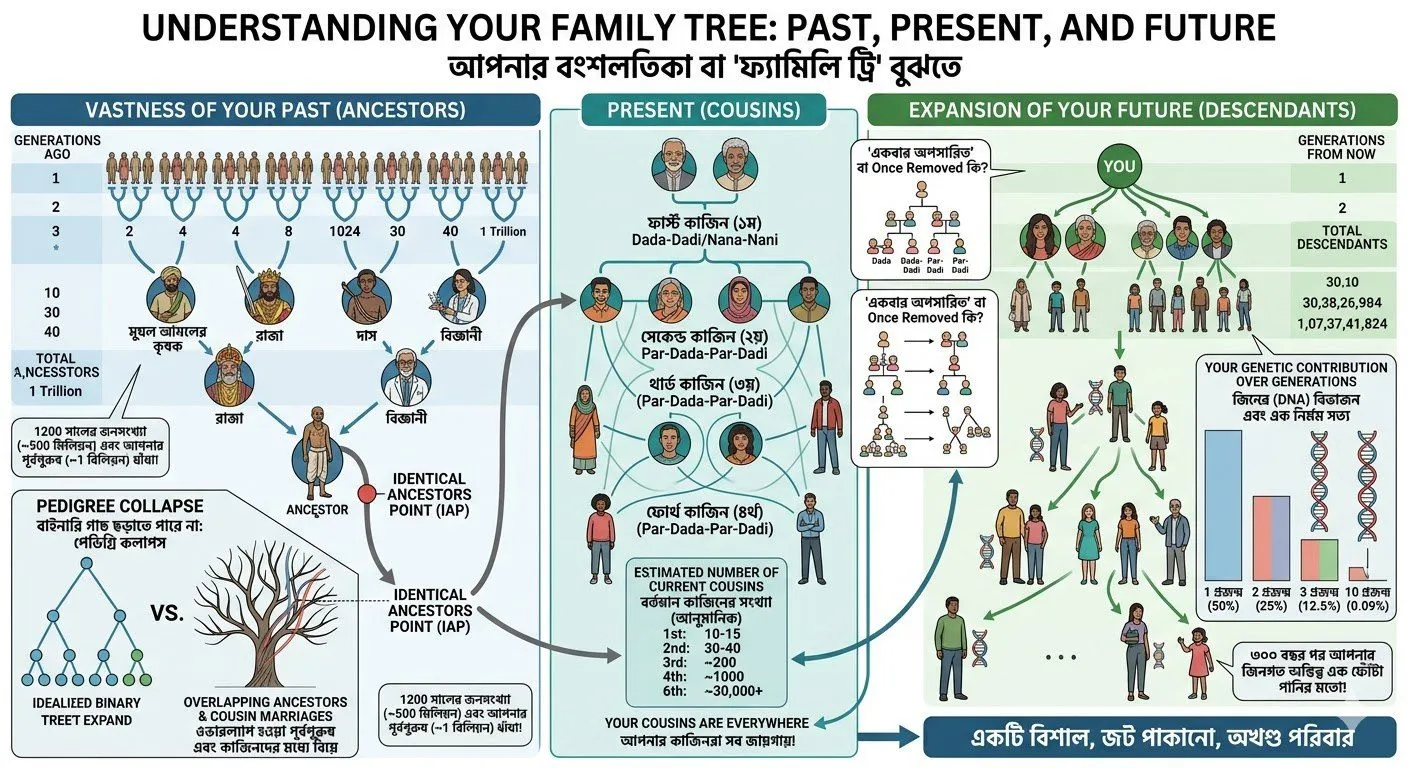
Move back one more generation: both of your parents had two parents, giving you four grandparents. In the generation prior, those four individuals each had two parents, yielding eight great-grandparents. With every generation you step backward, your theoretical ancestors double:
- 1 generation ago: 2 ancestors (parents)
- 2 generations ago: 4 ancestors (grandparents)
- 3 generations ago: 8 ancestors (great-grandparents)
- 4 generations ago: 16 ancestors
- 5 generations ago: 32 ancestors
- 12 generations ago (~300 years, circa 1700): 4,096 ancestors
Consider the poetic gravity of that number: just three centuries ago, roughly 4,096 distinct human beings walked the earth whose bloodlines converged to create you. If even one of those 4,096 individuals had died in childhood, chosen a different partner, or missed a scheduled ship, your unique genetic sequence would never have come into being.
The Mind-Bending Mathematical Paradox
While geometric doubling appears straightforward initially, pushing the calculation further into the past triggers an impossible mathematical paradox:
- 15 generations ago (~400 years): 32,768 ancestors
- 20 generations ago (~500 years): 1,048,576 ancestors
- 30 generations ago (~800 years, circa 1200): Over 1.07 billion ancestors
- 40 generations ago (~1,000 years, circa 1000): Over 1 trillion ancestors!
Here the arithmetic shatters against historical reality. In the year 1200, the entire human population of planet Earth was barely 400 to 500 million people. In 1000, it was smaller still. How could you personally possess one trillion ancestors a millennium ago when fewer than three hundred million humans were alive on Earth? Where does the math go wrong?
Pedigree Collapse: When Family Branches Intertwine
The resolution to this paradox is a fundamental demographic principle known as pedigree collapse. Your family tree is not an ever-expanding tree; rather, it resembles a diamond whose upper branches loop back and fuse together. The explanation is simple: your ancestors repeatedly intermarried with distant cousins.
Throughout most of human history, transport was limited. Most people lived, married, and died within a ten-mile radius of their birthplace, marrying individuals from neighboring villages. Without knowing it, they frequently wed distant third, fourth, or fifth cousins. Because they shared common ancestors, the same historical individuals occupy hundreds or thousands of different positions in your genealogical tree. Rather than expanding exponentially into trillions, your family tree contracts to match the actual historical population of the planet.
The Identical Ancestors Point
This leads directly to one of the most astonishing theorems in mathematical genealogy: the Identical Ancestors Point (IAP). Geneticists calculate that if you journey back roughly 3,000 to 4,000 years, you reach a horizon where every person alive at that time whose lineage survived is the common ancestor of every single human being living today.
If an individual living in 1500 BCE left descendants who survived into modern times, then King Tutankhamun, Confucius, ancient Amazonian hunters, and Celtic villagers are equally the direct biological ancestors of you, your neighbor, and everyone across the globe. All of humanity shares the exact same ancestral pool.
Part 2: The Modern Maze of Cousins
What does this geometric kinship mean for our contemporary world? Most of us understand immediate first cousins (sharing grandparents), second cousins (sharing great-grandparents), and third cousins (sharing great-great-grandparents). We also encounter the designation “once removed,” which simply denotes a one-generation offset.
If we calculate average historic birth rates across generations, the statistical prevalence of cousins living right now is staggering:
- First cousins: 5 to 15 individuals
- Second cousins: 25 to 50 individuals
- Third cousins: ~200 individuals
- Fourth cousins: ~1,000 to 1,500 individuals
- Fifth cousins: ~5,000 individuals
- Sixth cousins: ~30,000 individuals
Whenever you navigate a crowded airport, commute on a subway, or attend a stadium concert, you are constantly passing by third, fourth, or fifth cousins. In truth, no human being on Earth is a stranger: every person you encounter is, at most, your fifteenth or twentieth cousin.
Part 3: The Future and the Dilution of DNA
Now invert your perspective. Stand at the apex of the family tree and look forward into the future. You have children, who have children of their own. Within three centuries, your descendants may number in the thousands.
Yet population genetics reveals a sobering biological reality: genetic inheritance halves with every generation. Your child inherits 50% of your DNA; your grandchild inherits 25%; by the tenth generation, a descendant carries barely 0.09% of your genome. In three hundred years, your thousands of direct descendants will carry virtually no detectable trace of your DNA. In the vast genetic river of humanity, individual genomes disperse like drops of water in an ocean. We are temporary custodians of a collective genetic stream.
The Universal Kinship of Humankind
Tim Urban’s genealogical journey is far more than recreational mathematics—it is a profound philosophical truth. Human societies have divided themselves along ethnic, national, racial, and ideological boundaries for centuries, waging wars over constructed differences. Yet mathematical genetics proves that these divisions are fragile illusions. Biologically, the entire human species is one vast, ancient, intricately connected family. Our roots are shared, our present is entangled, and our future branches from the same living tree.