Black Hole Collision Light: A Historic Cosmic Flare
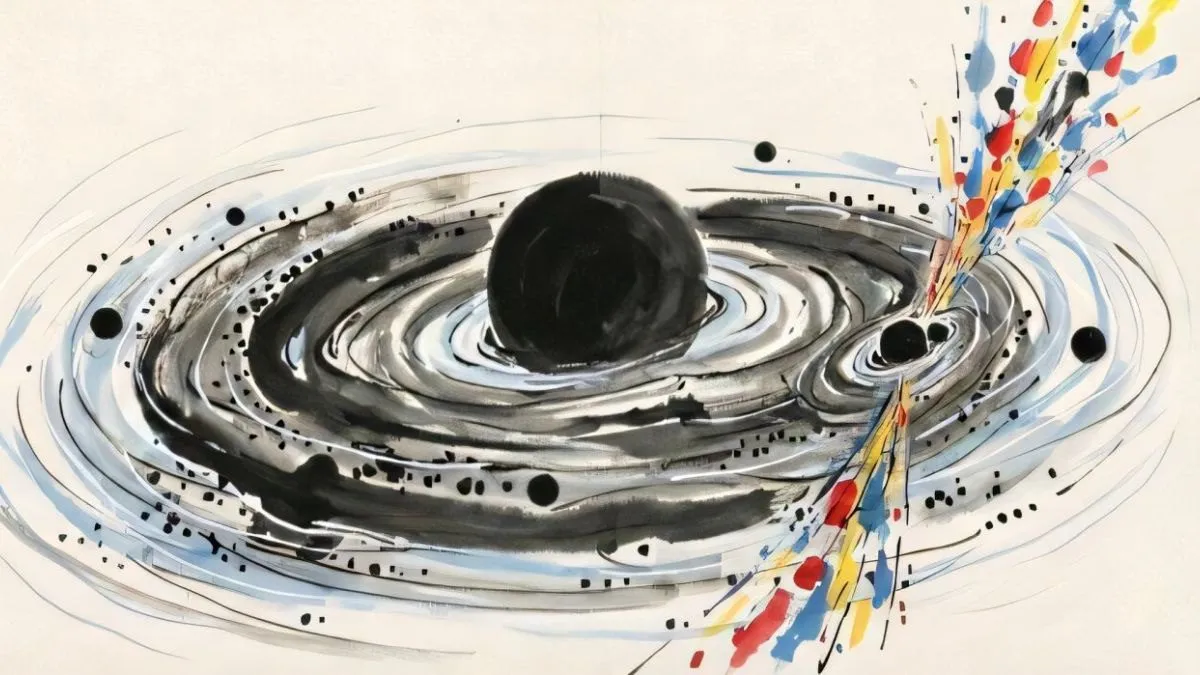
A cardinal rule of astrophysics has long held that black holes emit no light. Their gravitational pull is so intense that not even photons can escape past the event horizon. When two black holes collide in the dark expanse of space, the resulting cataclysm is among the most violent events in the cosmos—yet conventional wisdom assumed it unfolded in absolute optical darkness, silent and invisible.
Recently, that fundamental assumption was shattered. Terrestrial and orbital telescopes detected a dazzling flash of high-energy light directly accompanying a black hole collision. Astounded astrophysicists scrambled to decipher the riddle: how could two voracious cosmic voids produce brilliant radiation during their merger? The investigation has revealed an astonishing environment at the hearts of distant galaxies.
Ripples Across the Fabric of Spacetime
To appreciate this discovery, one must understand how astronomers detect black hole collisions. Before 2015, observing the cosmos relied entirely on electromagnetic radiation: radio waves, optical light, X-rays, and gamma rays. Because black holes do not emit light, observing their mergers remained impossible until the advent of gravitational wave astronomy.
General relativity predicts that when two massive bodies orbit each other at relativistic speeds and coalesce, they churn the fabric of spacetime, radiating ripples outward like waves in a pond: gravitational waves. In 2015, the Laser Interferometer Gravitational-Wave Observatory (LIGO) made history by detecting gravitational waves for the first time. Since then, the LIGO-Virgo-KAGRA collaboration has cataloged hundreds of black hole mergers—all universally devoid of any accompanying electromagnetic flash.
Migration Traps in Galactic Centers
The solution to this optical riddle lies in the chaotic hearts of active galaxies. Supermassive black holes weighing millions or billions of solar masses sit at galactic centers, encircled by dense, churning accretion disks of gas, interstellar dust, and stellar debris.
Astrophysicists describe these dense accretion disks as natural “migration traps” for smaller stellar-mass black holes. The disk’s thick gas acts like viscous fluid: as smaller black holes orbit through it, aerodynamic gas drag bleeds away their orbital momentum, pulling them inward toward specific orbital resonances where gravitational torques and drag balance out. This creates a celestial traffic jam where numerous black holes congregate, dramatically elevating the probability of violent collisions.
November 25, 2024: Breaking the Cosmic Rules
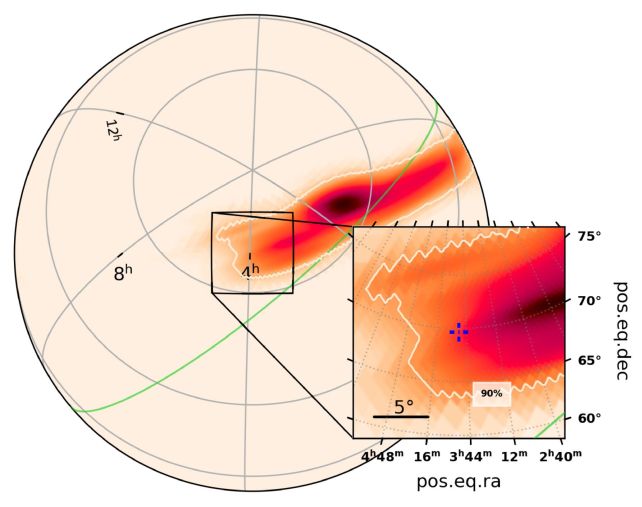
On November 25, 2024, gravitational waves from a merger 4.2 billion light-years away washed over the LIGO and Virgo detectors. Designated event S241125n, the signal revealed the coalescence of two intermediate black holes forming a single remnant approximately 150 times the mass of the Sun. But eleven seconds later came an unprecedented surprise.
Space-based X-ray and gamma-ray telescopes detected a fierce flare of radiation erupting from the precise patch of sky where the gravitational waves originated. Statistical calculations revealed that the probability of such an electromagnetic burst aligning coincidentally with the gravitational wave event by sheer chance was less than once in thirty years. The merger had undeniably radiated light.
The Natal Kick: Hurling a Newborn Giant
An international astrophysics team led by Shu-Rui Zhang at the University of Science and Technology of China provided the breakthrough explanation. The secret lies in a relativistic phenomenon known as the “natal kick.”
When two black holes of unequal masses or misaligned spins merge, the emission of gravitational waves is asymmetrical. To conserve linear momentum, the newly formed remnant black hole receives an immense recoil velocity—the natal kick—rocketing through space at thousands of kilometers per second like a bullet fired from a rifle.
Igniting the Ambient Gas
Plunging at hypersonic velocities into the dense surrounding gas of the supermassive black hole’s accretion disk, the newborn black hole voraciously accretes the ambient matter. As gas funnels inward under crushing gravitational forces, intense friction heats the infalling matter to billions of degrees, generating searing X-rays and gamma rays. Unable to swallow the torrential inflow of gas all at once, the spinning black hole funnels surplus plasma along its magnetic axes, blasting relativistic astrophysical jets into space. It was this energetic beam of radiation that traversed 4.2 billion light-years to reach our telescopes.
Anticipating a Second Flare
The drama is far from over. Bound within the gravitational grip of the host galaxy’s central supermassive black hole, the runaway remnant remains in a tilted eccentric orbit. Astrophysicists predict that within a few years, its trajectory will plunge it back through the accretion disk, triggering another blinding accretion flare. Observing this second flash would provide triumphant confirmation of the model.
A New Era in Multi-Messenger Astronomy
This discovery marks a watershed milestone for multi-messenger astrophysics: hearing the spacetime tremor with gravitational wave interferometers while simultaneously observing its electromagnetic signature through space telescopes. It proves that within the dynamic environments of galactic cores, nature orchestrates spectacular cosmic firework displays from the union of darkness itself.