Gifts of Dead Stars: The Cosmic Origin of Gold
Where Did Elements Like Gold, Platinum, and Uranium Come From?
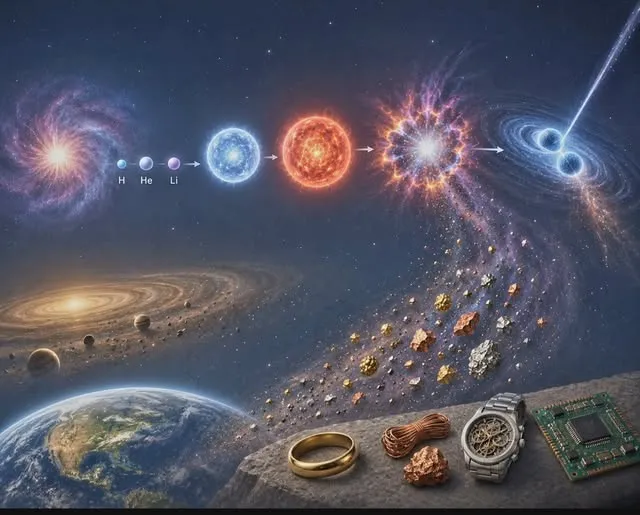
Have you ever wondered about the birthplace of the gold ring on your finger, the copper in computer circuits, or the silver gears inside a wristwatch?
Extraordinary as it sounds, most of these metals were not born on Earth. Nor were they synthesized inside our Sun. Their origins trace back to violent cosmic detonations across deep space.
At the dawn of the universe, the Big Bang produced almost exclusively hydrogen, helium, and trace amounts of lithium. Heavy elements like iron, gold, uranium, and lead did not exist.
In time, the first generation of stars ignited. Under the intense heat and crushing pressure of their stellar cores, hydrogen fused into helium, helium into carbon, oxygen, and silicon—sequentially building heavier nuclei. Yet stellar fusion halts at iron. Fusing elements heavier than iron consumes energy rather than releasing it, setting an ultimate boundary on ordinary stellar furnaces.
The Answer Lies in Stellar Death
When a massive star exhausts its core fuel, it ends its life in a cataclysmic supernova explosion. In fractions of a second, an immense flux of free neutrons floods the blast. Atomic nuclei capture these neutrons in rapid succession before radioactive decay can occur, building up heavy elements. This mechanism is known as rapid neutron capture, or the r-process.
For decades, astrophysicists assumed supernovae were the primary source of Earth’s heavy elements. Recent observations, however, revealed an even more dramatic mechanism.
In 2017, astronomers detected gravitational waves from the collision of two neutron stars. The kilonova explosion ejected vast quantities of neutron-rich matter into space, creating immense reservoirs of gold, platinum, and other heavy metals. Many researchers now conclude that much of the gold in our universe originated in colliding neutron stars rather than standard supernovae.
Gifts from Dead Stars
Every gold nugget mined from Earth’s crust was likely forged in the thermonuclear fire of colliding dead stars. Roughly 4.6 billion years ago, interstellar dust and gas enriched by countless ancient cosmic explosions condensed to form our Sun and planets. The iron in our blood, the calcium in our bones, and the gold around our fingers are all physical gifts from long-dead stars.
As astronomer Carl Sagan famously remarked, “We are made of star stuff.”
It is true in the most literal sense. We are not merely children of the Earth; we carry the tangible legacy of ancient dead stars.