AWD: Slashing Methane in Rice Cultivation
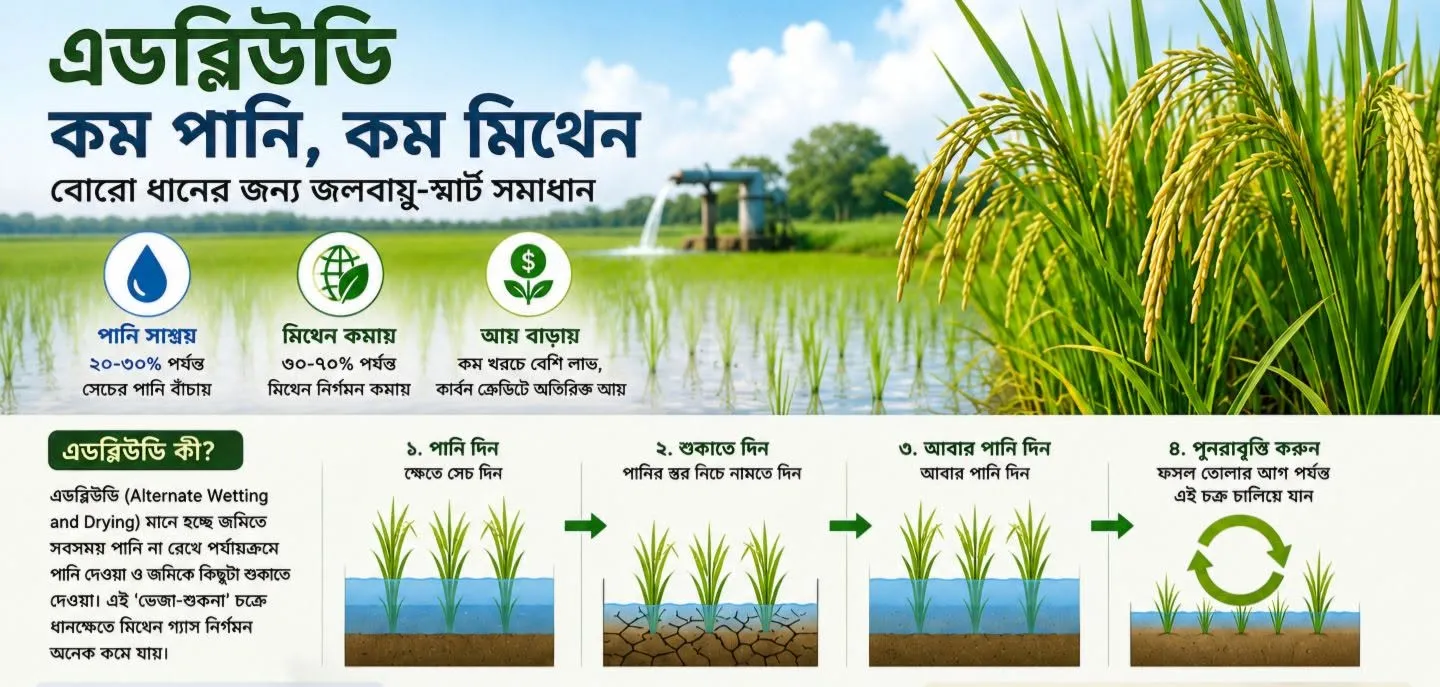
In Bangladesh, the Boro season is synonymous with irrigated rice cultivation. Water is a farmer’s primary lifeline, kept standing in the paddies almost continuously. In the eyes of a farmer, flooded fields offer peace of mind: the soil stays moist, weeds are suppressed, and crops thrive. Yet this traditional approach carries an unseen environmental cost: methane emissions.
The AWD Method: Mitigating Methane in Rice Paddies
Flooded rice paddies are among the largest anthropogenic sources of atmospheric methane. When fields remain continuously submerged, oxygen is depleted in the waterlogged soil. In this anaerobic environment, specialized methanogenic microbes break down organic matter and generate methane gas, which bubbles up into the atmosphere. Methane’s heat-trapping capacity in the atmosphere is roughly thirty times greater than carbon dioxide, making it a potent greenhouse gas.
A practical solution to this challenge is Alternate Wetting and Drying (AWD). Rather than keeping fields submerged continuously, water is applied, the field is allowed to dry for several days until oxygen re-enters the soil, and irrigation is reapplied. This cyclic irrigation rhythm is known as AWD.
The Benefits: Conserving Water and Protecting Climate
When the soil dries out temporarily, oxygen penetrates the root zone, sharply suppressing anaerobic methane production. Field studies demonstrate that AWD can reduce methane emissions by 30 to 70 percent, while saving 20 to 30 percent of irrigation water. It achieves a triple win: saving water, cutting fuel and electricity costs, and reducing greenhouse emissions.
Challenges and Opportunities: Mindsets and Agronomy
Rice scientists in Bangladesh have championed AWD for years. In the northern regions where groundwater tables are dropping rapidly, AWD offers a vital water-conservation tool.
However, agronomists caution that AWD is not a one-size-fits-all remedy. Soil texture, land topography, and irrigation control must be carefully factored in; drying fields at sensitive crop stages like flowering can reduce grain yields.
Another major obstacle is farmer psychology. For generations, farmers have equated flooded fields with security. Seeing dry, cracked soil naturally triggers anxiety. Overcoming this cultural barrier requires training and demonstrable proof.
Yet agriculture is changing. Farmers are evaluated not only on gross harvest tonnage, but also on their carbon footprint. If rice farming integrates into voluntary carbon markets, AWD could transform from a simple water-saving tactic into a direct source of supplemental income.
Future Agriculture: Carbon Markets and New Revenues
This economic dimension is compelling. By verifying methane reductions under AWD protocols, farmers can participate in carbon credit mechanisms. Estimates suggest that one hectare of Boro paddy managed under AWD can avoid roughly one tonne of carbon dioxide equivalent annually—amounting to approximately one carbon credit.
Future agriculture must feed humanity while restoring planetary balance. Sustainable farming unites three imperatives: producing food, sequestering carbon, and preserving ecosystems. In that paradigm, farmers will not merely grow food; they will help protect the planet’s climate.