The Central Dogma: The Epic Journey from DNA to Protein
The Blueprint, the Messenger, and the Engine of Life
To understand the molecular machinery of life, one must examine the harmonious cooperation of three foundational biological macromolecules: DNA, RNA, and protein. Deoxyribonucleic acid (DNA) functions as the master hereditary vault, archiving genetic instructions within its helical sequences. Yet DNA cannot directly execute cellular metabolic work. Information must be transcribed into ribonucleic acid (RNA) and translated into functional proteins.
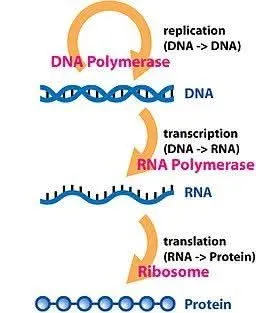
First articulated by Francis Crick in 1957, this universal flow of genetic information constitutes the central dogma of molecular biology:
- DNA replicates its information and directs the transcription of RNA.
- RNA directs the translation and assembly of amino acids into functional proteins.
The Cellular Factory: Information Transfer in Action
In eukaryotic cells, chromosomal DNA resides within the protected interior of the cell nucleus. When a specific structural protein or metabolic enzyme is required, the tightly coiled chromatin unwinds at a target locus, allowing RNA polymerase to synthesize a single-stranded messenger molecule: messenger RNA (mRNA).
The mRNA serves as a mobile working copy of the genomic blueprint. It exits the nucleus through nuclear pores into the cytoplasm, docking at molecular manufacturing complexes called ribosomes.
Ribosomes are composed of ribosomal RNA (rRNA) and catalytic proteins. In the ribosome, transfer RNA (tRNA) molecules act as molecular adapters, ferrying specific amino acids and matching their anticodon loops to the corresponding codons on the mRNA template.
RNA Processing and Post-Transcriptional Regulation
The primary transcript (pre-mRNA) synthesized from DNA requires extensive processing before translation. Non-coding intervening sequences known as introns are excised, while coding sequences called exons are ligated together by the spliceosome complex, a mechanism mediated by small nuclear RNA (snRNA).
Regulatory non-coding RNAs—including microRNAs (miRNAs) and small interfering RNAs (siRNAs)—bind to complementary sequences on target mRNAs to repress translation or induce degradation, fine-tuning gene expression dynamically in response to metabolic demands.
Transcription and Translation: Precision Molecular Translation
The central dogma executes information transfer in two sequential stages:
- Transcription: RNA polymerase unzips the DNA double helix, reading the template strand in the $3′ \to 5’$ direction to synthesize a complementary single-stranded pre-mRNA molecule in the $5′ \to 3’$ direction.
- Translation: Inside the ribosome, mRNA codons are read sequentially. Each tRNA delivers its designated amino acid, forming covalent peptide bonds to assemble an elongated polypeptide chain that subsequently folds into a functional three-dimensional protein.
The Genetic Code: Nature’s Universal Alphabet
The language of genetics utilizes an alphabet of four nucleotide bases: Adenine (A), Uracil (U; Thymine in DNA), Guanine (G), and Cytosine (C). Read in triplet groupings called codons, there are $4^3 = 64$ possible permutations.
Among these, $61$ codons specify the $20$ standard canonical amino acids, while $3$ codons (UAA, UAG, UGA) serve as stop signals terminating translation. A universal start codon (AUG) establishes the open reading frame and codes for methionine.
The RNA World and Modern Biotechnological Frontiers
Evolutionary biologists propose that early life operated in an “RNA World,” where versatile RNA molecules performed both genetic data storage and biochemical catalysis prior to the evolution of DNA and specialized proteins.
Today, mastery of the central dogma underpins revolutionary medical technologies. The rapid development of mRNA vaccines against SARS-CoV-2, CRISPR-Cas9 targeted genome editing, and RNA interference therapies all derive from our fundamental understanding of this molecular flow of life.