Synthetic Biology Breakthrough: Creating Artificial Starch from CO2
The Fundamental Role of Starch in Global Nutrition
Starch represents the primary dietary source of caloric energy for human civilization and animal biology. A complex polymeric carbohydrate composed of amylose and amylopectin, starch supplies the glucose molecules metabolized by living cells into ATP. Yet, animals lack the biochemical machinery to synthesize carbohydrates directly from elemental inorganic components. Instead, the animal kingdom depends entirely upon the plant world.
Through natural photosynthesis, green vegetation utilizes sunlight to convert atmospheric carbon dioxide ($\text{CO}_2$) and water into simple carbohydrates, packaging them into insoluble starch granules inside plastids. However, natural photosynthetic efficiency is remarkably low, typically converting less than $1\%$ to $2\%$ of absorbed solar energy into stored biomass.
The Challenge of In Vitro Chemical Synthesis
For decades, synthetic biochemists have pursued a seemingly impossible objective: can humanity synthesize starch directly from industrial carbon dioxide without cultivating agricultural crops? Because starch is a stereo-chemically complex macromolecule with intricate branching architecture, recreating its synthesis outside a living cell presented immense scientific barriers.
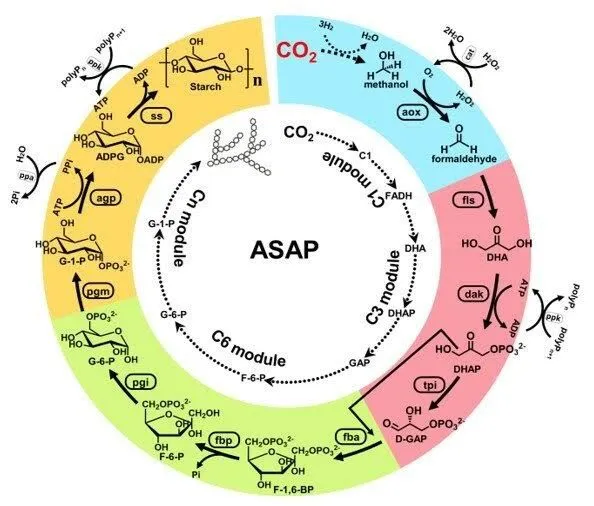
A transformative breakthrough occurred when researchers at the Tianjin Institute of Industrial Biotechnology, Chinese Academy of Sciences (CAS), successfully constructed a non-natural chemoenzymatic system capable of producing synthetic starch directly from gaseous $\text{CO}_2$. They designated this platform the Artificial Starch Anabolic Pathway (ASAP).
How the ASAP Pathway Works: An 11-Step Cascade
The ASAP system bridges inorganic catalytic chemistry and engineered biological enzymes across an eleven-step core reaction cascade:
- Chemical Reduction to Methanol: Atmospheric or industrial carbon dioxide is initially captured and hydrogenated using an inorganic chemical catalyst, converting $\text{CO}_2$ into single-carbon ($C_1$) methanol.
- Chemoenzymatic Carbon Condensation: Engineered enzymes then condense the $C_1$ methanol intermediates into three-carbon ($C_3$) dihydroxyacetone molecules.
- Sugar Polymerization: Downstream biocatalytic steps assemble $C_3$ metabolites into six-carbon ($C_6$) hexoses (glucose-6-phosphate), which are subsequently polymerized into high-molecular-weight amylose and amylopectin starch polymers.
Remarkably, the entire sequence occurs within an in vitro reactor without cellular membranes or intact plant tissues. Through directed protein evolution and genetic engineering, the researchers optimized rate-limiting enzymes to ensure rapid kinetic throughput.
Superior Efficiency and Global Food Security
Laboratory evaluations indicate that the catalytic efficiency of this artificial starch system is approximately $8.5$ times higher than conventional corn photosynthesis. The resulting synthetic starch exhibits chemical and molecular signatures identical to natural plant-derived starch.
This achievement offers profound implications for sustainable agriculture and climate resilience:
- Drastic Land and Water Conservation: If commercialized at industrial scale, synthetic starch synthesis could theoretically reduce agricultural land and freshwater requirements for starch production by more than $90\%$.
- Closed-Loop Carbon Utilization: Transforming captured greenhouse gases directly into staple food carbohydrates provides a dual solution for industrial decarbonization and caloric food production.
Conclusion
The development of artificial starch through the ASAP pathway represents a milestone in synthetic biology. By liberating food production from arable land and seasonal climate constraints, in vitro metabolic engineering points toward a resilient agricultural paradigm for the future.