Bose-Einstein Condensate: The Fifth State of Matter and Bose's Legacy
The Classical States of Matter and Thermal Energy
In classical physics, matter is traditionally classified into three familiar macroscopic states: solid, liquid, and gas. A solid possesses a definite volume and rigid geometric shape, resisting deformation under moderate shear stress. In contrast, liquids maintain a fixed volume but deform readily to match their container. Gases possess neither fixed shape nor constant volume, expanding dynamically to fill any available space.
These macroscopic phase transitions are governed by thermodynamic kinetic energy. In a crystalline solid, constituent atoms or molecules are locked in tight lattice arrays by chemical bonds. As thermal energy increases, atomic vibrations overcome intermolecular forces, inducing a phase shift into fluid liquid. Higher temperatures impart kinetic velocities sufficient to break cohesive forces entirely, transitioning the substance into the gaseous state.
The Fourth State: Plasma
When gaseous matter is heated to extreme thermal thresholds—thousands or millions of degrees—thermal collisions strip valence electrons from atomic nuclei. This yields a highly conductive, ionized gas composed of free electrons and positive ions. Termed plasma, this fourth state of matter dominates the visible cosmos, powering the thermonuclear cores of stars and permeating the interstellar medium.
The Fifth State: Bose-Einstein Condensate
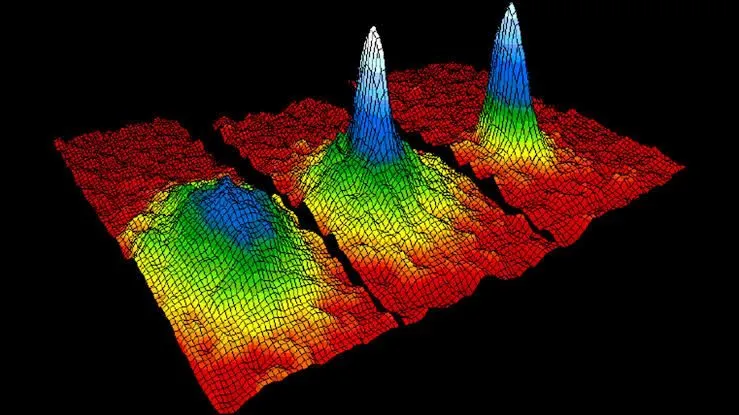
At the opposite extreme of the temperature scale lies a far stranger physical regime. When matter is cooled to within fractions of a microkelvin above absolute zero, atomic individuality dissolves into a collective quantum phenomenon known as the Bose-Einstein condensate (BEC), the fifth state of matter.
Satyendra Nath Bose and Albert Einstein: The Theoretical Genesis
The theoretical foundation of this quantum state began in 1924 in Dhaka, where Bengali physicist Professor Satyendra Nath Bose derived Planck’s quantum radiation law from purely statistical principles without invoking classical electrodynamics. Bose treated light photons as indistinguishable relativistic particles with integer spin.
When an initial submission was rejected by the Philosophical Magazine, Bose sent his English manuscript directly to Albert Einstein in Berlin. Recognizing its genius, Einstein translated the paper into German for publication in the Zeitschrift für Physik. Einstein quickly generalized Bose’s statistical framework from massless photons to massive atoms possessing integer spin, predicting that below a critical temperature, a collection of non-interacting particles would spontaneously drop into the lowest possible quantum ground state, coalescing into a single macroscopic super-atom.
Experimental Creation and the 2001 Nobel Prize
Because the required critical temperatures lie mere nanokelvins above absolute zero ($0\text{ K} = -273.15^\circ\text{C}$), generating a Bose-Einstein condensate remained experimentally elusive for seven decades. In 1995, physicists Eric Cornell and Carl Wieman at JILA (NIST/University of Colorado Boulder) produced the first atomic BEC in a dilute vapor of rubidium-87 atoms. Shortly thereafter, Wolfgang Ketterle achieved condensation in sodium-23 at MIT. For this triumph, Cornell, Wieman, and Ketterle were awarded the 2001 Nobel Prize in Physics.
The Physics of Cryogenic Macroscopic Coherence
Creating a condensate requires sophisticated optical and magnetic cooling techniques:
- Laser Cooling: Counter-propagating laser beams tuned slightly below atomic resonances exert radiation pressure on atoms, decelerating their thermal velocities to microkelvin levels in an “optical molasses.”
- Magnetic Trapping and Evaporative Cooling: Decelerated atoms are held in magnetic potential wells, where the highest-energy particles are selectively allowed to escape, lowering the remaining cluster’s temperature to nanokelvins.
According to the de Broglie hypothesis, every particle exhibits wave-particle duality with wavelength $\lambda = h/p$. As temperature approaches absolute zero, thermal momentum $p$ drops, causing the thermal de Broglie wavelength to stretch. When atomic spacing matches this de Broglie wavelength, individual matter waves overlap constructively. The atoms lose individual identity, behaving as a single macroscopic quantum wave packet governed by a single wave function.
Technological Applications of BEC
The discovery and manipulation of Bose-Einstein condensates have paved the way for advanced quantum technologies:
- Atom Lasers: Emitting coherent beams of propagating matter waves for ultra-high-resolution nanoscale lithography and surface metrology.
- Precision Gravimetry and Atomic Clocks: Leveraging matter-wave interferometry to detect minute variations in Earth’s gravitational field and mineral deposits.
- Quantum Simulation: Modeling complex condensed-matter physics, high-temperature superconductivity, and superfluid dynamics under controlled laboratory conditions.
The Enduring Legacy of Satyendra Nath Bose
Although Satyendra Nath Bose never received a Nobel Prize despite multiple nominations, his scientific legacy is permanently woven into the lexicon of modern physics. In the Standard Model, all fundamental particles in the universe are divided into two fundamental families: fermions (matter constituents obeying the Pauli exclusion principle, named after Enrico Fermi) and bosons (force carriers obeying Bose-Einstein statistics, named in honor of Satyendra Nath Bose). From the photon and gluon to the Higgs boson, the discoveries inspired by Bose’s vision continue to shape our understanding of the cosmos.