Cosmic Microwave Background: Discovering the Echo of the Big Bang
The Great Cosmological Debate
During the mid-twentieth century, cosmology was split into two rival camps. The Steady State theory, championed by Fred Hoyle, posited an eternal, unchanging universe where new matter continuously forms as galaxies separate. Conversely, the Big Bang theory, originating from Georges Lemaître and George Gamow, proposed that the cosmos erupted from an unimaginably hot, dense primordial singularity billions of years ago.
For decades, neither model possessed definitive observational proof. That stalemate ended dramatically in 1964 in Holmdel Township, New Jersey.
The Holmdel Horn Antenna and the Persistent Hiss
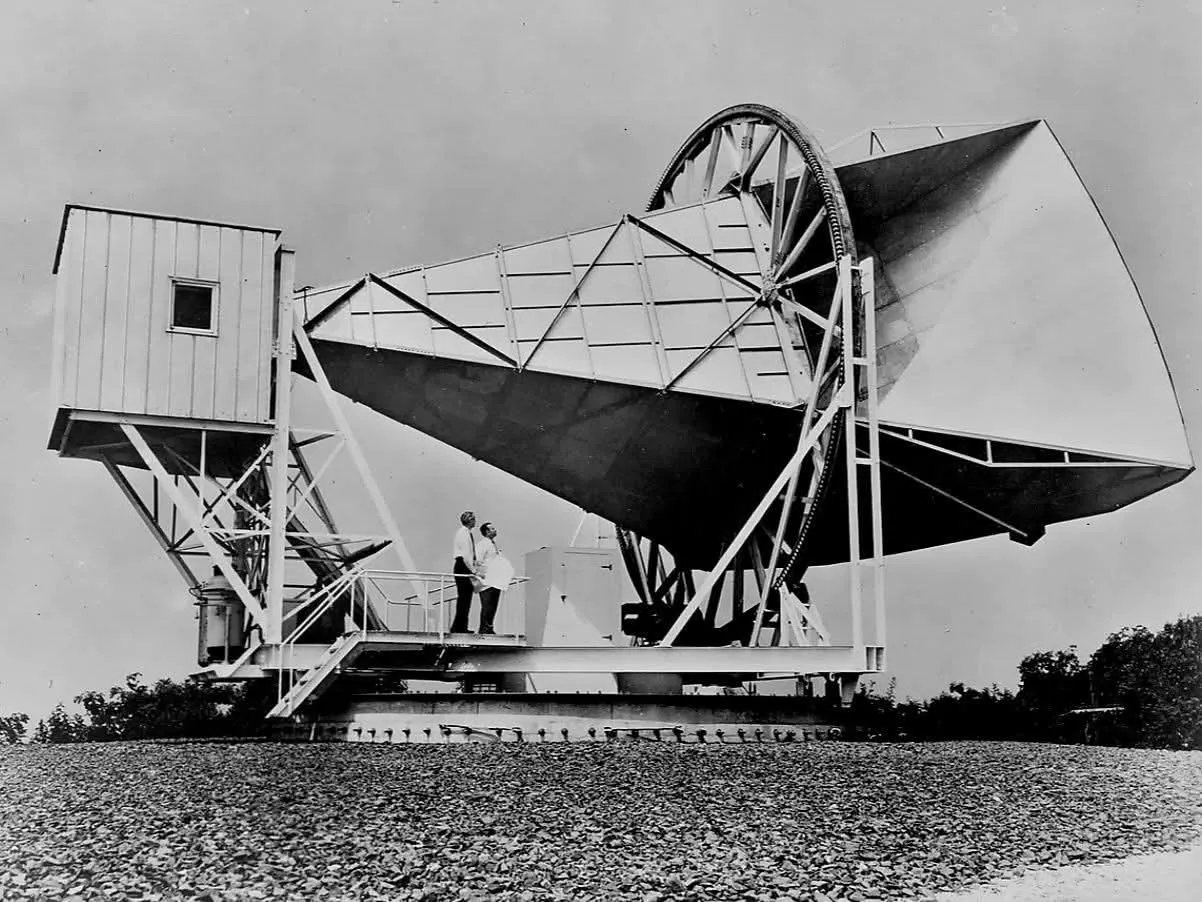
At Bell Telephone Laboratories, radio astronomers Arno Penzias and Robert Wilson were conducting sky surveys using a massive, 20-foot horn-reflector antenna originally built for satellite telecommunications. Their objective was to measure galactic radio emissions from the Milky Way.
To their frustration, the antenna detected a persistent, isotropic background hiss operating at microwave frequencies (wavelength 7.35 cm). The mysterious noise remained constant regardless of the direction the antenna was pointed, whether day or night, summer or winter. Systematically troubleshooting, the researchers replaced electronic components, recalibrated circuits, and even scrubbed the antenna interior to remove nesting pigeons and droppings (“white dielectric material”). Yet the uniform background hiss persisted unabated.
The Princeton Connection: The Ancient Relic Found
Thirty miles away at Princeton University, a team of theoretical astrophysicists led by Robert Dicke, Jim Peebles, and David Wilkinson was actively preparing an experiment to detect the relic radiation of the Big Bang. Their calculations predicted that if the universe originated in a hot fireball, primordial thermal radiation would have cooled through cosmic expansion to approximately 3 Kelvin, manifesting as a uniform microwave glow across the sky.
When Penzias contacted Dicke to discuss their puzzling antenna noise, Dicke famously turned to his colleagues and said, “Boys, we’ve been scooped.” The Bell Labs astronomers had inadvertently discovered the Cosmic Microwave Background (CMB)—the thermal fossil of the infant universe.
The Ancient Light: Recombination Era
The CMB represents the oldest electromagnetic radiation in the cosmos, dating back to 380,000 years after the Big Bang (the Recombination Era). Prior to this epoch, temperatures exceeded 3,000 Kelvin, ionization kept free electrons scattering photons, and the universe was an opaque plasma fog.
As the universe expanded and cooled below 3,000 K, protons captured electrons to form neutral hydrogen atoms. Photons were suddenly free to travel unimpeded through space. Over 13.8 billion years of cosmic expansion, these primordial photons redshifted by a factor of 1,100, stretching from blinding visible light into invisible microwave radiation at $2.7255$ Kelvin.
Nobel Recognition and Modern Space Missions
Penzias and Wilson were awarded the 1978 Nobel Prize in Physics for their accidental discovery. In subsequent decades, NASA’s COBE, WMAP, and the European Space Agency’s Planck satellite mapped microscopic temperature fluctuations ($Delta T / T sim 10^{-5}$) within the CMB, revealing the primordial density seeds that grew into modern galaxy clusters.
Conclusion
The discovery of the Cosmic Microwave Background transformed cosmology from theoretical speculation into an empirical precision science, providing indisputable evidence that our universe was born in a fiery Big Bang.