General Relativity: The Historic Race Between Einstein and Hilbert
The Quest for a Geometric Theory of Gravity
Following his formulation of special relativity in 1905, Albert Einstein realized that his theory was incomplete. Special relativity applied strictly to unaccelerated inertial frames and was fundamentally incompatible with Sir Isaac Newton’s law of universal gravitation, which assumed instantaneous action at a distance.
Einstein embarked on an arduous decade-long intellectual journey to construct a comprehensive theory of gravitation. Guided by his Equivalence Principle—the realization that gravitational acceleration is indistinguishable from uniform mechanical acceleration—Einstein posited a revolutionary hypothesis:
- Gravity is not an invisible force pulling through empty space.
- Mass and energy warp the four-dimensional fabric of spacetime.
- Freely falling objects follow curved geometric trajectories (geodesics) through this warped spacetime.
To express this physical vision mathematically, Einstein needed sophisticated non-Euclidean differential geometry (Riemannian geometry and tensor calculus).
Enter David Hilbert: The Titan of Göttingen Mathematics
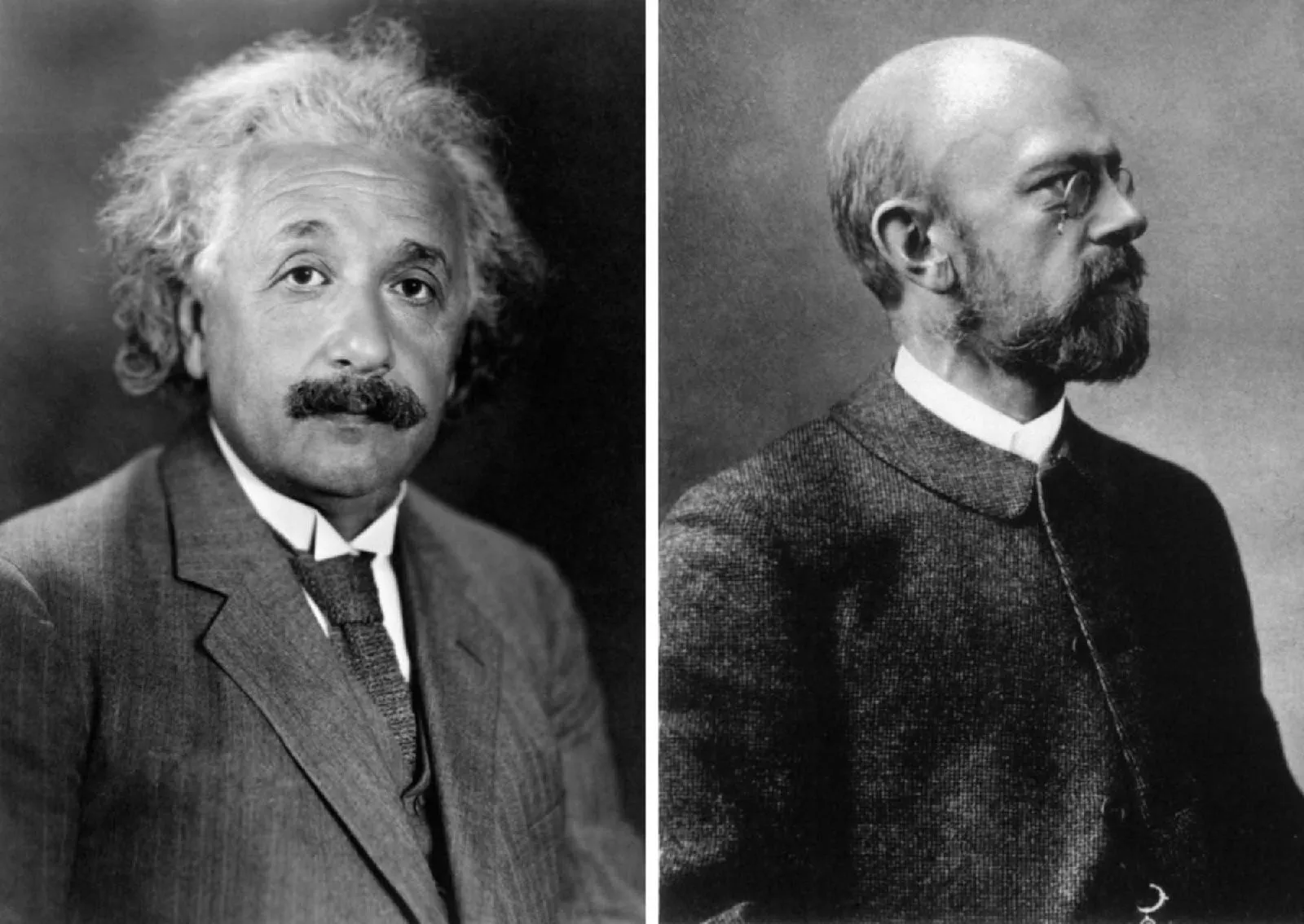
In the summer of 1915, Einstein delivered a series of lectures at the University of Göttingen. In the audience sat David Hilbert, widely regarded as the foremost mathematician of the era. Hilbert was fascinated by Einstein’s physical ideas and immediately recognized that gravitational field equations could be derived through the mathematical principle of least action.
What followed was an exhilarating intellectual contest between two brilliant minds: Einstein racing against time in Berlin, guided by physical intuition, and Hilbert in Göttingen, deploying variational calculus.
The Dramatic November of 1915
In November 1915, the race reached its climax:
- Albert Einstein: Delivered four consecutive weekly lectures before the Prussian Academy of Sciences in Berlin on November 4, 11, 18, and finally November 25, when he presented the correct gravitational field equations: $G_{\mu\nu} = \frac{8\pi G}{c^4} T_{\mu\nu}$.
- David Hilbert: Submitted his paper to the Royal Society of Sciences in Göttingen on November 20, five days before Einstein’s final lecture, deriving the field equations via the Einstein-Hilbert action ($S = \int (R + 2\kappa L_m) \sqrt{-g} d^4x$).
Mutual Respect and Historical Credit
While brief priority tensions flared between the two giants, mutual admiration and magnanimity prevailed. Hilbert generously and consistently accorded primary credit to Einstein, writing: “Every boy in the streets of Göttingen understands more about four-dimensional geometry than Einstein. Yet, despite that, Einstein did the work and not the mathematicians.”
History rightfully recognizes Albert Einstein as the father of general relativity because he discovered the profound physical principles, equivalence postulates, and relativistic cosmology, whereas Hilbert provided an elegant mathematical derivation of Einstein’s physical insight.
Conclusion
The collaborative convergence between Einstein’s physical vision and Hilbert’s mathematical elegance gave birth to general relativity, transforming our modern understanding of gravitational waves, black holes, and the expanding cosmos.