Special Relativity: The Overlooked Contributions of Poincaré and Einstein
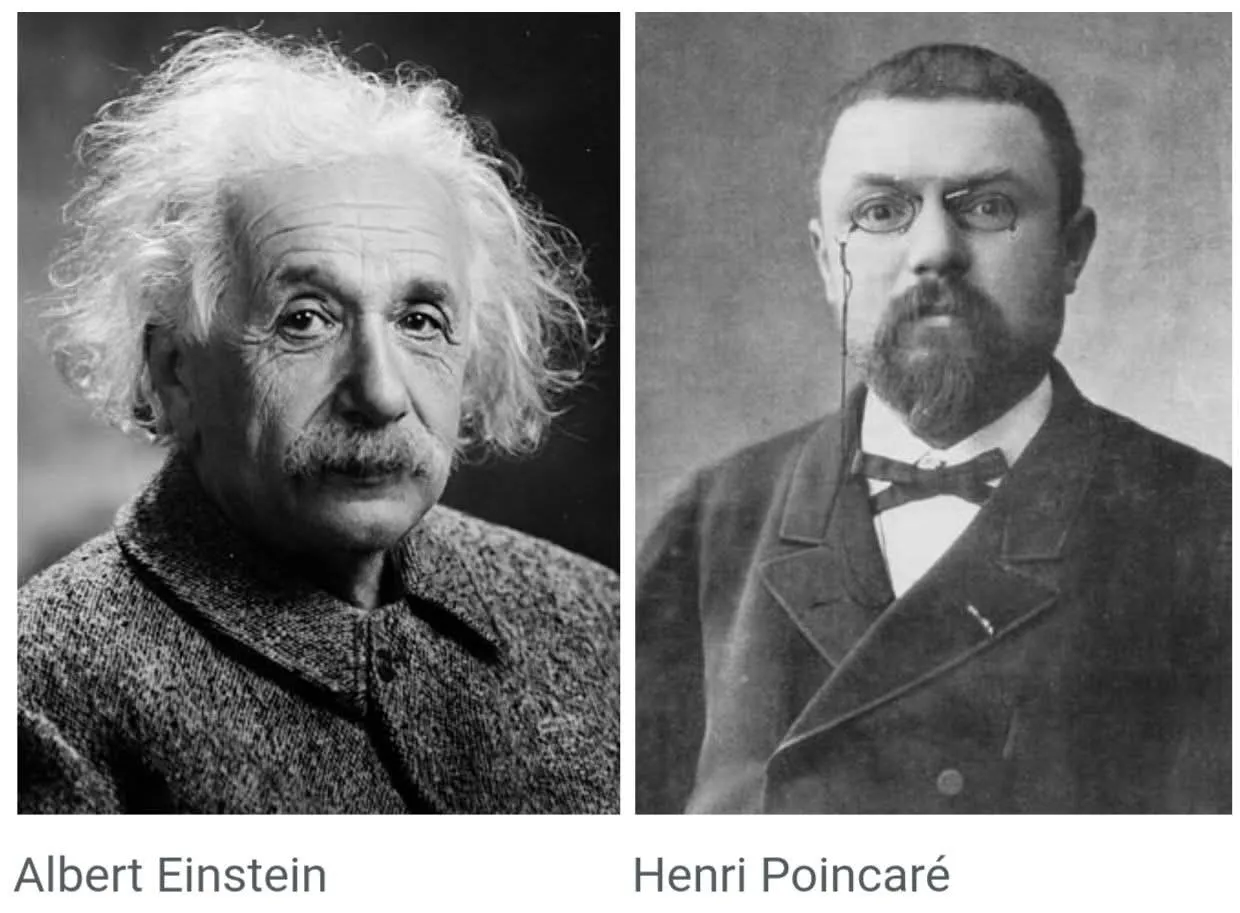
The Unsung Pioneer of Relativistic Time
In the closing years of the nineteenth century, French mathematical physicist and philosopher Henri Poincaré was engaged in profound reflections on the nature of physical time. Observing railway networks and telegraph synchronization, Poincaré raised a revolutionary question: if an event is observed by a passenger inside a speeding train and by a stationary bystander on a platform, do their clocks measure identical elapsed intervals?
Poincaré argued that absolute simultaneity is an unprovable physical assumption. In his seminal 1898 essay “La mesure du temps” (The Measure of Time), he asserted that time is a physical convention defined by exchanging light signals between observers. At the 1904 International Congress of Arts and Science in St. Louis, Poincaré formally articulated the Principle of Relativity: the laws of physical phenomena must be identical for an observer at rest and for an observer moving in uniform translation.
Lorentz Transformations and Mathematical Dynamism
In June 1905, Poincaré published a landmark paper titled “Sur la dynamique de l’électron” (On the Dynamics of the Electron). In this work, he corrected and completed the coordinate transformations previously formulated by Hendrik Lorentz, naming them the “Lorentz transformations.” Poincaré demonstrated that:
- Clocks in relative motion undergo apparent temporal retardation (time dilation).
- Moving bodies undergo spatial contraction in the direction of motion (length contraction).
- The speed of light ($c$) functions as an insurmountable velocity threshold in electrodynamics.
Despite these profound mathematical breakthroughs, Poincaré retained the classical concept of the luminiferous aether, viewing relativistic transformations primarily as dynamical deformations of electrons rather than intrinsic properties of spacetime itself.
Einstein’s 1905 Radical Reimagining
Three months later, in September 1905, an unknown twenty-six-year-old patent examiner in Bern, Switzerland, named Albert Einstein, published his foundational paper: “Zur Elektrodynamik bewegter Körper” (On the Electrodynamics of Moving Bodies). This paper established the Special Theory of Relativity.
Einstein approached the problem from pure foundational principles, declaring two universal postulates:
- The laws of physics are invariant across all inertial reference frames.
- The speed of light in a vacuum is a universal constant, independent of the motion of the emitting source.
With audacious simplicity, Einstein discarded the luminiferous aether as completely superfluous. Where Poincaré saw electrodynamic coordinate adjustments, Einstein recognized that space and time themselves are relative, elastic constructs.
Historical Verdict: Crafting the Final Architecture
While Einstein acknowledged the mathematical foundations laid by Lorentz, he arrived at his postulates through independent physical reasoning. The historical distinction between Poincaré and Einstein lies in conceptual scope:
- Poincaré: Approached relativity as a brilliant mathematical and philosophical modification of classical electrodynamics, hesitating to discard the underlying mechanical aether.
- Einstein: Elevated relativity into a universal kinematics governing all physical reality, fearlessly dismantling classical Newtonian mechanics.
Conclusion
History honors Henri Poincaré for standing at the very threshold of modern relativistic physics, but it celebrates Albert Einstein for courageously pushing open the door to reveal the true nature of special relativity to the world.