Quantum Reality: Are Physical Objects Merely Shadows of Probability?

The Classical Illusion of Static Matter
Human perception experiences the physical universe as a tangible collection of solid, independent objects. Tables, chairs, geological strata, and celestial bodies appear to possess objective, enduring boundaries. For centuries, classical physics affirmed this intuition, treating physical matter as immutable particles occupying definite coordinates across absolute space.
However, the conceptual revolution of quantum mechanics shattered this classical framework. At the fundamental level, the foundation of physical reality consists not of hard, isolated objects, but of an interconnected dance of probabilities and oscillating wave fields.
Professor Dennis Dieks and the Philosophy of Quantum Mechanics
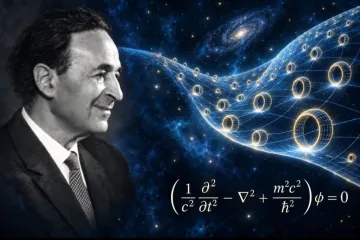
For decades, Dennis Dieks, Emeritus Professor of History and Philosophy of Science at Utrecht University in the Netherlands, has explored the ontological implications of quantum mechanics. Widely celebrated for formulating the modal interpretation of quantum mechanics, Professor Dieks argues that our traditional understanding of physical “objects” is fundamentally misleading.
According to Dieks, physical entities do not possess independent, immutable identities; rather, what we perceive as solid objects are transient shadows cast by underlying quantum probability distributions.
The Metaphor of the Bank Account
To demystify this abstract concept, Dieks employs the intuitive analogy of a modern bank account. Consider the balance in your financial account:
- Where does your money physically exist? It does not reside as a pile of physical currency notes stored in a vault; it exists purely as digital information and mathematical relations.
- The funds only materialize into physical reality when you execute a financial transaction, withdrawing cash or executing a purchase.
In quantum ontology, subatomic matter operates analogously. A particle does not occupy an exact point in space when unobserved. Instead, it exists as an evolving wave of potentiality, condensing into a localized manifestation only upon interaction with a measuring apparatus or external observer.
Relational Reality: The Cloud Metaphor
Consider a cloud drifting across an azure sky. From a distance, it appears as a distinct, solid object. Yet, upon closer inspection, the cloud is not an immutable entity; it is a dynamic, continuously shifting equilibrium of water vapor condensing, evaporating, and dispersing across atmospheric air currents. Our visual apparatus synthesizes this dynamic process into the mental concept of a static object.
Similarly, Professor Dieks suggests that macroscopic reality is relational. Subatomic entities do not exist in isolation; their properties emerge through continuous mutual correlations. The universe is not an assemblage of standalone objects, but a unified web of relationships.
Conclusion: The Observer as Co-Creator of Reality
This perspective shifts our understanding of physical truth. Truth in the quantum realm is not a rigid monolith, but fluid and context-dependent. As observers, our questions and measurements actively shape the manifestations of nature.
In reflecting on quantum reality, the words of the Persian poet and philosopher Jalal al-Din Rumi resonate with modern physics:
“What you see is not the truth; the truth lies concealed beneath the veil.”