Betelgeuse: The Red Supergiant in Orion and the Supernova Mystery
The Hunter’s Radiant Red Shoulder
Since the antiquity of human civilization, the constellation of Orion the Hunter has stood as one of the most recognizable starry figures in the nocturnal sky. Formed by three bright aligned stars outlining Orion’s belt, the constellation is crowned at its right shoulder by a brilliant, ruby-colored jewel: the red supergiant Betelgeuse (Alpha Orionis, known in Bengali astronomy as Ardra).
Located approximately $650$ light-years from Earth, Betelgeuse is a colossal star with a radius exceeding $700$ times that of our Sun. Placed at the center of our solar system, its outer convective surface would engulf the orbits of Mercury, Venus, Earth, Mars, and possibly extend out toward Jupiter.
The Great Dimming of 2019–2020
In late 2019 and early 2020, Betelgeuse captivated astrophysicists and skywatchers when it underwent an unprecedented loss of luminosity, dropping to roughly one-third of its normal brightness. This dramatic event—dubbed the “Great Dimming”—fueled widespread speculation that a historic Betelgeuse supernova was imminent.
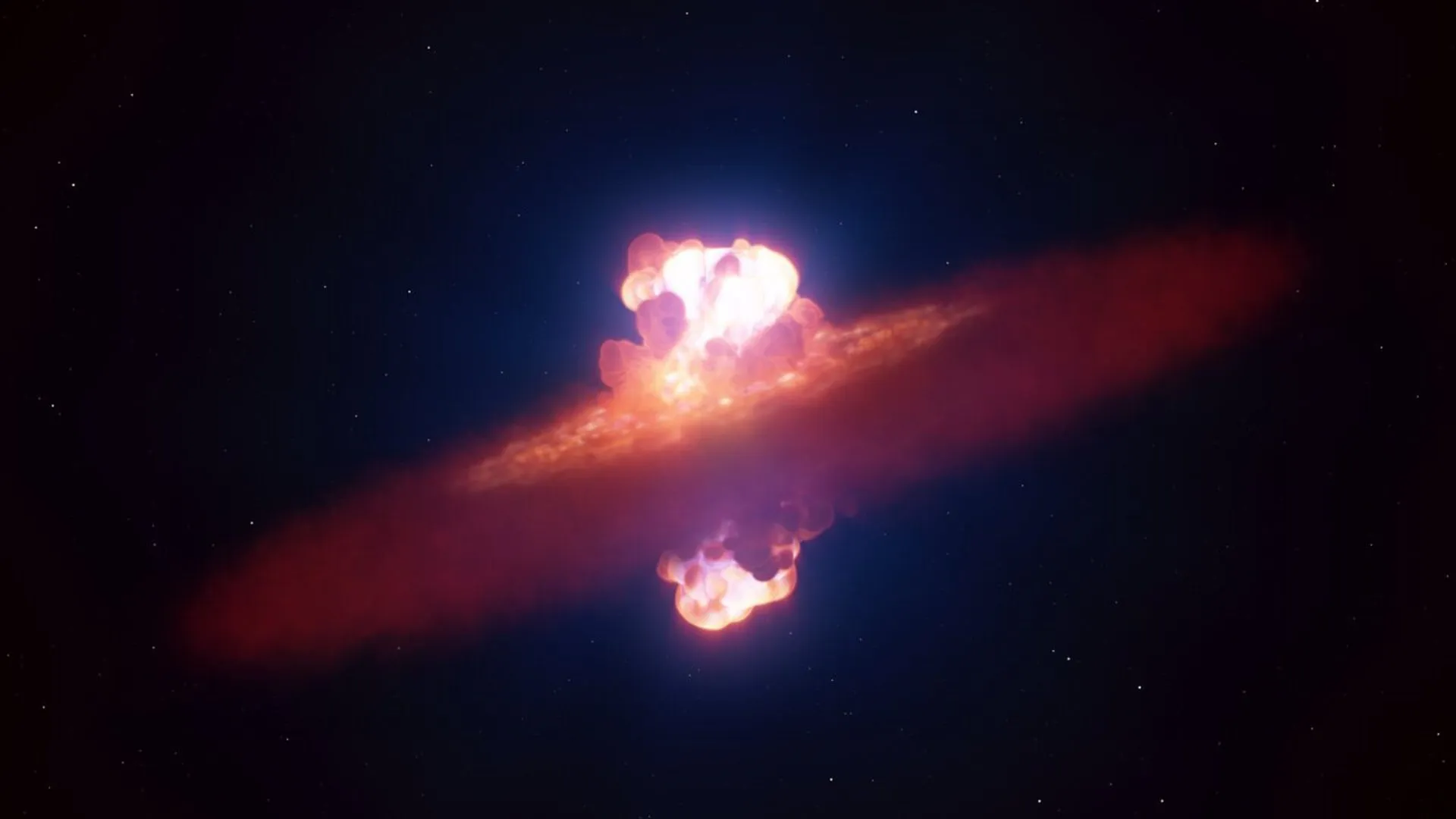
Subsequent high-resolution observations by the European Southern Observatory’s Very Large Telescope (VLT) solved the puzzle: Betelgeuse had ejected a colossal surface mass bubble of plasma. As this superheated gas expanded outward into cold space, it condensed into an immense obscuring dust cloud that temporarily blocked the star’s visible light from our line of sight.
Stellar Evolution Toward Core Collapse
Although the Great Dimming was caused by episodic mass loss rather than immediate core collapse, Betelgeuse is unmistakably in the final evolutionary stage of its life cycle. Having exhausted the hydrogen fuel in its core, it is rapidly burning through heavier elements—helium, carbon, oxygen, neon, and silicon.
When silicon fusion creates an inert iron-nickel core, thermonuclear fusion will abruptly halt. Unable to support its colossal mass against gravity, the core will collapse in fractions of a second, rebounding into a catastrophic Type II core-collapse supernova.
What Will Earth Witness?
When the supernova detonation occurs, it will produce an awe-inspiring astronomical spectacle:
- Daytime Visibility: The exploding star will shine with the brightness of a full moon, remaining easily visible to the naked eye in broad daylight for several weeks.
- Historical Parallels: It will mirror the famous supernova of 1054 CE recorded by ancient Chinese and Arab astronomers, which left behind the magnificent Crab Nebula.
- Biosphere Safety: Because Betelgeuse resides approximately $650$ light-years away, well beyond the fifty-light-year danger zone for cosmic radiation, its high-energy gamma rays will not harm Earth’s protective ozone layer or biosphere.
Conclusion
Whether the Betelgeuse supernova erupts tomorrow night or several hundred thousand years from now, astronomers continue to monitor this dying titan with vigil. It stands as a vivid celestial laboratory, reminding us of the dynamic, cyclical evolution that governs the starry cosmos.