Australian Bushfires: Climate Change and the Black Summer Crisis
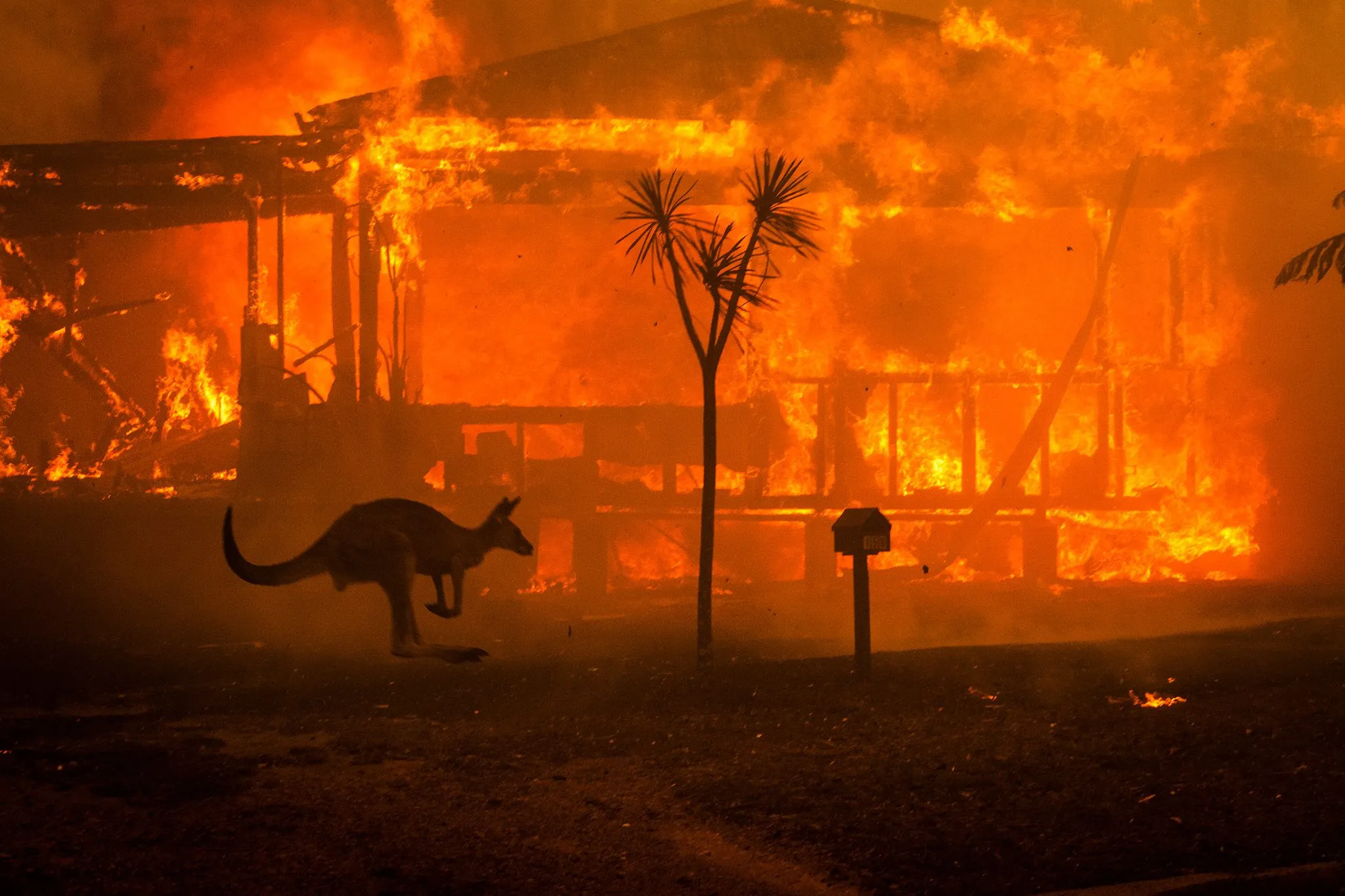
An Unprecedented Catastrophe in the Southern Hemisphere
Bushfires are an established feature of Australia’s ecology, traditionally occurring during the dry, scorching summer months of December and January. However, during the historic “Black Summer” season, the fire emergency erupted with unprecedented fury at the start of spring in September, intensifying relentlessly through December and January.
The scale of the Australian bushfires escalated into a catastrophic national emergency. Millions of hectares of eucalyptus forests burned to ash, destroying thousands of residential homes, claiming dozens of human lives, and causing the death or displacement of an estimated three billion native animals, including imperiled koala and wallaby populations.
Atmospheric and Environmental Impact
The fires unleashed massive plumes of pyrocumulonimbus clouds, sending choking smoke across major metropolitan centers including Sydney, Canberra, and Melbourne, where air quality indexes reached hazardous levels hundreds of times above safety limits.
Colossal smoke plumes drifted more than eleven thousand kilometers across the Pacific Ocean, reaching South America and circling the globe in the stratosphere. Satellite imagery from NASA and international space agencies revealed an immense ring of smoke enveloping the Southern Hemisphere, demonstrating the transcontinental reach of the disaster.
Prolonged Drought and Agricultural Hardship
The inferno was preceded by years of severe, record-breaking drought across eastern Australia. Major river systems across the Murray-Darling Basin experienced historic flow reductions, drying up irrigation channels and devastating agricultural crop yields. Rural farming communities were pushed to financial exhaustion, increasingly dependent on emergency federal disaster relief.
The Fingerprint of Climate Change
Atmospheric scientists confirmed that anthropogenic global warming dramatically amplified the crisis. Decades of greenhouse gas emissions—primarily carbon dioxide from fossil fuel combustion—have elevated global mean surface temperatures, setting successive heat records across the continent.
Rising temperatures coupled with a strongly positive Indian Ocean Dipole (IOD) drew moisture away from Australia, baking forest vegetation into explosive tinder. Climate scientists had warned for thirty years that continuing along a high-emissions trajectory would inevitably produce longer, more severe wildfire seasons. Black Summer provided tragic real-time validation of those scientific models.
Global Implications and Climate Justice
The ecological crisis in Australia serves as an alarming omen for vulnerable nations worldwide. As polar ice sheets melt and atmospheric thermal energy accelerates, low-lying coastal regions—such as Bangladesh’s coastal deltas—face severe threats from accelerating sea-level rise and intensified tropical cyclones.
A Call for Decisive Mitigation
Overcoming this accelerating environmental crisis demands concerted global action:
- Decarbonizing Energy: Accelerating the transition to solar, wind, and storage technologies to curb greenhouse emissions.
- Forest Stewardship: Preserving native forests and integrating indigenous cultural burning practices into land management.
- Resource Efficiency: Fostering a circular economy that curbs waste and minimizes ecological footprints.
Conclusion
The apocalyptic infernos of the Australian bushfires demonstrate that climate disruption is no longer a distant theoretical threat. It is an unfolding reality demanding immediate international resolve to protect the living biosphere.