Quantum Spacetime: Black Holes, Wormholes, and Cosmic Architecture
Einstein’s Relativistic Fabric of Spacetime
In classical Newtonian mechanics, space and time were viewed as rigid, independent backdrops against which physical events unfolded. Albert Einstein shattered this static paradigm with his general theory of relativity, revealing that space and time are inextricably interwoven into a dynamic four-dimensional continuum known as spacetime.
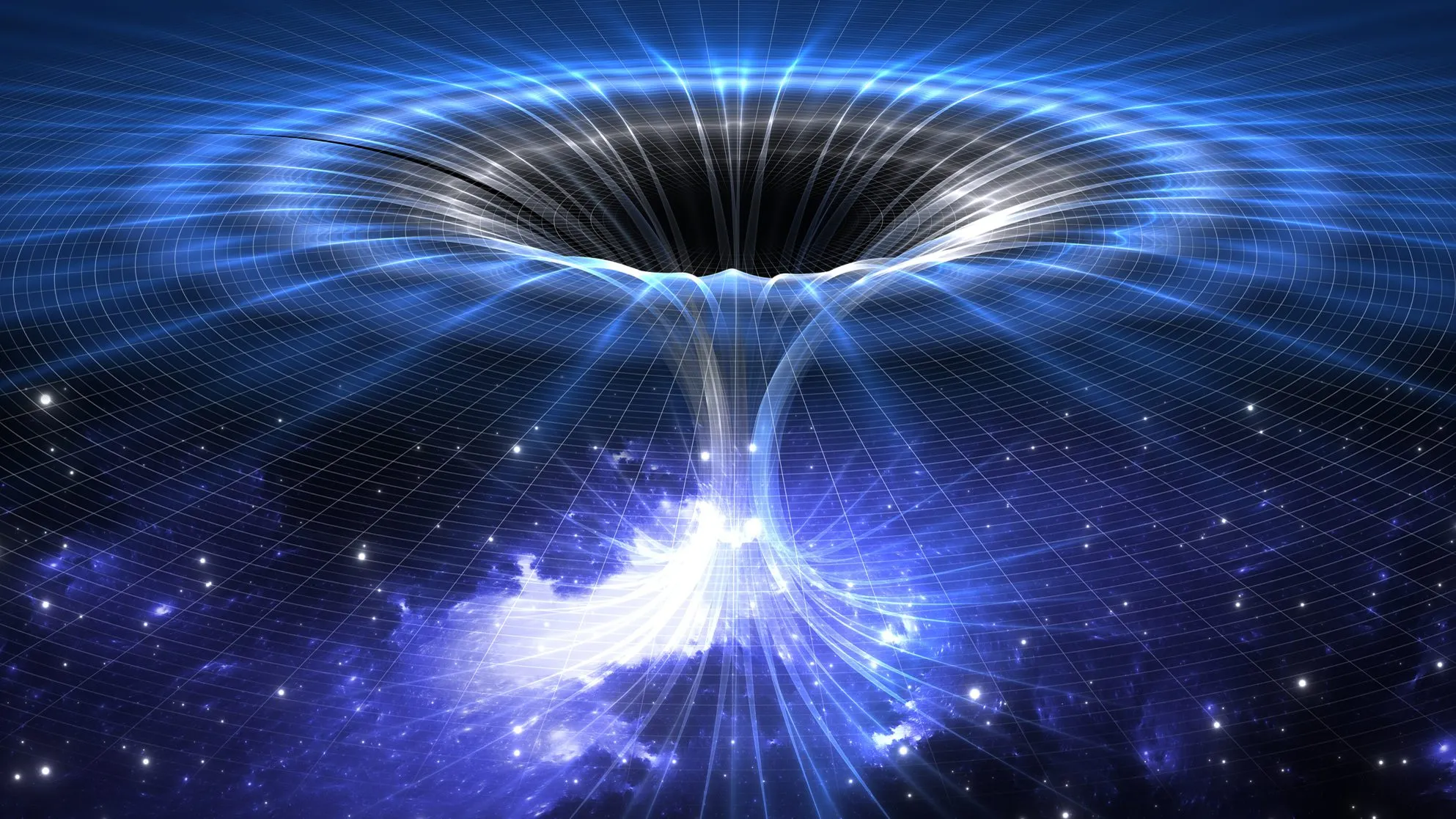
Einstein demonstrated that mass and energy warp this geometric fabric. Massive celestial bodies—such as planets, stars, and galaxies—create depressions within the spacetime metric, and orbiting bodies simply follow the natural curvature (geodesics) of this warped geometry. For more than a century, general relativity has passed every empirical test with flying colors, predicting gravitational waves, gravitational lensing, and cosmic expansion.
Black Holes: The Ultimate Gravitational Limit
The most extreme manifestation of spacetime curvature is the black hole. When a massive stellar core undergoes catastrophic gravitational collapse, its matter compresses into a region so dense that the escape velocity exceeds the speed of light. Surrounding this dark abyss is the event horizon—the point of no return calculated by Karl Schwarzschild.
According to general relativity, all matter within the event horizon collapses into a gravitational singularity: a point of infinite density and infinite spacetime curvature where time ceases and classical physics breaks down entirely. To resolve this breakdown, physicists must look beyond classical geometry to the quantum microcosm.
Wormholes and the Einstein-Rosen Bridge
In 1935, Albert Einstein and Nathan Rosen discovered an intriguing mathematical solution to the field equations: the Einstein-Rosen Bridge, colloquially known as a wormhole. This theoretical structure represents a topological tunnel connecting two distant regions of spacetime.
While originally treated as a mathematical curiosity that would instantly pinch closed under gravitational collapse, modern theoretical physics has revisited the wormhole through the lens of quantum information theory, discovering profound links between wormholes and quantum entanglement.
ER = EPR: Quantum Entanglement as Spacetime Scaffolding
In quantum mechanics, quantum entanglement describes a non-local correlation wherein two separated particles share a single quantum state, such that measuring one instantaneously determines the properties of the other. In 2013, theoretical physicists Juan Maldacena and Leonard Susskind proposed a revolutionary conjecture: ER = EPR.
The conjecture asserts that the geometric connection provided by an Einstein-Rosen bridge (ER) is physically equivalent to quantum entanglement (EPR, named after Einstein, Podolsky, and Rosen). In this paradigm, microscopic entanglement between quantum particles acts as the fundamental glue that weaves the continuous geometric fabric of quantum spacetime. Spacetime geometry is not an elementary building block of nature, but an emergent macroscopic manifestation of underlying quantum information networks.
Conclusion
The realization that quantum spacetime may be stitched together by quantum entanglement represents a historic convergence between general relativity and quantum mechanics. By demonstrating that black hole interiors and wormholes are manifestations of quantum information, theoretical physics is taking its boldest strides toward a unified Theory of Everything.