Primordial Black Holes: Big Bang Origins and Hawking Radiation
Cosmic Dawn and Primordial Chaos
Approximately 13.8 billion years ago, during the turbulent initial fractions of a second following the Big Bang, extreme physical conditions governed the infant cosmos. Amid these violent primordial density fluctuations, extraordinary cosmic entities were forged: primordial black holes (PBHs).
Unlike stellar-mass black holes formed by the gravitational collapse of dying massive stars, primordial black holes arose long before the first stars ever condensed. Extreme regional overdensities collapsed directly under their own self-gravitation, yielding black holes spanning masses from microscopic subatomic scales to thousands of solar masses.
Stephen Hawking and Black Hole Evaporation
In the early 1970s, legendary theoretical physicist Stephen Hawking made a discovery that transformed modern physics: black holes are not completely black, nor are they eternal. By synthesizing quantum field theory with general relativity, Hawking demonstrated that black holes emit thermal radiation—a phenomenon now known as Hawking radiation.
Quantum vacuum fluctuations near the event horizon generate virtual particle-antiparticle pairs. When one particle falls past the horizon while the other escapes, the black hole loses net mass. Smaller black holes radiate at higher temperatures, losing mass at an accelerating pace until they terminate in an explosive flash of high-energy gamma rays and elementary particles.
Dark Electric Charge and Explosive Instabilities
Recent theoretical research conducted by physicists at the University of Massachusetts has introduced compelling insights into primordial black hole dynamics. Their models suggest that microscopic primordial black holes might harbor an exotic internal charge dubbed “dark electric charge.”
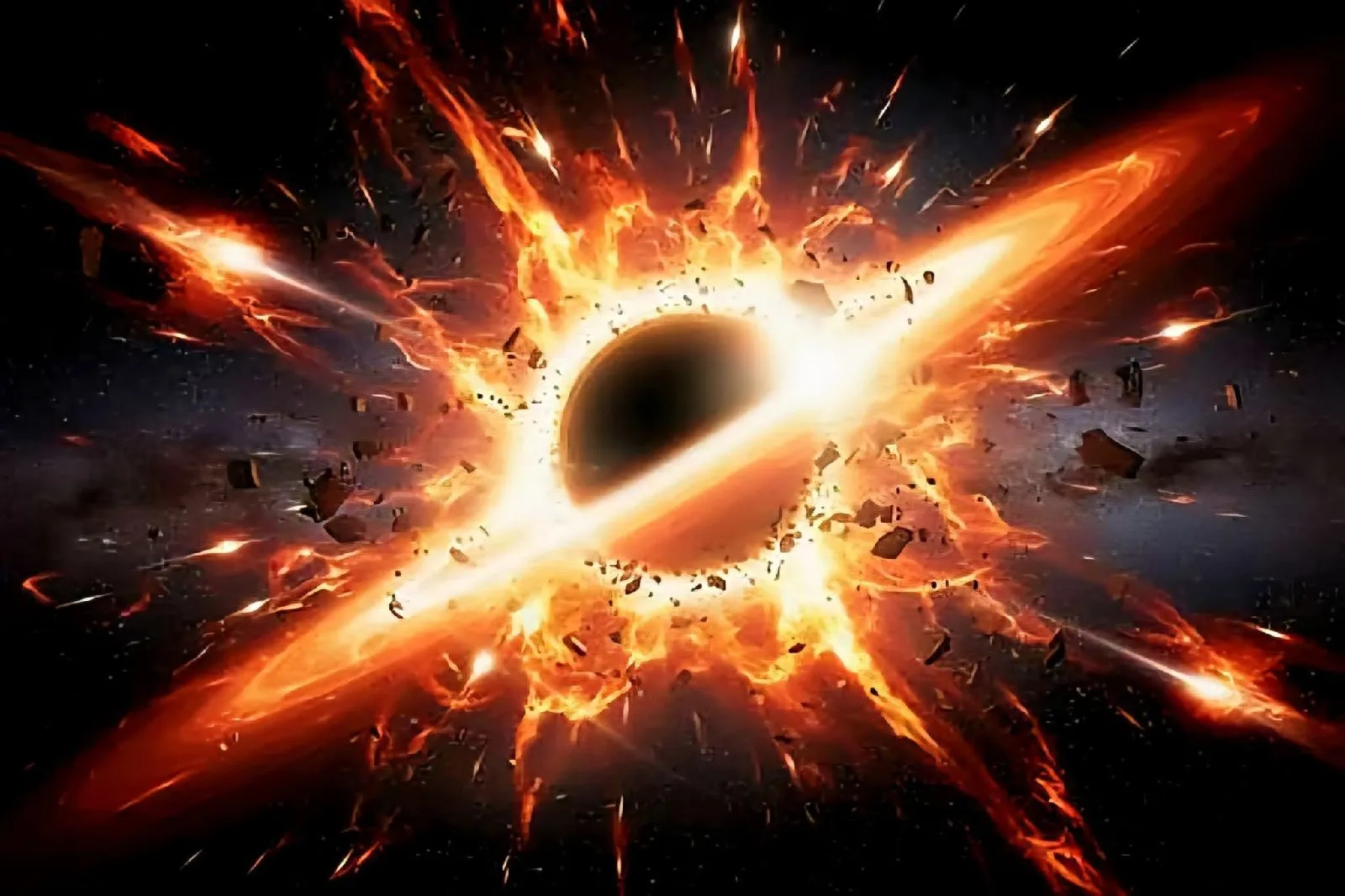
While this exotic charge could transiently stabilize the black hole against rapid evaporation, the internal equilibrium eventually breaks down, culminating in a cataclysmic final detonation. Such an explosion would release a spectrum of familiar fundamental particles—such as electrons, positrons, and quarks—alongside potentially unknown particles, providing direct observational signatures of dark matter.
Observational Prospects and Astrophysical Searches
Classical models suggested that primordial black hole explosions were exceedingly rare events, occurring once in hundreds of thousands of years within detectable cosmic neighborhoods. However, updated analytical calculations suggest the detection probability is substantially higher.
Astrophysicists estimate that next-generation high-energy gamma-ray observatories and cosmic-ray detectors could detect a primordial black hole detonation within the coming decades. Observing such an event would provide empirical proof of Hawking radiation and offer an unprecedented window into particle physics beyond the Standard Model.
A Potential Revolution in Fundamental Physics
Just as Copernicus displaced Earth from the center of the solar system and Einstein unified spacetime, the discovery and confirmation of primordial black holes would initiate a profound scientific revolution. Validating Hawking radiation empirically would bridge quantum mechanics and general relativity, bringing physics closer to an elusive unified Theory of Everything.