Olbers' Paradox: Why Is the Night Sky Dark in an Endless Universe?
A Deceptively Simple Cosmic Question
Throughout the history of science, some of the most revolutionary breakthroughs have emerged from asking questions that seem deceptively childish at first glance. When Isaac Newton wondered why apples fall straight down, his inquiry yielded the universal law of gravitation. In the nineteenth century, German astronomer Heinrich Wilhelm Olbers (1758–1840) posed an equally fundamental question: Why is the night sky dark?
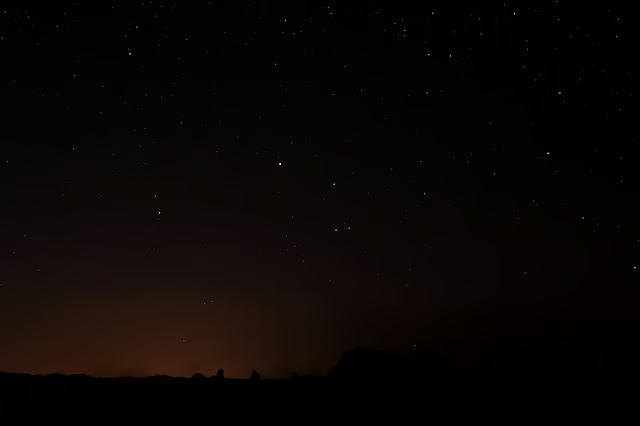
To an everyday observer, the answer appears trivial: the night sky is dark because the Sun has set. However, when viewed through the principles of astrophysics and classical geometry, the darkness of the nocturnal sky presents a profound puzzle known as Olbers’ paradox.
The Geometric Dilemma of a Static, Infinite Cosmos
In Olbers’ time, astronomers assumed the universe was static, eternal, and infinitely populated with stars uniformly distributed across space. Under these classical assumptions:
- As you gaze into space, the apparent brightness of an individual star diminishes with the square of its distance ($1/r^2$).
- However, the volume of a spherical shell of space—and consequently the number of stars contained within it—increases with the square of the distance ($r^2$).
- These two geometric factors cancel each other out exactly. Every concentric layer of stars across the cosmos should contribute an identical amount of light to an observer on Earth.
Consequently, in an infinite, timeless cosmos, every line of sight from Earth would eventually strike the blazing surface of a star. The entire nighttime sky should be intensely luminous, glowing as uniformly bright as the surface of the Sun.
Flawed Hypotheses: Interstellar Dust and Redshift
Early nineteenth-century astronomers suggested that clouds of interstellar dust and gas might absorb the starlight from distant stars. However, thermodynamics invalidates this explanation: over infinite time, interstellar dust would absorb radiation, heat up to stellar temperatures, and reradiate that energy as visible light.
Similarly, while cosmic redshift stretches optical starlight into the infrared spectrum, redshift alone is insufficient to account for the total absence of blinding nighttime illumination.
The Big Bang and the Cosmic Horizon
The true resolution to Olbers’ paradox arrived in the twentieth century with Edwin Hubble’s discovery of cosmic expansion and the formulation of the Big Bang theory:
- Finite Age of the Universe: The universe is not eternal; it originated approximately $13.8$ billion years ago.
- Finite Speed of Light: Because light travels at a finite velocity ($c \approx 300,000$ kilometers per second), we can only see light that has had time to travel to Earth since the Big Bang. The radius of the observable universe is strictly limited by this cosmic horizon.
- Finite Stellar Lifetimes: Stars do not shine forever; they burn through their nuclear fuel and expire in millions or billions of years, far too quickly to fill the vast expanses of spacetime with continuous light.
Thus, the night sky is dark because the universe is dynamic, young, and finite in observable scope—a beautiful cosmic truth revealed every time we look up at the stars.