Nobel Prize Legacies: Seven Father-and-Son Laureate Pairs
Scientific Excellence as a Family Heritage
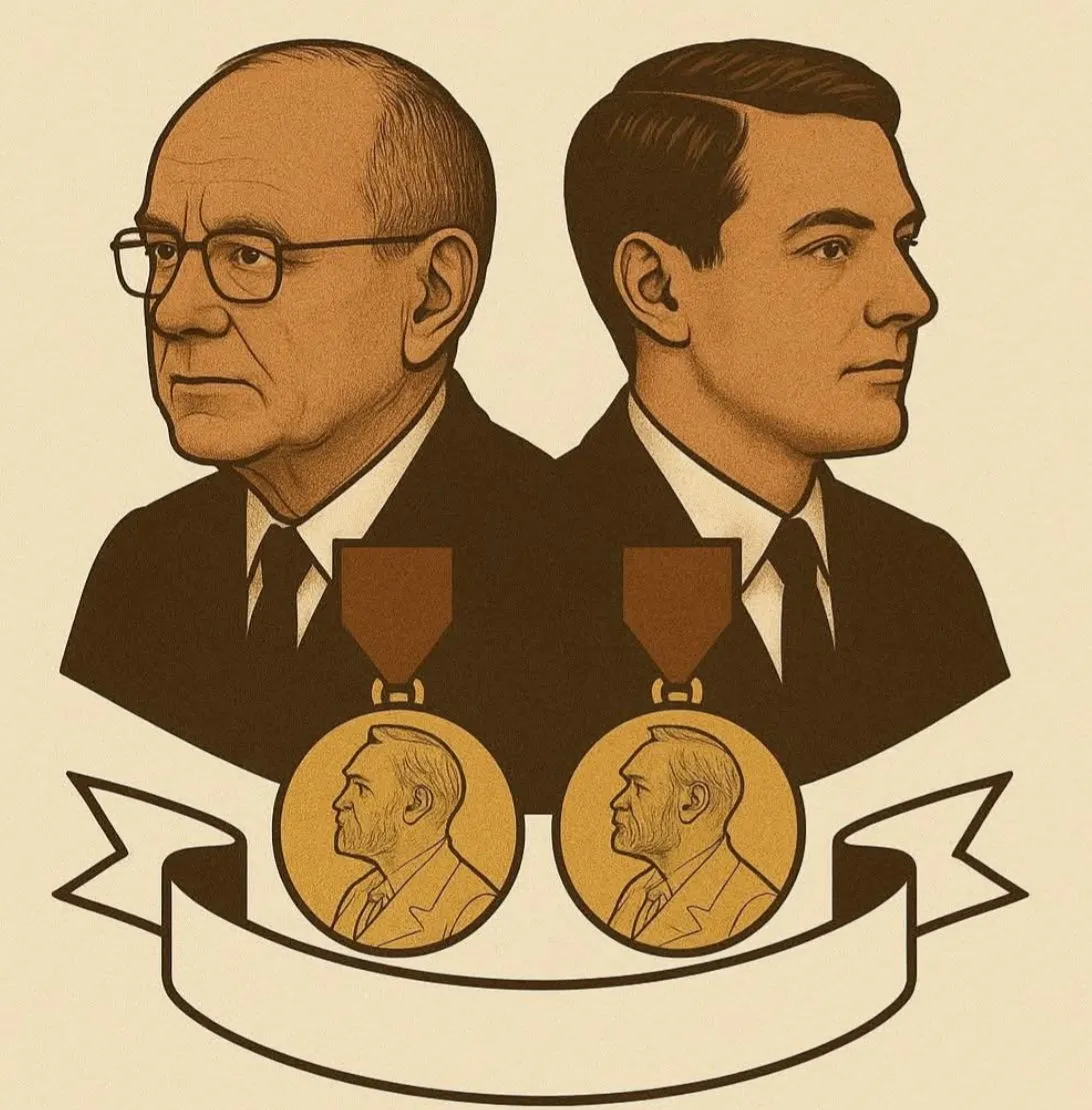
Receiving the Nobel Prize represents the pinnacle of global scientific recognition, honoring discoveries that fundamentally alter the course of human knowledge. Yet when two successive generations of the same family—father and son—both attain this extraordinary distinction, it reflects an unprecedented tradition of intellectual curiosity, dedication, and mentorship.
Across more than a century of Nobel history, only seven father-and-son Nobel laureates have achieved this rare distinction in the sciences.
1. J. J. Thomson and George Paget Thomson
Sir Joseph John (J. J.) Thomson received the 1906 Nobel Prize in Physics for discovering the electron as a discrete subatomic corpuscle. Three decades later, his son, Sir George Paget Thomson, received the 1937 Nobel Prize in Physics for demonstrating electron diffraction through crystals, proving that the electron behaves as a wave. In a poetic scientific paradox, the father proved the particle nature of the electron, while the son proved its wave nature.
2. William Henry Bragg and William Lawrence Bragg
Sir William Henry Bragg and his son Sir William Lawrence Bragg share the unique distinction of winning the 1915 Nobel Prize in Physics jointly. Together, they founded X-ray crystallography, using X-ray diffraction to determine the internal three-dimensional atomic structures of crystals. Lawrence Bragg was awarded the prize at the age of twenty-five, remaining the youngest-ever Nobel laureate in the sciences.
3. Niels Bohr and Aage Bohr
Danish theoretical physicist Niels Bohr earned the 1922 Nobel Prize in Physics for his foundational quantum model of the atom and atomic radiation. His son, Aage Bohr, received the 1975 Nobel Prize in Physics for discovering the connection between collective motion and particle motion in atomic nuclei, developing the unified geometric model of the nuclear structure.
4. Manne Siegbahn and Kai Siegbahn
Swedish physicist Manne Siegbahn won the 1924 Nobel Prize in Physics for his pioneering discoveries in X-ray spectroscopy. Fifty-seven years later, his son Kai Siegbahn received the 1981 Nobel Prize in Physics for developing high-resolution Electron Spectroscopy for Chemical Analysis (ESCA), advancing modern surface science and chemical analysis.
5. Hans von Euler-Chelpin and Ulf von Euler
German-Swedish biochemist Hans von Euler-Chelpin was awarded the 1929 Nobel Prize in Chemistry for elucidating the enzymatic fermentation of sugars. His son, physiologist Ulf von Euler, won the 1970 Nobel Prize in Physiology or Medicine for identifying norepinephrine as the key neurotransmitter regulating sympathetic nervous system function.
6. Arthur Kornberg and Roger D. Kornberg
American biochemist Arthur Kornberg was awarded the 1959 Nobel Prize in Physiology or Medicine for discovering DNA polymerase and synthesizing DNA in a cell-free system. Nearly five decades later, his son Roger D. Kornberg won the 2006 Nobel Prize in Chemistry for mapping the molecular basis of eukaryotic transcription—revealing how RNA polymerase transcribes DNA into RNA.
7. Sune Bergström and Svante Pääbo
Swedish biochemist Sune Bergström received the 1982 Nobel Prize in Physiology or Medicine for isolating and chemically characterizing prostaglandins. In 2022, his son Svante Pääbo was awarded the Nobel Prize in Physiology or Medicine for pioneering paleogenomics, successfully sequencing Neanderthal and Denisovan genomes to illuminate human evolutionary history.
Conclusion
These seven extraordinary pairs of father-and-son Nobel laureates demonstrate how an environment of inquisitive rigor, passion for discovery, and scientific dedication can transcend generations, permanently enriching human understanding.