Gamma-Ray Bursts: Cosmic Mysteries and the Anomalous GRB 250702B
Cosmic Titans: The Physics of Gamma-Ray Bursts
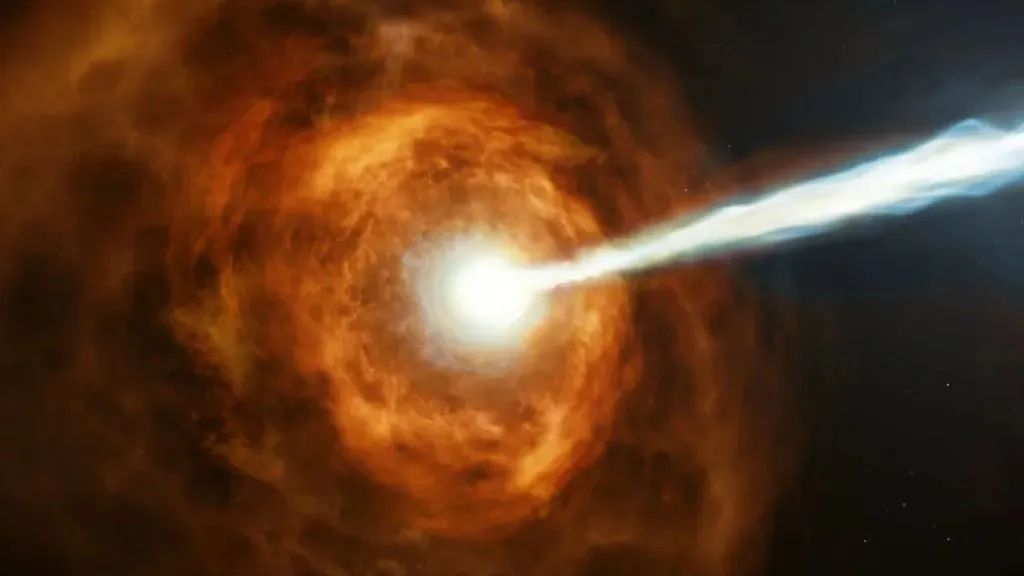
The universe appears serene from Earth’s vantage point, yet cosmic space is punctuated by cataclysmic detonations releasing more energy in seconds than our Sun will emit over its entire 10-billion-year lifespan. These titanic explosions are known as gamma-ray bursts (GRBs).
Astronomers have long divided GRBs into two canonical categories based on duration: short GRBs (lasting less than two seconds, caused by colliding binary neutron stars) and long GRBs (lasting up to several minutes, triggered by the core collapse of massive hypernova stars forming black holes). Once the blast occurs, the emission decays into a fading afterglow, never repeating.
The Anomaly: GRB 250702B Breaks the Rules
On July 2, 2025, NASA’s Fermi Gamma-ray Space Telescope detected an extraordinary burst designated GRB 250702B. Initial telemetry suggested a typical high-energy event. However, rather than extinguishing permanently, the burst defied known astrophysics by erupting repeatedly over the course of a full 24-hour period.
Deep optical and near-infrared observations conducted by the European Southern Observatory’s Very Large Telescope (VLT) utilizing its HAWK-I instrument localized the burst to an extragalactic host galaxy, a finding corroborated by the Hubble Space Telescope. Lead astrophysicist Antonio Martin-Carrillo noted that in half a century of GRB observations, such sustained repeating behavior had never before been witnessed.
Theoretical Explanations: Multiple Energy Releases
Astrophysicists have proposed several compelling hypotheses to explain the unprecedented reactivation of GRB 250702B:
- Episodic Black Hole Accretion: The newly formed central black hole experienced episodic mass feeding from a fragmented stellar envelope, releasing multiple relativistic jets in discrete bursts.
- Multiple Stellar Collisions: A chaotic multi-body collision involving neutron stars and dense stellar remnants in a dense globular cluster core.
- Magnetar Flaring and Fallback: Magnetic reorganization and fallback accretion onto an ultra-magnetized proto-neutron star (magnetar).
Next-Generation Observatories and Deep-Space Probes
Deciphering such cosmic anomalies requires advanced multi-messenger astronomy. The James Webb Space Telescope (JWST) provides unparalleled spectroscopic imaging of infrared afterglows, probing heavy element nucleosynthesis (r-process) in ejecta clouds.
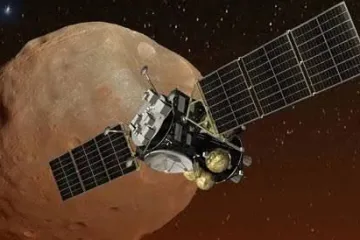
Over the coming decade, the European Space Agency’s Athena X-ray Observatory, the JAXA/NASA XRISM mission, and ESA’s dedicated THESEUS satellite will monitor high-energy transients with unprecedented spatial and timing precision, determining whether repeating GRBs represent rare anomalies or an undiscovered class of cosmic phenomena.
Probing Quantum Gravity at the Edge of Spacetime
Beyond stellar astrophysics, gamma-ray bursts serve as cosmic laboratories for fundamental physics. Theoretical models of quantum gravity, including Loop Quantum Gravity (LQG), suggest that spacetime possesses a discrete quantum structure at the Planck scale ($10^{-35}$ meters).
If spacetime is quantized, ultra-high-energy gamma photons might travel at infinitesimal velocity differences compared to lower-energy photons across billions of light-years. Instruments like Fermi and the ground-based MAGIC telescopes actively test for Lorentz invariance violation using GRB photons.
Conclusion
GRB 250702B demonstrates that the universe retains the power to surprise us. As astronomical observatories peer deeper into the cosmos, each breakthrough in gamma-ray astrophysics brings humanity closer to deciphering the birth of black holes and the fundamental laws of physics.