The Long Journey of Evolution: From Ancient Thinkers to Modern Genetics
Centuries of Curiosity: The Genesis of Evolutionary Thought
Humanity has long pondered the rich tapestry of the natural world. Why do plants, animals, and microscopic life undergo transformative physical changes over time? Why does Earth harbor such staggering biodiversity? These questions laid the foundation for the theory of biological evolution—a grand intellectual synthesis spanning cultures, eras, and scientific paradigms.
The Golden Age of Islamic Natural Philosophy
During the Islamic Golden Age in ninth-century Baghdad, polymath Al-Jahiz (776–869) authored his seminal Kitab al-Hayawan (The Book of Animals). Al-Jahiz articulated how living organisms engage in a relentless struggle for existence, environmental adaptation, and reproductive survival, anticipating core elements of natural selection a millennium before modern biology.
Later scholars, including Ibn Miskawayh (932–1030) in Al-Fawz al-Asghar and Persian astronomer Nasir al-Din al-Tusi (1201–1274) in Akhlaq-i Nasiri, proposed graduated developments across the natural kingdom, exploring how species dynamically adapt and diversify over geological time.
The European Scientific Enlightenment
Centuries later, the European Scientific Revolution transformed natural history. Carl Linnaeus established binomial nomenclature, categorizing species into systematic hierarchies. Georges Cuvier proved the reality of biological extinction through fossil anatomy, while Jean-Baptiste Lamarck proposed that organisms adapt via inherited acquired traits. Though Lamarck’s mechanism was superseded, he firmly positioned species transformation on the scientific agenda.
Charles Darwin and Alfred Russel Wallace
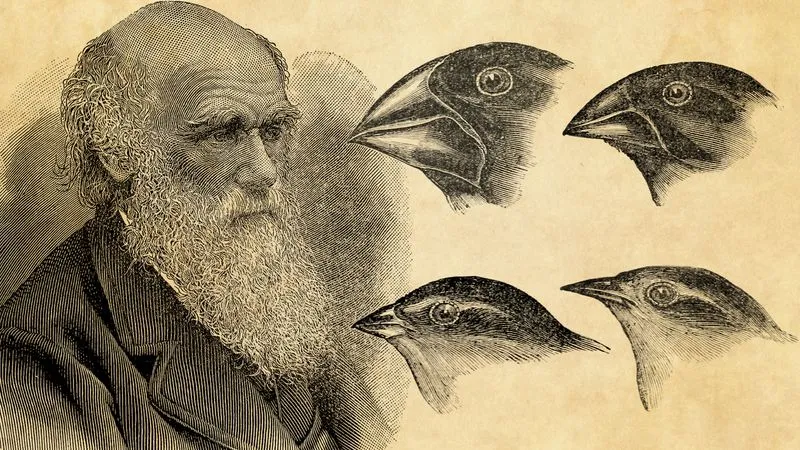
In the mid-nineteenth century, Charles Darwin (1809–1882) embarked on a historic five-year voyage aboard HMS Beagle. Observing anatomical variations among Galapagos finches, tortoises, and fossils, Darwin formulated his theory of evolution by natural selection, culminating in his 1859 masterpiece, On the Origin of Species.
Simultaneously, British naturalist Alfred Russel Wallace (1823–1913), researching the Malay Archipelago, independently formulated an identical theory of natural selection. In 1858, their findings were jointly presented before the Linnean Society of London, establishing natural selection as biology’s unifying framework.
Mendel and the Modern Synthesis
Darwin recognized that natural selection required a mechanism of inheritance, yet he lacked knowledge of genetics. That mechanism had already been uncovered by Moravian friar Gregor Mendel through his pea-plant breeding experiments. When Mendel’s laws were rediscovered around 1900, geneticists and paleontologists forged the “Modern Synthesis” in the 1930s and 1940s, synthesizing Darwinian selection with Mendelian population genetics.
The Molecular Revolution: DNA and Beyond
The discovery of the DNA double helix by James Watson, Francis Crick, and Rosalind Franklin in 1953 rooted evolutionary biology in molecular genetics. Evolutionary change could now be read directly in the nucleotide sequences of genomes, driven by mutation, genetic drift, gene flow, and natural selection.
In recent decades, Evolutionary Developmental Biology (“Evo-Devo”) revealed that ancient master regulator genes, such as Hox genes, coordinate body patterning across vastly disparate taxa—from fruit flies to humans—proving that nature repurposes deeply conserved genetic toolkits to generate anatomical diversity.
Genomics and the Molecular Clock
Whole-genome sequencing has confirmed that humans share approximately $98.8\%$ of their functional DNA sequence with chimpanzees. Ancient DNA sequencing of Neanderthal and Denisovan remains reveals that archaic human lineages interbred with modern humans. Concurrently, the “molecular clock” technique measures nucleotide substitution rates to date ancient phylogenetic divergences with remarkable precision.
Evolution in Real Time
Evolution is not an artifact of the distant past; it operates dynamically today. Clinical examples include the rapid emergence of multidrug-resistant bacteria and pesticide resistance in agricultural insect pests. In humans, recent selective pressures have spread lactase persistence across pastoral populations and high-altitude hypoxia adaptations among Tibetan and Andean communities.
Conclusion
The evolutionary history of life represents one of humanity’s greatest scientific triumphs. In the famous words of evolutionary geneticist Theodosius Dobzhansky: “Nothing in biology makes sense except in the light of evolution.” From ancient philosophy to modern molecular genetics, evolutionary biology continues to illuminate our place within the living cosmos.