The Speed of Light: From Galileo's Lanterns to Einstein's Relativity
The Concept of Infinity and Galileo’s Mountain Lanterns
Measuring the speed of light represents one of the most enthralling quests in scientific history. For millennia, classical philosophers, including Aristotle, believed light traveled instantaneously across space with infinite velocity.
In 1638, Italian physicist Galileo Galilei sought to test this assumption empirically. Stationing himself and an assistant on distant hilltops at night, each equipped with a shuttered lantern, they attempted to measure the time delay between uncovering one lantern and observing the response from the other. Because light travels far faster than human neurological reflexes can react, Galileo could not establish a numerical speed, though he wisely concluded that light travels at an exceptionally rapid, finite speed.
Ole Rømer and the Cosmic Clockwork of Io
The first successful measurement of light’s finite velocity occurred in 1676 through Danish astronomer Ole Rømer. While observing Jupiter’s volcanic moon Io, Rømer noticed that the intervals between Io’s eclipses varied depending on Earth’s orbital distance from Jupiter.
When Earth moved away from Jupiter, Io’s eclipses occurred later than predicted; when Earth approached, they occurred earlier. Rømer deduced that this timing discrepancy was caused by the additional time light required to traverse the varying distance across Earth’s orbit, proving conclusively that light’s velocity is finite and measurable.
Bradley’s Stellar Aberration and Fizeau’s Toothed Wheel
In 1728, English astronomer James Bradley discovered “stellar aberration”—the apparent seasonal shift in the observed positions of distant stars caused by Earth’s orbital velocity relative to incoming starlight. Using this angular displacement, Bradley calculated light’s speed at approximately 301,000 kilometers per second, an astonishingly accurate estimate for the era.
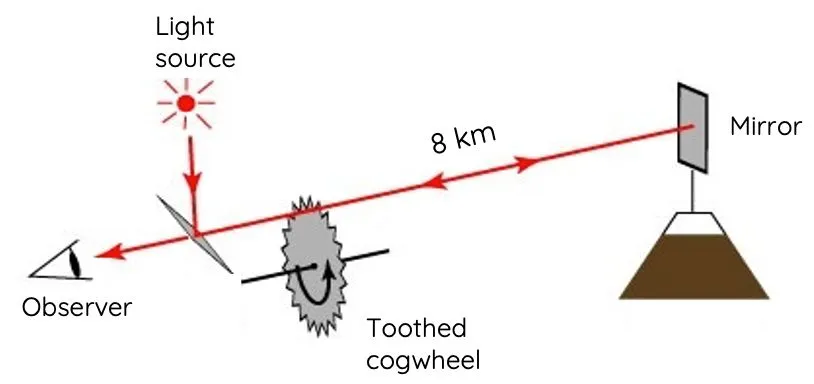
Over a century later, in 1849, French physicist Armand Fizeau achieved the first direct terrestrial measurement without astronomical observations. Fizeau directed a light beam through the perimeter of a rapidly spinning toothed cogwheel with 720 teeth toward a mirror placed 8.6 kilometers away in Suresnes.
By adjusting the cogwheel’s rotational speed until returning light was eclipsed by the adjacent tooth upon reflection, Fizeau calculated the round-trip transit time, arriving at approximately 313,300 km/s. Léon Foucault soon refined this method using rotating mirrors, achieving 298,000 km/s. Today, laser interferometry defines the exact constant in a vacuum as 299,792.458 kilometers per second.
The Michelson-Morley Experiment and the Disproved Aether
During the late nineteenth century, physicists assumed light waves required an all-pervading mechanical medium to propagate through space, termed the “luminiferous aether.” In 1887, Albert Michelson and Edward Morley designed an exquisitely sensitive optical interferometer to detect Earth’s velocity through this aether wind.
By splitting a light beam into perpendicular paths and recombining them, they searched for interference fringe shifts as Earth orbited the Sun. To their astonishment, the experiment yielded a null result: light traveled at identical velocities in all directions regardless of Earth’s motion. The aether did not exist.
Einstein’s Special Relativity and Universal Constant
This famous null result served as a vital cornerstone for Albert Einstein’s 1905 Special Theory of Relativity. Einstein postulated that the speed of light in a vacuum, denoted as c, is a universal invariant that remains identical for all inertial observers regardless of the motion of the source or the observer.
Nothing with mass can accelerate to or exceed this ultimate cosmic speed limit. The constancy of light velocity fundamentally altered our understanding of space and time, leading to relativistic time dilation, length contraction, and mass-energy equivalence ($E=mc^2$).
Conclusion
From Galileo’s lantern experiment to modern atomic clocks and GPS satellite timing systems, our mastery of the speed of light transformed humanity’s conception of the cosmos, anchoring modern physics, telecommunications, and deep-space astronomy.