James Clerk Maxwell: Architect of Modern Physics and Electromagnetism
Architect of the Modern Connected World
Every time we send a text, stream video across Wi-Fi, or listen to the radio, we rely on electromagnetic signals propagating at the speed of light. While these technologies feel like twentieth-century inventions, their theoretical foundation rests upon the brilliant nineteenth-century Scottish physicist James Clerk Maxwell. The modern electronic era stands firmly on the foundation of his mathematical equations.
A Scottish Prodigy and the Four Master Equations
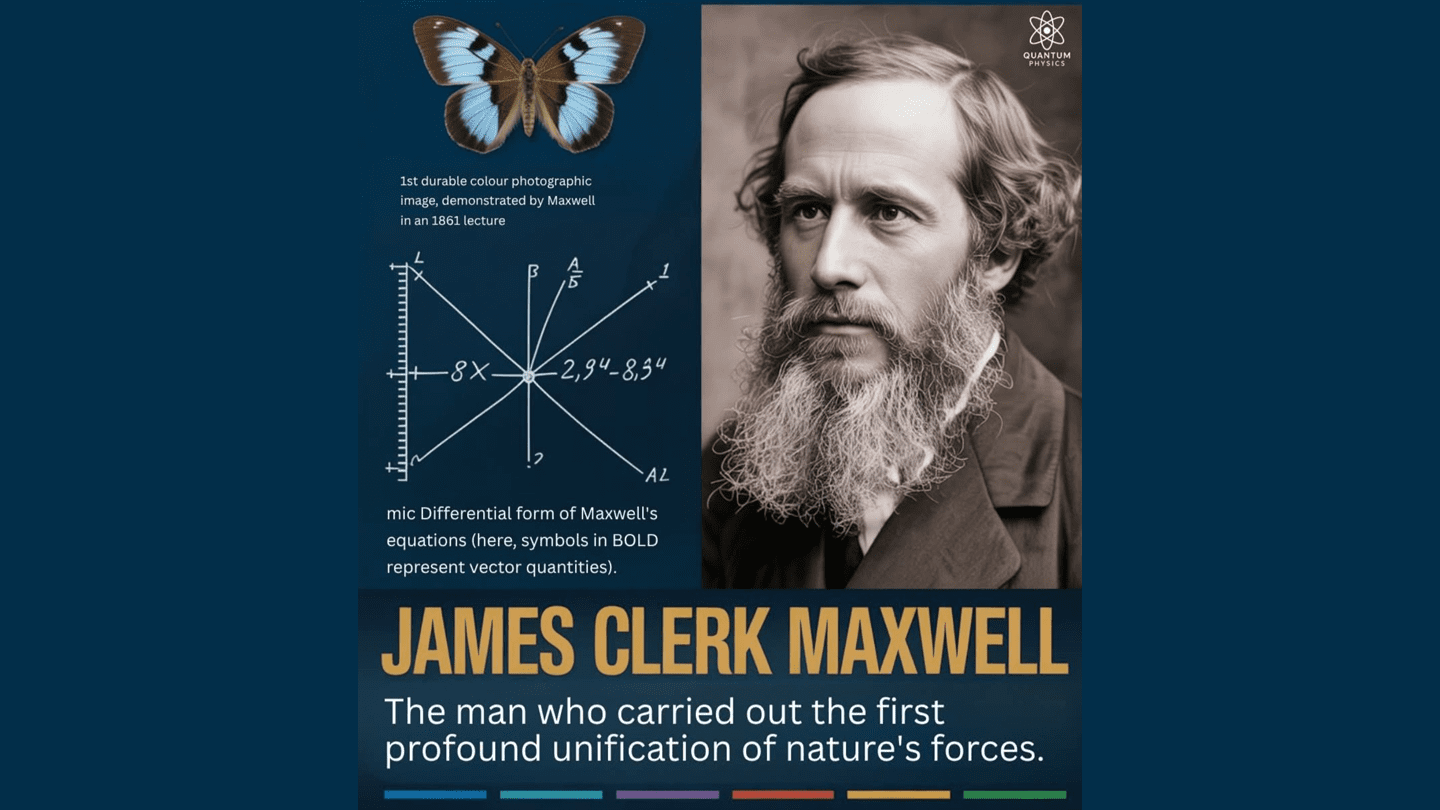
Born in Edinburgh, Scotland, Maxwell demonstrated extraordinary mathematical ability early in life, publishing his first scientific paper at age fourteen. His greatest triumph was formulating a unified mathematical framework for electricity and magnetism, culminating in the four partial differential equations known worldwide as “Maxwell’s Equations.”
Prior to Maxwell, electricity, magnetism, and light were considered separate physical phenomena. Maxwell proved they are manifestations of a unified electromagnetic field, interconnecting nature’s fundamental forces.
Unifying Electricity, Magnetism, and Light
Maxwell’s equations revealed profound physical truths:
- Electric charges generate electric fields (Gauss’s Law).
- Magnetic monopoles do not exist in classical electromagnetism (Gauss’s Law for Magnetism).
- A changing magnetic field induces an electric field (Faraday’s Law of Induction).
- An electric current or changing electric field induces a magnetic field (Maxwell-Ampère Law).
Combining these relations, Maxwell derived a wave equation for electromagnetic disturbances propagating through space. When he calculated their propagation speed from measured electrical and magnetic constants, the value matched the known speed of light. In a breathtaking realization, Maxwell concluded that light itself is an electromagnetic wave.
From Newtonian Mechanics to Modern Field Theory
Before Maxwell, Newtonian physics conceptualized the physical cosmos as hard material particles acting upon one another through direct forces. Maxwell shifted that paradigm toward field theory, demonstrating that invisible physical fields pervade space, storing energy and carrying momentum.
This paradigm shift established the framework that enabled modern telecommunications, radar, satellite communications, and quantum electrodynamics.
Experimental Verification: Heinrich Hertz and Radio Transmission
In 1887, German physicist Heinrich Hertz experimentally verified Maxwell’s predictions by generating and detecting radio waves in his laboratory. Shortly thereafter, Guglielmo Marconi harnessed these electromagnetic waves for wireless telegraphy, inaugurating the age of radio communications.
Color Vision and the First Durable Color Photograph
Maxwell’s contributions extended beyond electrodynamics into optics and human sensory perception. Investigating how the human eye perceives color, he demonstrated that all observable hues can be synthesized by combining red, green, and blue light (the three-color receptor theory).
In 1861, Maxwell produced the world’s first durable color photograph using three black-and-white plates photographed through red, green, and blue filters. This RGB principle remains the foundational architecture of every digital display, camera sensor, and television screen manufactured today.
Einstein’s Tribute and Lasting Legacy
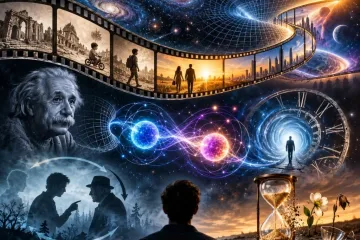
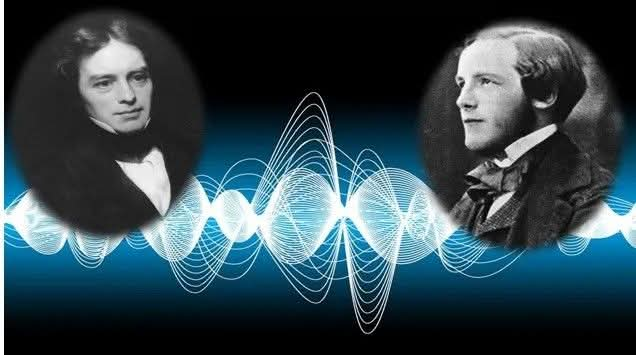
Albert Einstein kept portraits of Newton, Faraday, and Maxwell on his study wall. Einstein once remarked, “The special theory of relativity owes its origins to Maxwell’s equations of the electromagnetic field.” By demonstrating that the speed of light is an invariant constant of nature, Maxwell paved the way for Einstein’s revolutionary spacetime physics.
Theoretical physicist James Clerk Maxwell passed away in 1879 at the premature age of 48. His enduring legacy surrounds us in every invisible signal that connects our global civilization.