From Faraday to Maxwell: The Electromagnetism Revolution
Two Extraordinary Pioneers
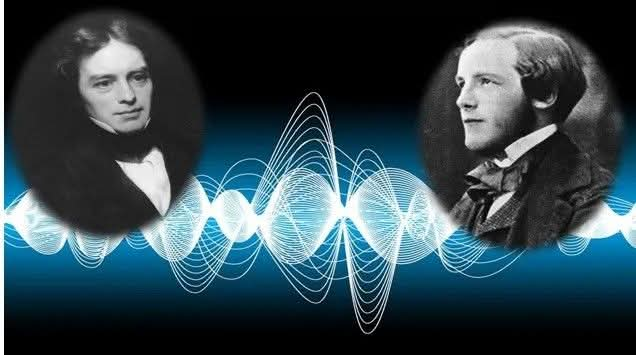
Nineteenth-century London was enveloped in industrial coal smoke. Factory gears turned, and steam engines transformed transportation. Yet concurrently, a quieter and vastly more profound revolution was underway: the mastery of electromagnetism, led by two extraordinary minds—Michael Faraday and James Clerk Maxwell.
Faraday was a self-taught experimental virtuoso; Maxwell was a brilliant mathematical theorist. One possessed an intuitive genius for observing nature through physical apparatus, while the other captured those physical truths in the language of differential equations. Modern electrified civilization was built upon their shared legacy.
The Laboratory Magician
Born into humble circumstances, Faraday had minimal formal schooling. Apprenticed to a London bookbinder, the workshop became his informal university. Binding books, he devoured volumes on chemistry and electricity.
Attending lectures by noted chemist Sir Humphry Davy at the Royal Institution, Faraday compiled meticulously bound notes that so impressed Davy that he appointed Faraday as his laboratory assistant, commencing one of science’s most remarkable careers.
Faraday possessed an exceptional visual imagination. While contemporaries viewed electricity and magnetism as separate phenomena, Faraday intuited their deep reciprocal connection.
In 1831, he discovered electromagnetic induction: moving a magnet near a wire coil induces an electric current in the circuit. That principle drives every electrical generator, turbine, transformer, and power grid operating across the world today.
Lacking formal mathematical training, Faraday visualized physical forces through spatial fields, imagining invisible lines of magnetic and electric force radiating through empty space—a concept initially mocked, but destined to revolutionize physics.
The Master of Equations
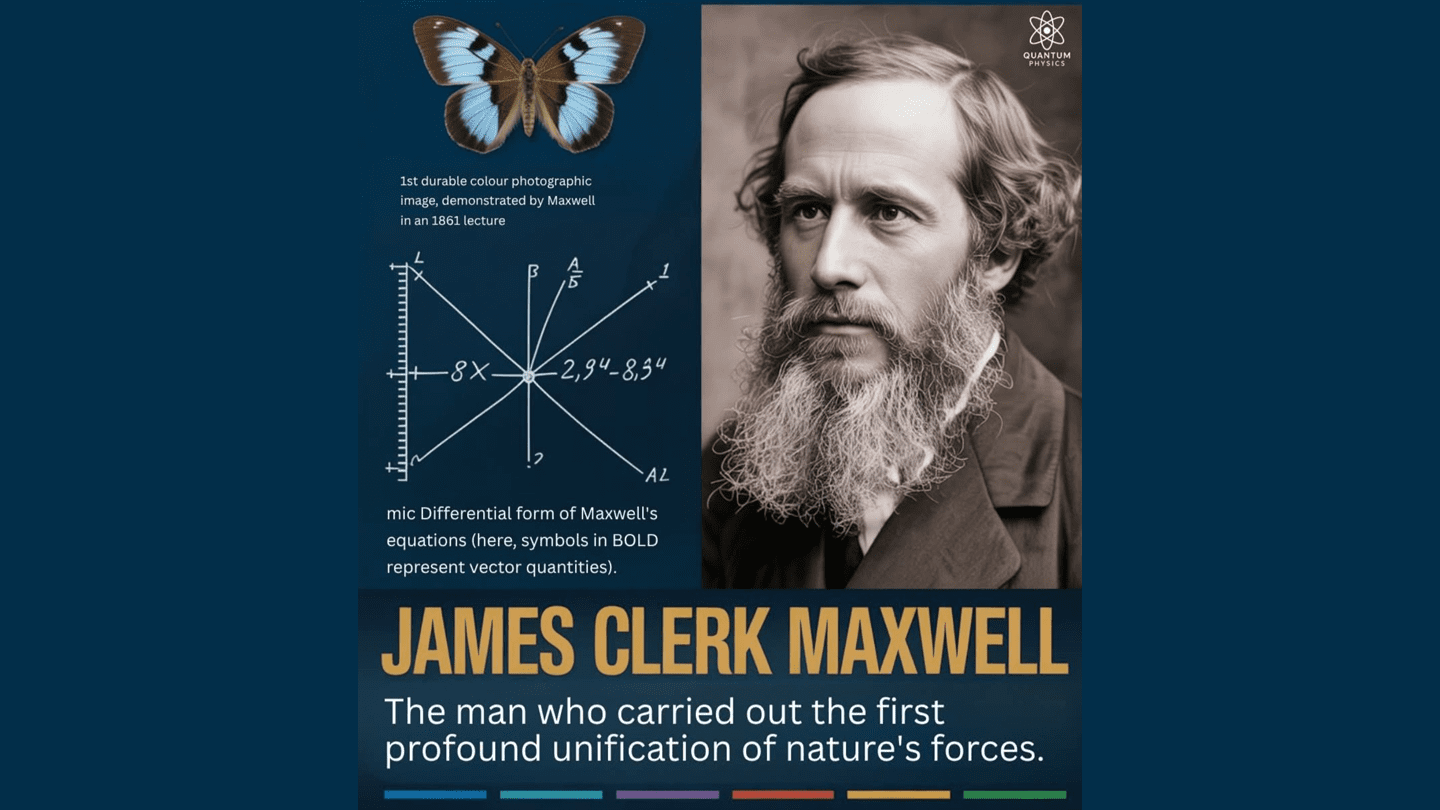
Enter James Clerk Maxwell. The young Scottish mathematical physicist immersed himself in Faraday’s experimental papers, translating Faraday’s geometric field lines into rigorous vector calculus, resulting in the celebrated Maxwell’s equations.
Manipulating these equations, Maxwell made a monumental theoretical discovery: oscillating electric and magnetic fields propagate together through space as self-sustaining waves. Computing their velocity from electromagnetic constants, the figure matched the speed of light.
Light itself, Maxwell realized, is an electromagnetic wave. In a stroke of theoretical genius, optics, electricity, and magnetism were unified into a single coherent framework.
Every radio broadcast, television signal, smartphone network, Wi-Fi router, and interplanetary communication link operates on the principles Faraday and Maxwell unveiled.
Building Modern Electrified Civilization
Faraday listened to nature through experimental observation; Maxwell articulated her laws in mathematical elegance. Their complementary work forms a cornerstone of modern science, directly inspiring Einstein’s special theory of relativity, which took the constancy of light speed as its bedrock postulate.
Together, Faraday and Maxwell did not merely explain electromagnetism; they built the intellectual and technological foundation of our modern world.