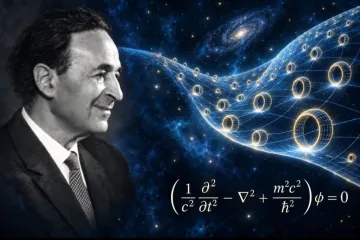
The Wave Equation: Schrödinger's Quantum Century
A Centenary Equation
Exactly one hundred years ago, in 1926, Austrian physicist Erwin Schrödinger wrote down a compact differential equation that became the bedrock of modern quantum mechanics.
Certain discoveries in physics do more than expand knowledge; they transform how we conceptualize reality. Schrödinger’s equation opened the doorway to a subatomic universe that completely defied classical Newtonian physics.
Particle or Wave?
In the early 1900s, atomic physics faced a profound paradox. Electrons manifested particle-like properties in certain experiments and wave-like diffraction in others. Light exhibited the same dual nature.
In 1924, French physicist Louis de Broglie put forward a bold hypothesis: if light waves can behave like particles, material particles must possess wave properties. Electrons have wavelengths.
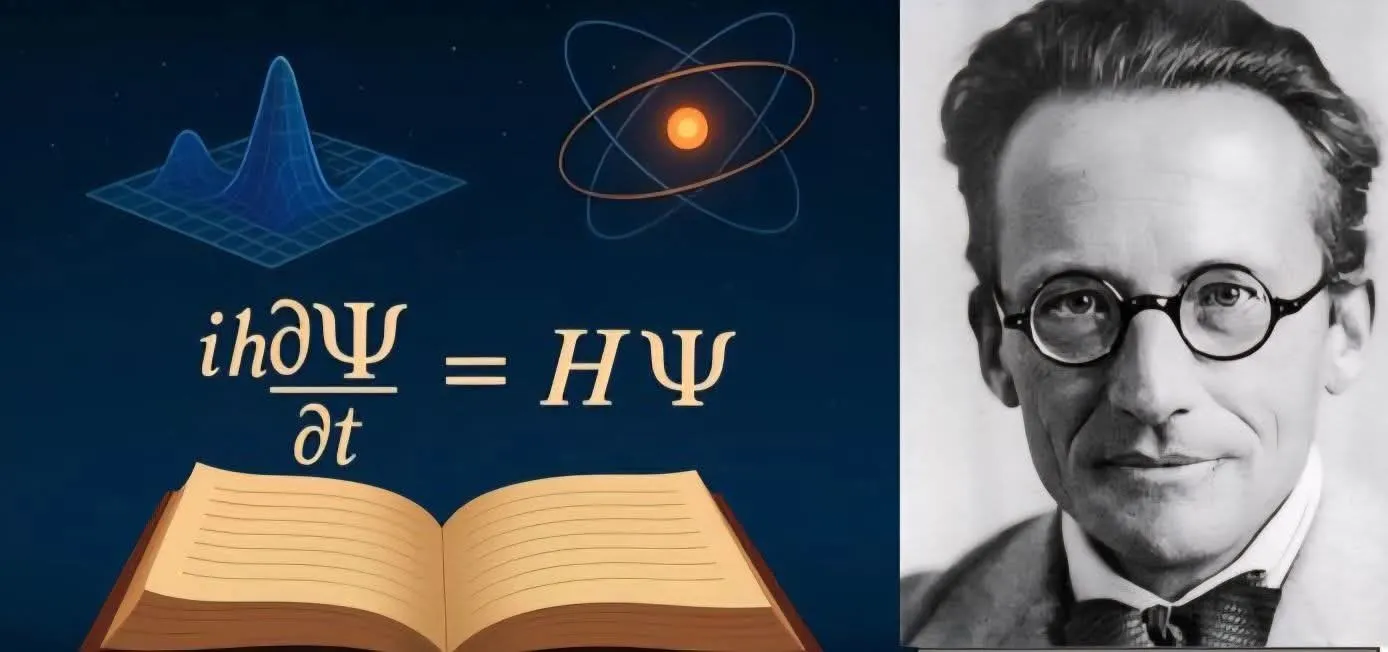
This insight inspired Schrödinger: if matter behaves as a wave, that wave must obey a fundamental wave equation. Through intense mathematical derivation, he formulated his iconic equation for the quantum state of a physical system:
\(i\hbar \frac{\partial\psi}{\partial t} = \hat{H}\psi\)
A concise partial differential equation using few mathematical symbols, yet it redefined humanity’s understanding of matter.
A Realm of Probability
In this equation, \(\psi\) represents the wave function. It does not trace a classical deterministic trajectory; instead, its squared magnitude \(|\psi|^2\) gives the probability density of finding a particle at a given point in space and time.
In classical mechanics, knowing initial conditions determines future trajectories with absolute certainty. Schrödinger’s equation revealed that microscopic nature speaks in the language of probability amplitudes. Reality resembles a cloud of possibilities until measured.
Schrödinger’s Cat
To highlight the counterintuitive paradoxes of quantum superposition, Schrödinger conceived his famous thought experiment: Schrödinger’s cat.
A cat is enclosed in a steel chamber with a radioactive atom, a Geiger counter, a relay, a hammer, and a flask of hydrocyanic acid. If an atom decays, the counter triggers the hammer to shatter the vial, releasing the poison. If no decay occurs, the vial remains intact and the cat lives.
Under Copenhagen quantum mechanics, unobserved decay is described by a linear superposition of decayed and undecayed states. Transposed to macroscopic scales, the feline would exist in a simultaneous superposition of being both alive and dead until the chamber is opened and observed.
No actual cat was ever harmed; Schrödinger proposed the scenario specifically to illustrate the absurdity of applying quantum indeterminacy directly to everyday macroscopic objects.
The Foundation of Modern Technology
Strange as quantum superposition seems, modern technology is engineered upon Schrödinger’s mathematics. Band theory in semiconductors, transistors, microprocessors, LEDs, lasers, magnetic resonance imaging (MRI), and quantum computation all rely directly on solutions to the Schrödinger equation.
An Unresolved Mystery
A century later, foundational debates persist: What is the physical ontological reality of the wave function? Does measurement collapse the wave function, or do parallel branches emerge?
Yet one fact is certain: written in a few elegant symbols, Schrödinger’s equation changed the language of physics forever, providing the primary lens through which humanity probes quantum reality.