The Wow! Signal: Space's Most Famous Mystery
An Astonishing Radio Signal
On 15 August 1977, in the quiet late hours at Ohio State University’s radio observatory, a massive antenna listened for faint whispers from deep space. The routine task was recording narrow-band radio signals from cosmic coordinates. Suddenly, the instrumentation captured an extraordinary pulse.
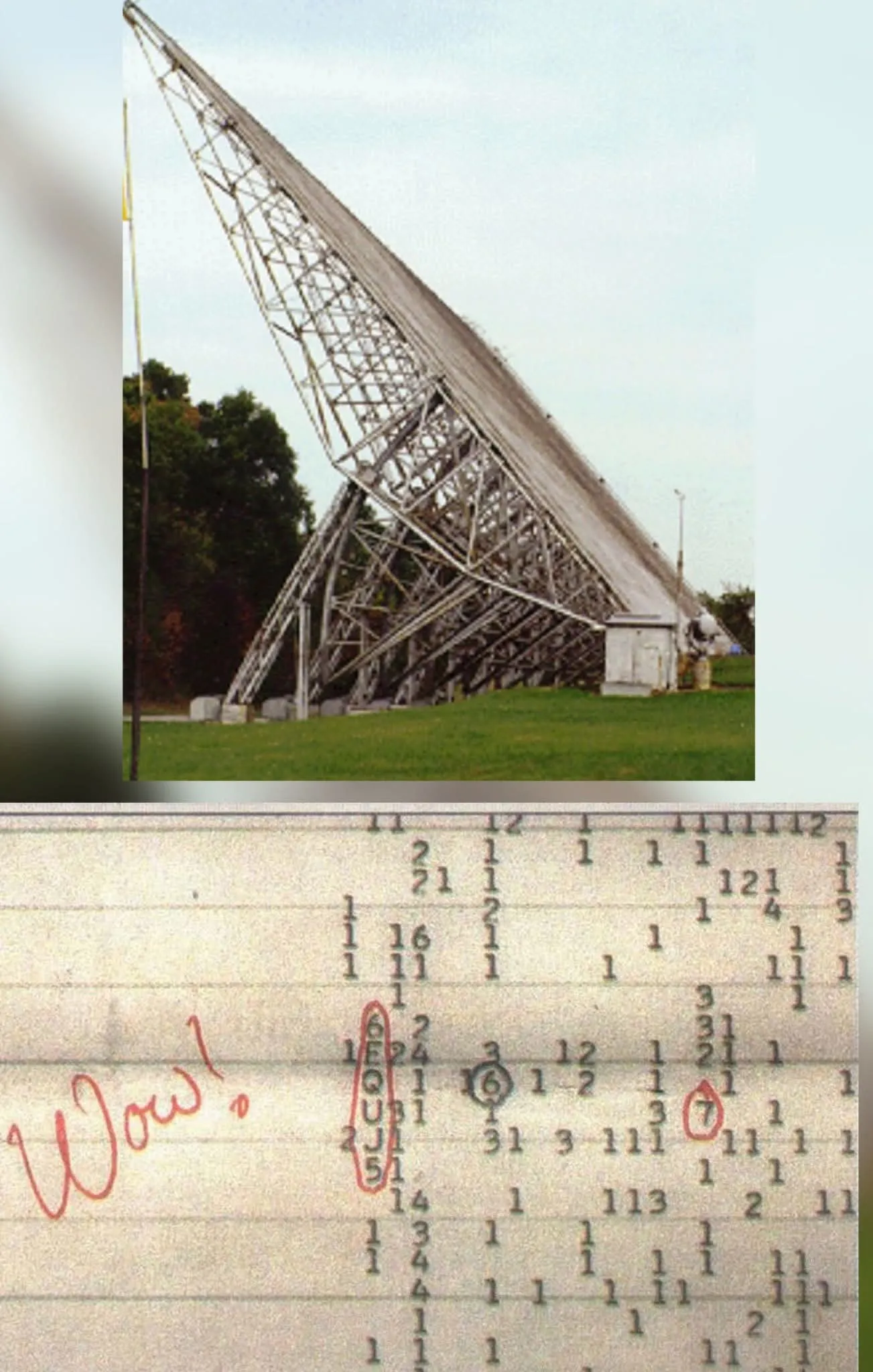
Days later, while reviewing computer printouts, astronomer Jerry Ehman noticed an anomalous spike in signal intensity. Astonished, he circled the six-character alphanumeric sequence with a red pen and scribbled “Wow!” in the margin. The moniker “Wow! Signal” was born, becoming one of astronomy’s most enduring mysteries.
Are We Alone in the Universe?
For generations, humans have asked whether we are alone in this vast cosmic arena, or if conscious beings across distant star systems are gazing back with the same longing question.
This curiosity gave rise to SETI—the Search for Extraterrestrial Intelligence. Scientists reasoned that a technologically advanced civilization would likely utilize radio transmissions, which travel unimpeded across interstellar expanses.
Radio telescopes worldwide began listening to the sky, like observers on a cosmic shore straining to hear the distant horn of an unknown ship.
The Big Ear Telescope
The instrument that detected the anomaly was Ohio State’s Big Ear radio telescope. Jerry Ehman was serving as a volunteer scientist on the SETI project when he found the signal.
Big Ear was a fixed meridian telescope. It did not steer across the heavens; instead, Earth’s daily rotation swept its beam across celestial coordinates. An extraterrestrial radio source crossing Big Ear’s field of view would take exactly seventy-two seconds to pass from entrance to exit. And the signal lasted for precisely seventy-two seconds.
6EQUJ5: The Code of the Anomaly
The transmission was so intense that it stood out vividly on the paper printout: 6EQUJ5. This alphanumeric sequence represented signal-to-noise intensity. The signal rose, peaked at letter U (an intensity ratio thirty times background noise), and faded symmetrically—the exact bell curve expected of a point-source emitter in deep space.
Intriguingly, the transmission registered at approximately 1420.456 MHz—the fundamental emission frequency of neutral hydrogen, known as the 21-centimeter hydrogen line.
Hydrogen is the most abundant element in the universe. Astronomers had long hypothesized that interstellar civilizations wishing to establish contact would transmit at this frequency as a universal cosmic calling card.
Was It an Extraterrestrial Transmission?
The mystery deepened. The Wow! Signal was narrowband, powerful, and devoid of satellite or terrestrial radar artifacts. Many researchers initially considered it a plausible candidate for an extraterrestrial beacon.
Yet the transmission never repeated. Follow-up observations swept the same coordinates in the constellation Sagittarius with larger, more sensitive radio dishes, but the patch remained utterly silent.
Plausible Hypotheses
Various alternative explanations have emerged over the decades: terrestrial interference, classified military transmissions, or exotic astrophysical anomalies. In 2017, a researcher suggested that passing comets enveloped in neutral hydrogen gas clouds could have produced the burst, though critics pointed out that cometary emissions are diffuse and could hardly explain such a sharp, intense spike.
Cosmic Silence and the Fermi Paradox
The Wow! Signal emphasizes the central puzzle of the Fermi Paradox: in a galaxy containing hundreds of billions of stars, why do we observe silence?
Where is everybody?
Was the Wow! Signal a fleeting glimpse of an alien radio beam sweeping across Earth, or an unrepeatable natural phenomenon? Half a century later, Big Ear has been demolished, yet the mystery persists. Jerry Ehman’s red-inked note—”Wow!”—remains an iconic symbol of our eternal search for companionship in the cosmos.