The Science of Comets: Tails, Orbits, and Great Visits
Dirty Snowballs of the Solar System
Throughout human history, comets appearing suddenly in the night sky were viewed with awe, reverence, and trepidation. Today, modern planetary astrophysics reveals that comets are primitive remnants from the outer accretion disk of our early solar system—often described scientifically as “dirty snowballs.” Composed of volatile ices (water, carbon monoxide, carbon dioxide, and methane) mixed with mineral dust and complex organic macromolecules, comets spend most of their lifespans in the frigid outer reservoirs of the Kuiper Belt and the Oort Cloud.
How Comet Tails Form in the Inner Solar System
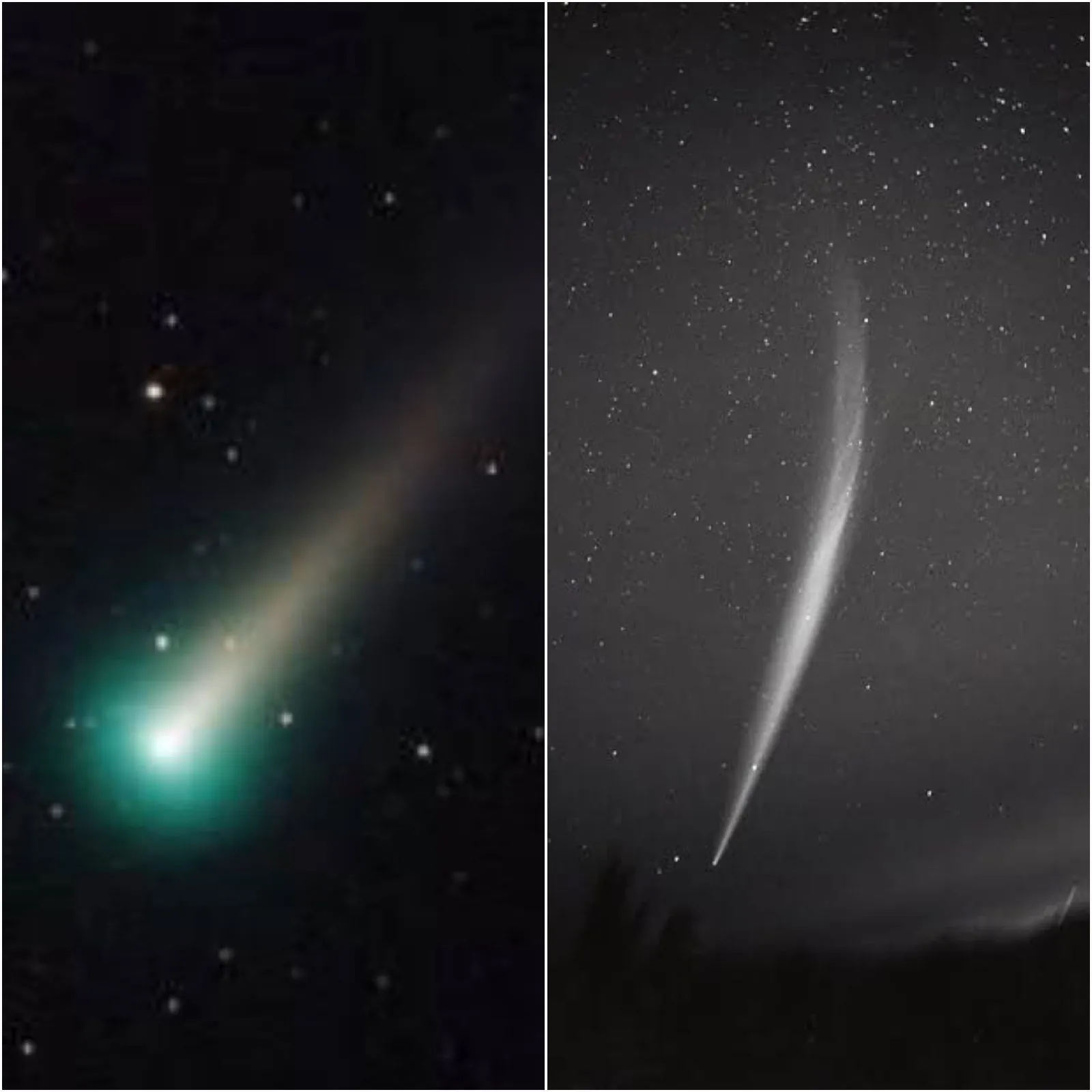
When a comet’s highly eccentric, elliptical orbit draws it toward the inner solar system, escalating solar radiation sublimates its volatile ices directly into gas. This expanding gas forms an ephemeral atmosphere around the solid nucleus called a coma. Solar radiation pressure and the supersonic solar wind push material away from the nucleus, producing two spectacular tails that stretch millions of kilometers across space:
- The Dust Tail: Composed of microscopic dust particles pushed gently by solar photon radiation, appearing curved, yellowish-white, and reflecting sunlight.
- The Ion (Gas) Tail: Formed by ionized gas molecules swept directly outward by the charged solar wind, glowing blue due to fluorescence and pointing straight away from the Sun.
Halley’s Comet and Orbital Dynamics
The most famous periodic comet in history is Halley’s Comet (1P/Halley). Applying Sir Isaac Newton’s laws of universal gravitation, English astronomer Edmond Halley calculated in 1705 that sightings recorded in 1531, 1607, and 1682 were appearances of the exact same celestial object returning on a roughly 76-year orbital period. Halley’s triumphant prediction of its 1758 return solidified Newtonian celestial mechanics. Halley’s Comet last swung past the Sun in 1986 and is scheduled to return to our night sky in mid-2061.
Great Comets: Ikeya-Seki and Modern Observers
While periodic comets return regularly, occasionally a massive sungrazer comet produces a truly awe-inspiring spectacle. In 1965, Comet Ikeya-Seki (C/1965 S1) grazed within 450,000 kilometers of the Sun’s surface, growing so immensely bright that it was plainly visible in broad daylight next to the Sun and unfurled a magnificent, sweeping tail spanning tens of degrees across the dawn sky.
More recently, in late 2021, the hyperbolic comet C/2021 A1 (Leonard) treated astronomers and stargazers worldwide to a fine display in the western evening twilight before its close perihelion passage disintegrated its delicate icy nucleus. Each comet that visits the inner solar system provides planetary scientists with invaluable glimpses into the prebiotic chemistry and raw planetary building blocks that assembled our world.