Mysteries of the Universe: Cosmic Expansion and Fate
The Mind-Bending Scale of the Cosmos
Gazing into an unpolluted night sky, the celestial vault appears dusted with sparkling stars. Yet modern astrophysics reveals that every star visible to the unaided eye belongs strictly to our local galactic neighborhood. Our Milky Way galaxy alone harbors between 100 and 400 billion stars, and the observable universe contains an estimated 200 billion to two trillion individual galaxies. Against this staggering backdrop, planet Earth is a pale blue dot—yet on this dot, human curiosity has uncovered the fundamental architecture of the cosmos.
The 93-Billion-Light-Year Observable Universe
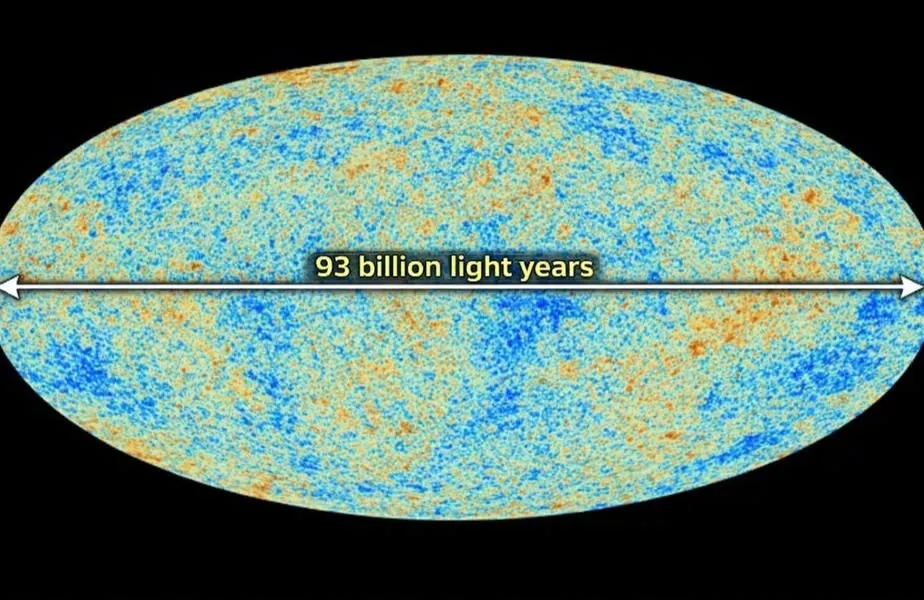
Astrophysicists estimate that the observable universe has a diameter of roughly 93 billion light-years (extending 46.5 billion light-years in every direction from Earth). At first glance, this presents a paradox: if the universe is 13.8 billion years old, how can we observe radiation originating from 46.5 billion light-years away? The resolution lies in the fact that space itself has been expanding continuously since the Big Bang, carrying distant matter away as its emitted light traveled toward us.
The Cosmic Microwave Background (CMB)
The foundation of modern cosmology was cemented in 1964 when radio astronomers Arno Penzias and Robert Wilson accidentally detected an isotropic radio hiss using Bell Labs’ Holmdel Horn Antenna. This faint glow is the Cosmic Microwave Background (CMB)—the primordial thermal afterglow released approximately 380,000 years after the Big Bang, when the universe cooled sufficiently for neutral hydrogen atoms to form and photons to decouple. Mapped with exquisite precision by space observatories like NASA’s WMAP and ESA’s Planck satellite, the CMB provides an indelible baby picture of cosmic structure.
Cosmic Inflation and Dark Energy
In the earliest fraction of a second after the Big Bang, the universe underwent an epoch of hyper-accelerated exponential expansion known as cosmic inflation, smoothing out spacetime geometry and seeding quantum fluctuations that grew into galaxies. Far from decelerating under the pull of gravity, observations of distant Type Ia supernovae in the late 1990s revealed that cosmic expansion is currently accelerating. Cosmologists attribute this outward acceleration to dark energy—a mysterious repulsive force constituting approximately 68 percent of the total mass-energy budget of the cosmos.
The Ultimate Fate of the Universe
As dark energy drives galaxies beyond our cosmic event horizon, cosmologists investigate three primary scenarios for the ultimate destiny of our cosmos:
- The Big Freeze (Heat Death): The leading cosmological model predicts that continuous expansion will eventually exhaust star-forming gas. Over trillions of years, stars burn out, black holes slowly evaporate via Hawking radiation, and the universe reaches thermodynamic equilibrium at maximum entropy near absolute zero.
- The Big Rip: If dark energy density escalates over time (phantom energy), repulsive expansion could become so violent that it tears apart galaxy clusters, stars, planets, and eventually atomic nuclei before ending in a spacetime singularity.
- The Big Crunch: If dark energy reverses and gravity dominates, cosmic expansion would halt and collapse into an ultra-dense, ultra-hot singularity. Current observational data renders this outcome highly unlikely.
Decoding these cosmic enigmas reminds us of humanity’s remarkable capacity to comprehend the vast cosmos that gave us birth.