Sagittarius A*: The Supermassive Black Hole at the Galactic Center
The Supermassive Anchor of the Milky Way
At the gravitational heart of our home galaxy, approximately $26,000$ light-years from Earth, resides a cosmic leviathan: the supermassive black hole designated Sagittarius A* (pronounced Sagittarius A-star, abbreviated Sgr A*). Containing a mass equivalent to approximately $4.3$ million suns compressed into a region smaller than Mercury’s orbit, it acts as the gravitational anchor for billions of stars orbiting the galactic nucleus.
Decades of meticulous infrared observations tracking stellar orbits near the galactic center provided the definitive evidence for its existence. For measuring the orbital dynamics of star S2 around this invisible compact mass, astronomers Andrea Ghez and Reinhard Genzel were awarded the 2020 Nobel Prize in Physics alongside mathematical physicist Roger Penrose.
Accretion Dynamics and the Obscured Core
Like all black holes, Sagittarius A* is enveloped by an event horizon—the boundary beyond which gravitational escape velocity exceeds the speed of light. Although the black hole itself emits no light, gas and dust pulled toward the horizon form a swirling, incandescent accretion disk.
Within this inner disk, ionized plasma accelerates to relativistic fractions of the speed of light, generating intense synchrotron radiation through extreme friction and magnetic shear before slipping beyond the event horizon. However, observing this luminous glow from Earth is exceptionally challenging because dense clouds of interstellar hydrogen gas and molecular dust along the galactic plane obstruct optical wavelengths.
Imaging the Unseen with the Event Horizon Telescope
To pierce through this dense cosmic shroud, astrophysicists turned to long-wavelength radio astronomy. In May 2022, the Event Horizon Telescope (EHT) collaboration released the historic first direct image of Sagittarius A*.
Achieving this image required Very Long Baseline Interferometry (VLBI), synchronizing eight millimeter-wavelength radio observatories worldwide—from the South Pole to Chile and Hawaii—to create a virtual Earth-sized telescope. By analyzing massive streams of petabyte-scale data, astronomers resolved the shadowy silhouette of the black hole framed by a glowing ring of magnetized plasma, confirming Einstein’s general relativity in the strong-field gravitational limit.
Polarized Light Reveals Magnetic Architecture
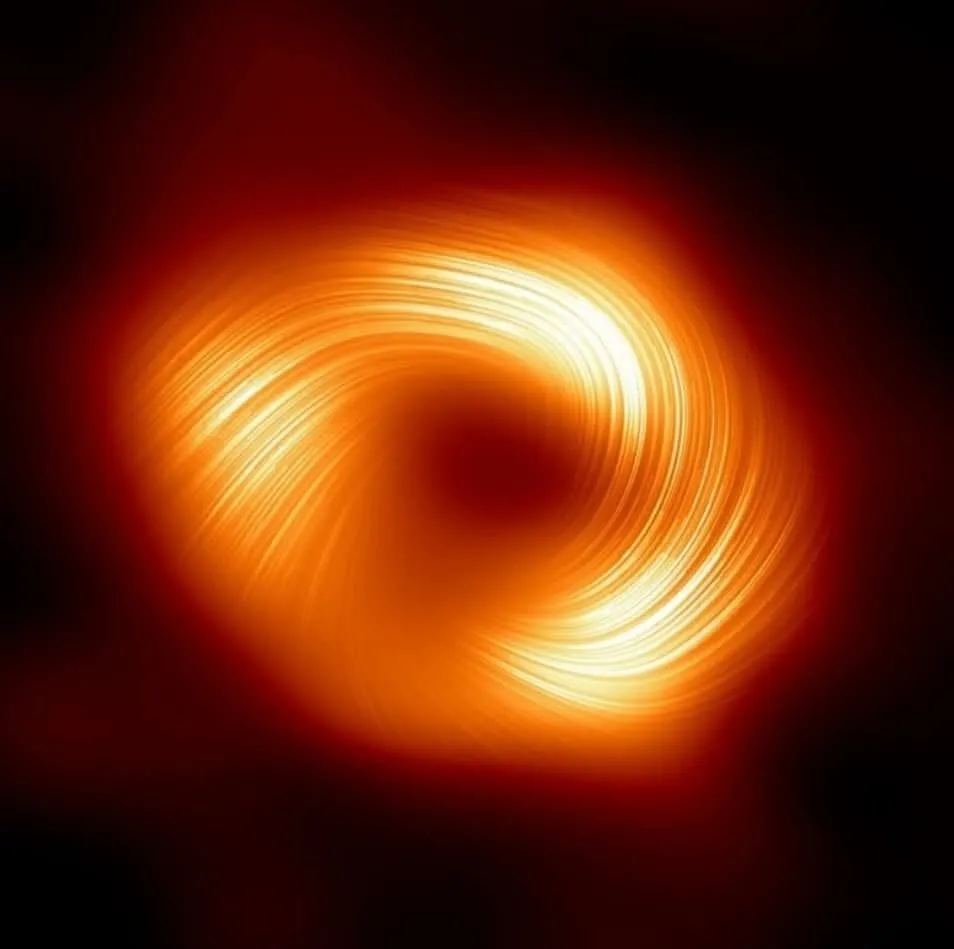
On March 27, 2024, the European Southern Observatory and the EHT team unveiled an unprecedented new portrait of Sagittarius A* captured in polarized light. Polarization filters reveal the geometric orientation of electric and magnetic fields in radiating plasma.
This high-resolution polarized image revealed orderly, tightly wound spiral magnetic fields encircling the event horizon. Intriguingly, these magnetic field structures closely resemble those observed around M87*, a supermassive black hole over a thousand times larger. This remarkable structural similarity indicates that strong, organized magnetic topologies are an intrinsic feature of all accreting supermassive black holes, governing how they ingest matter and potentially launch relativistic jets into interstellar space.